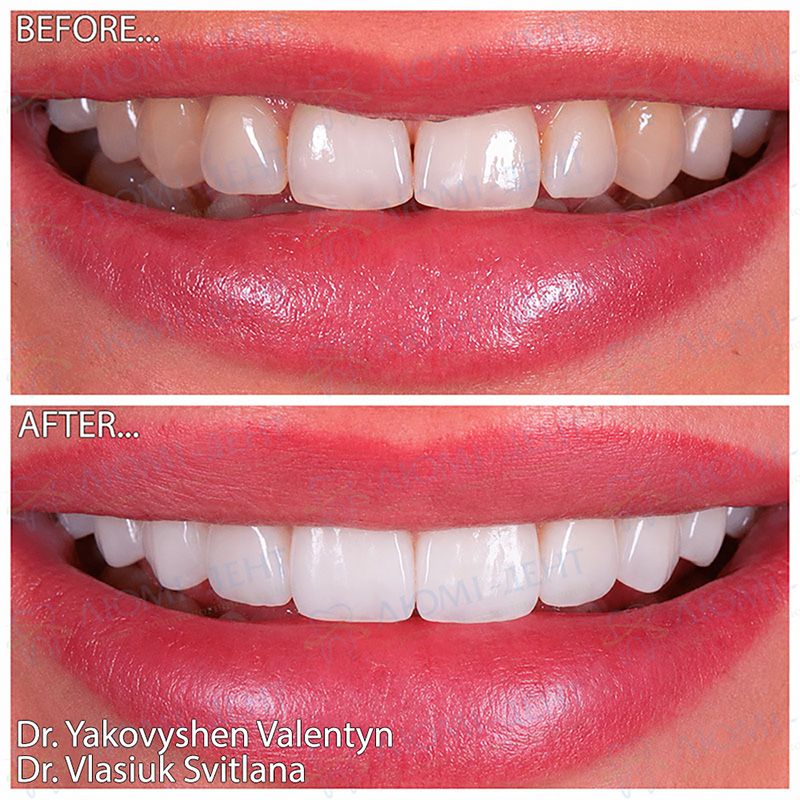
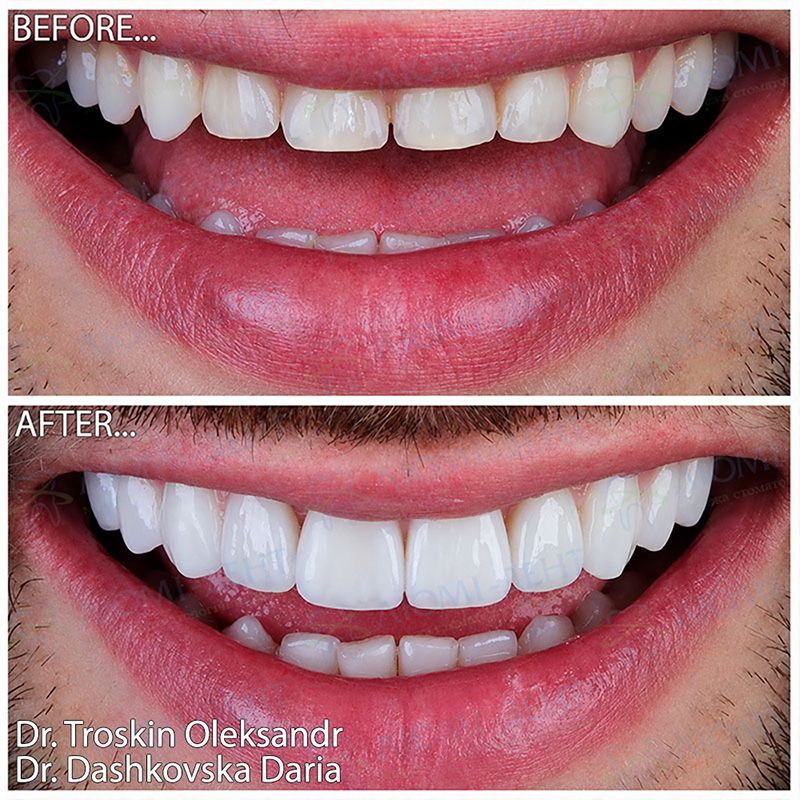
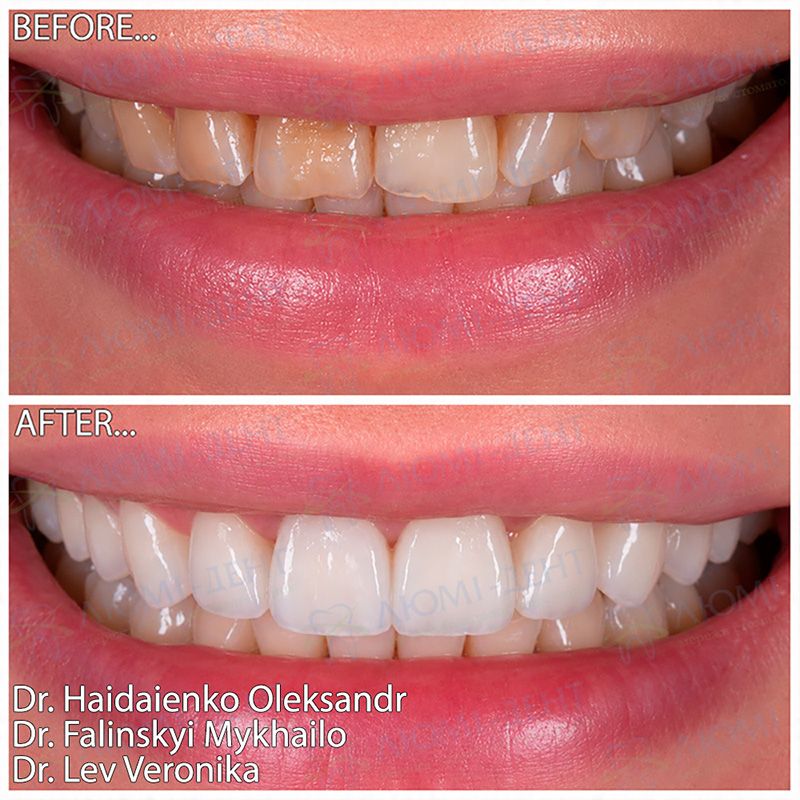
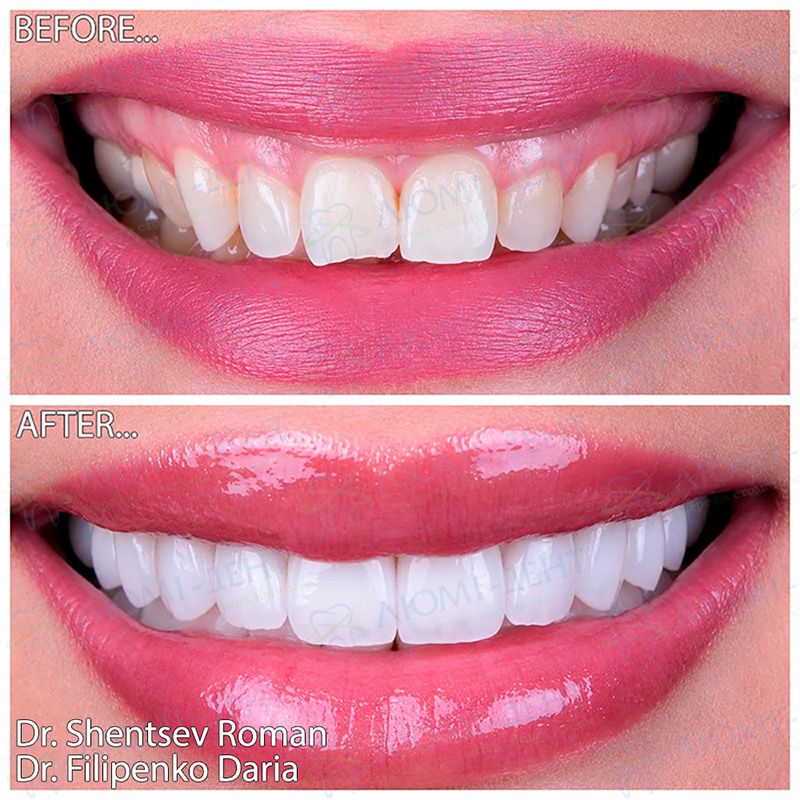
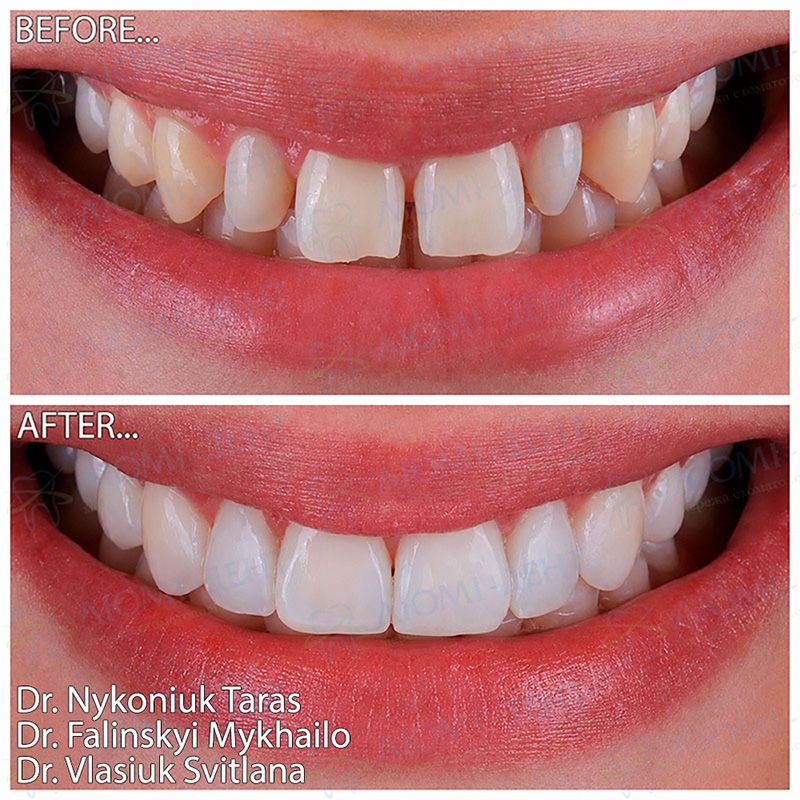
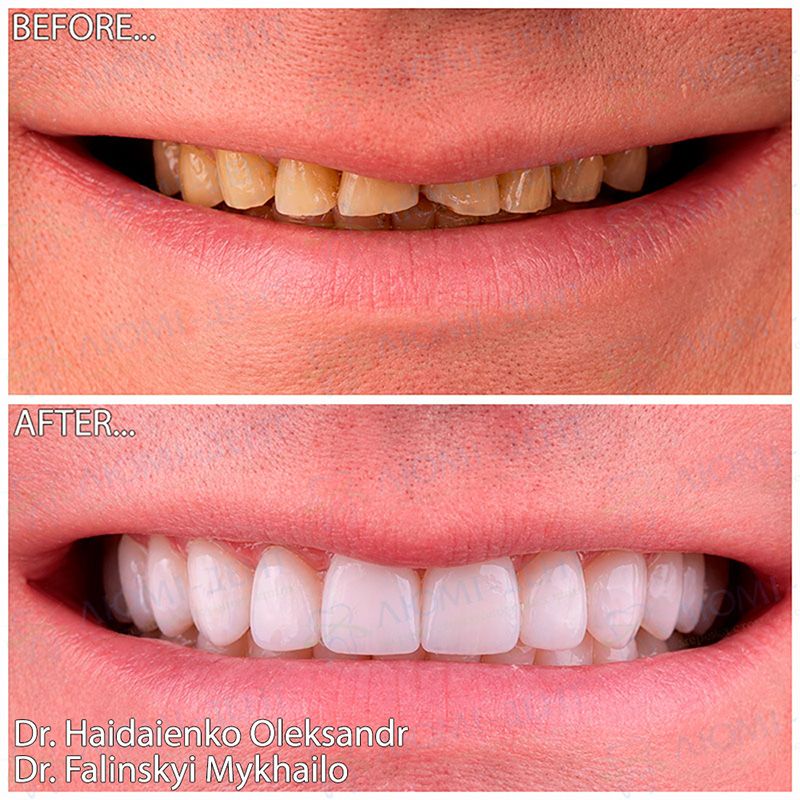
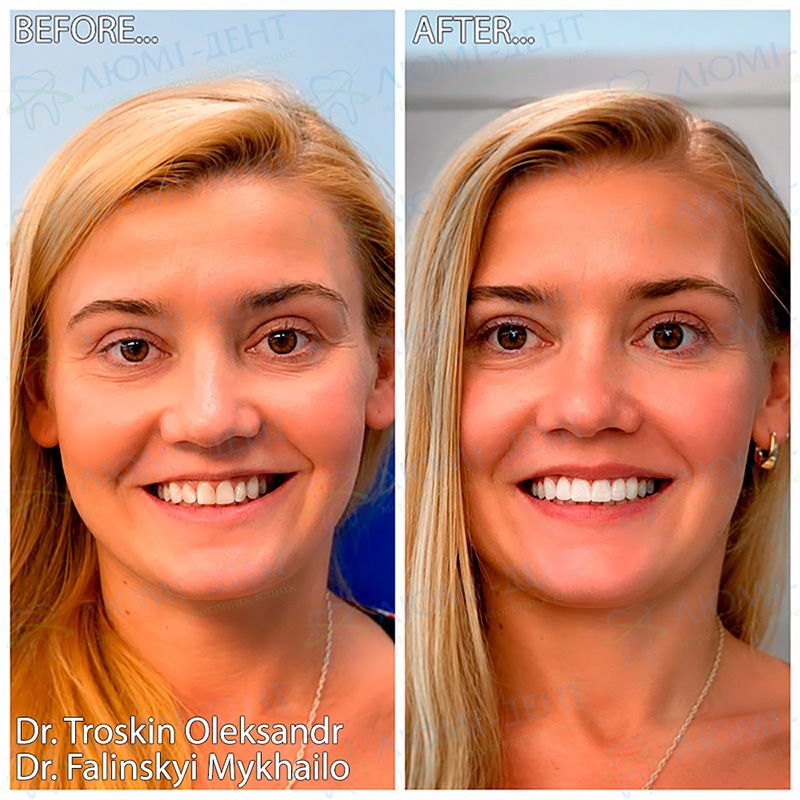
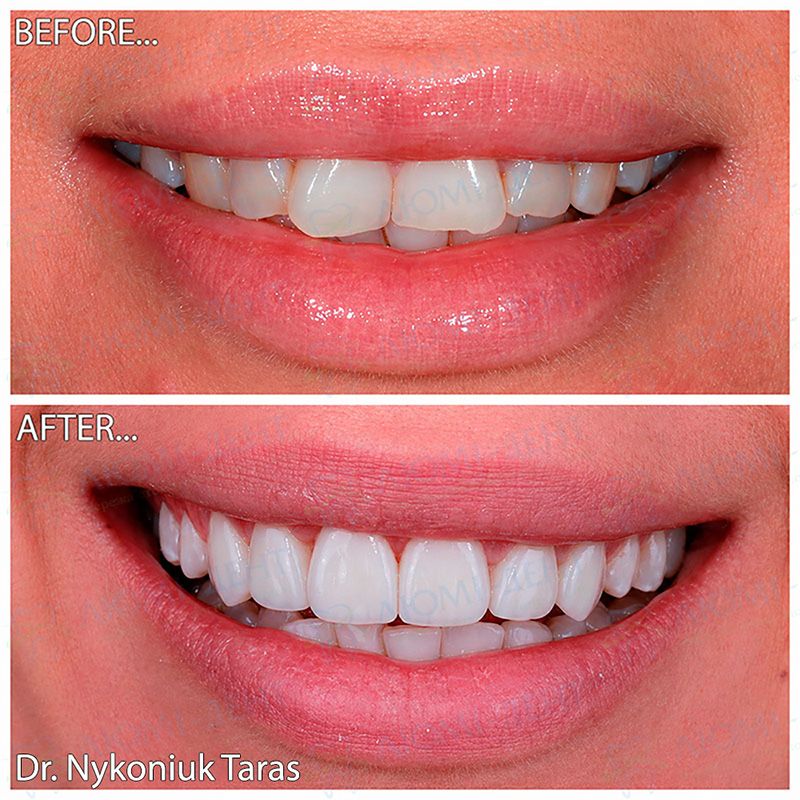
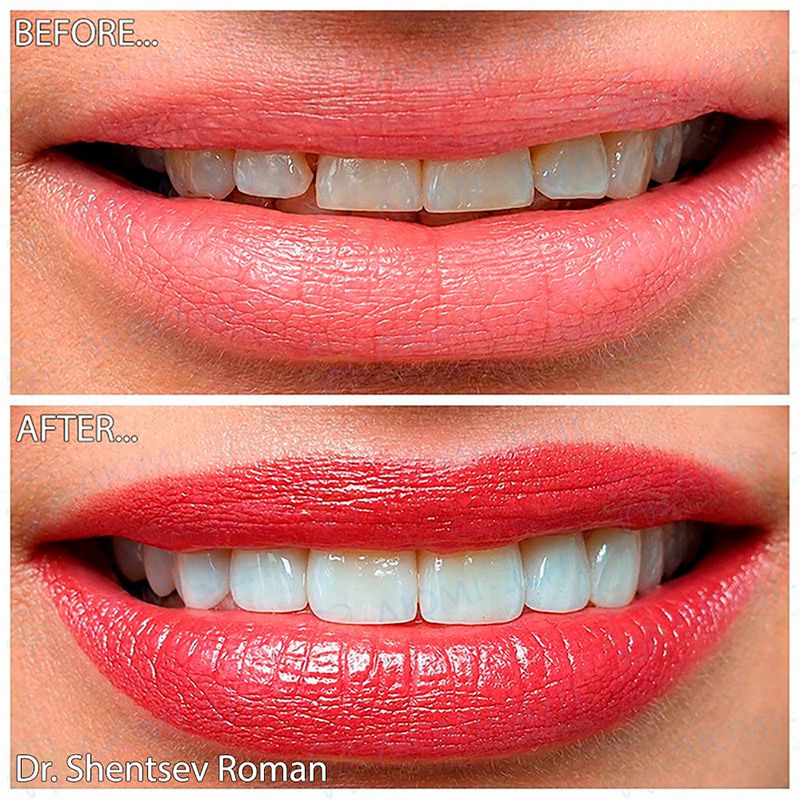
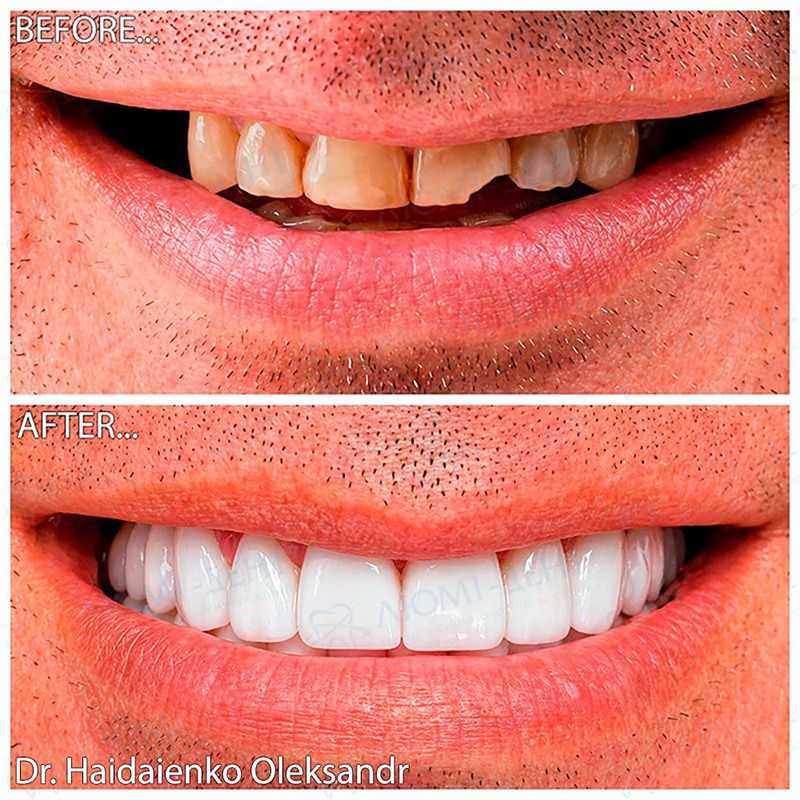
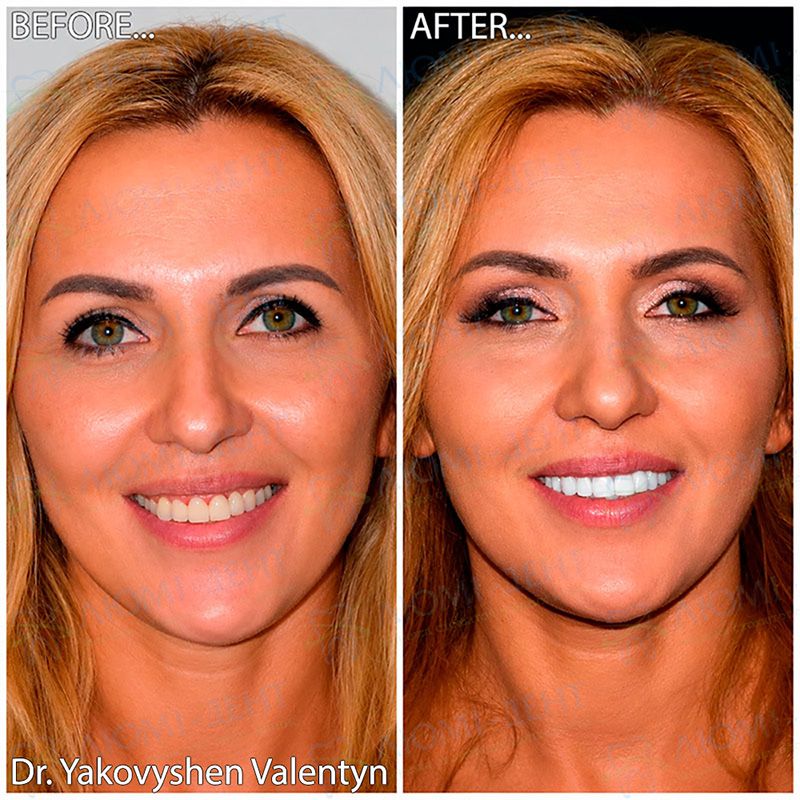
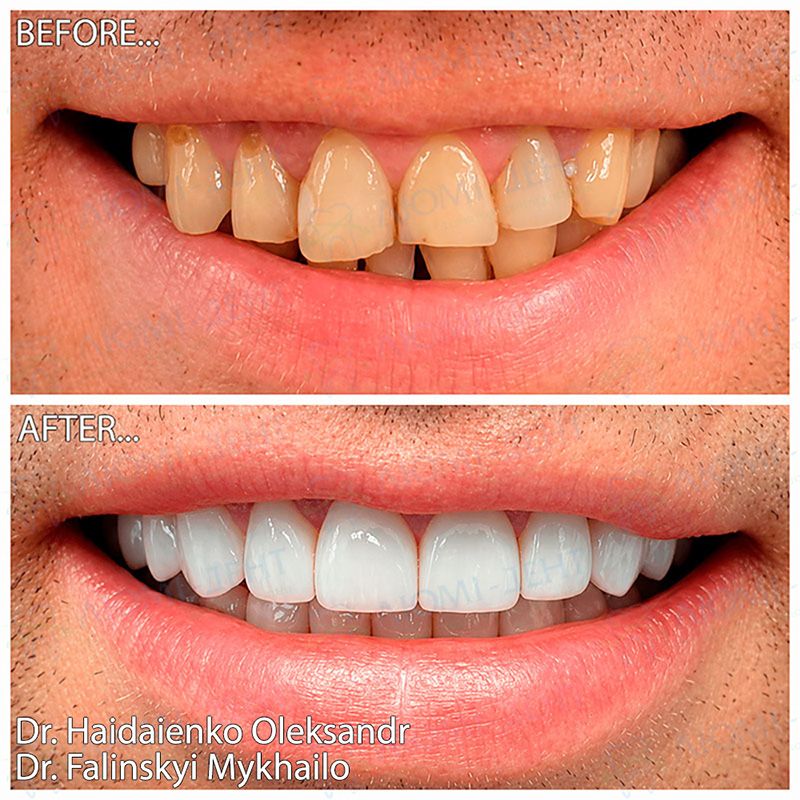
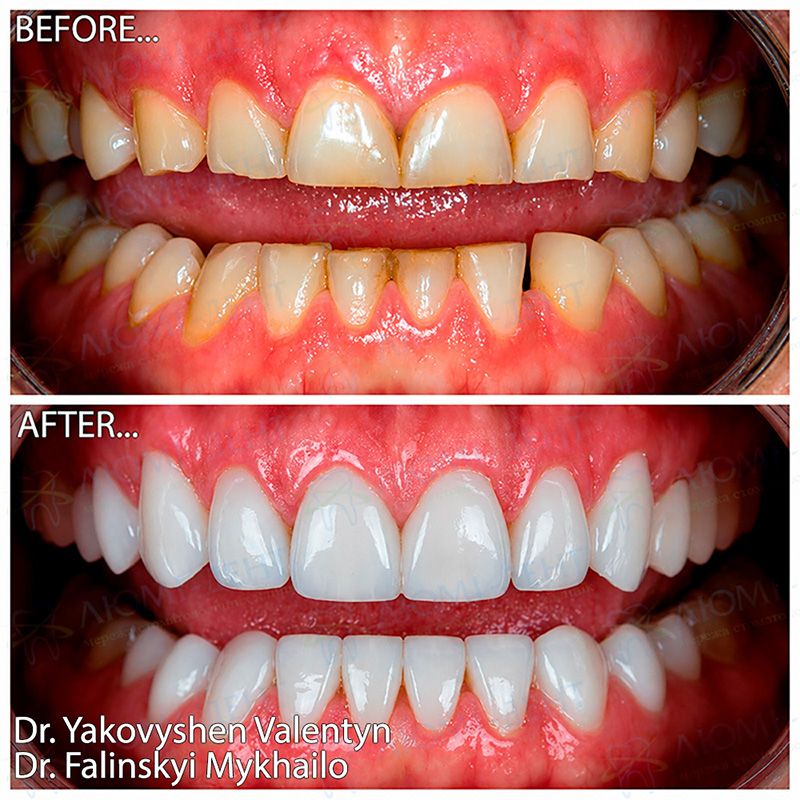
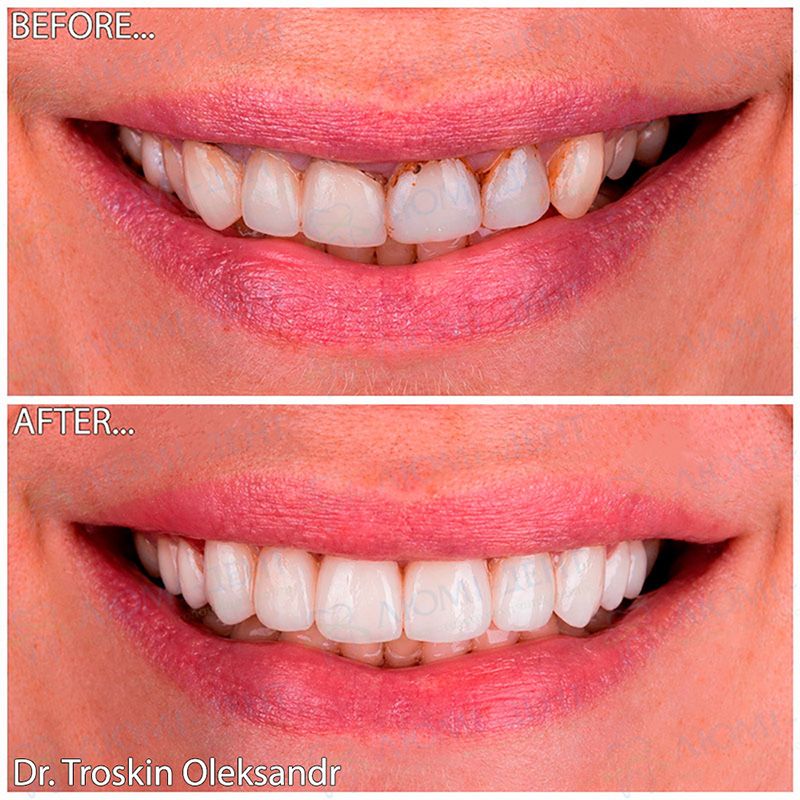
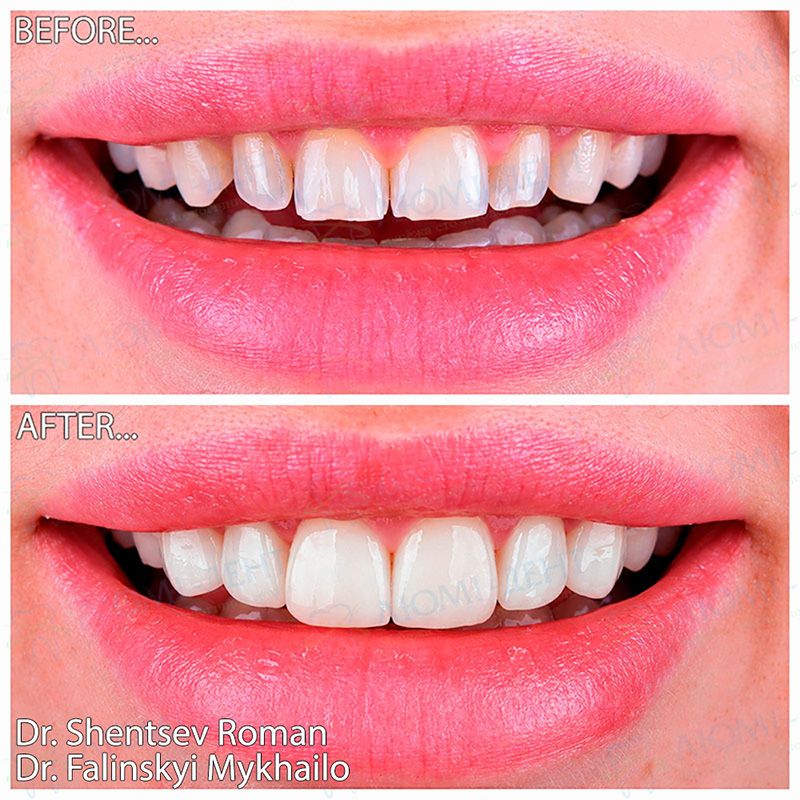
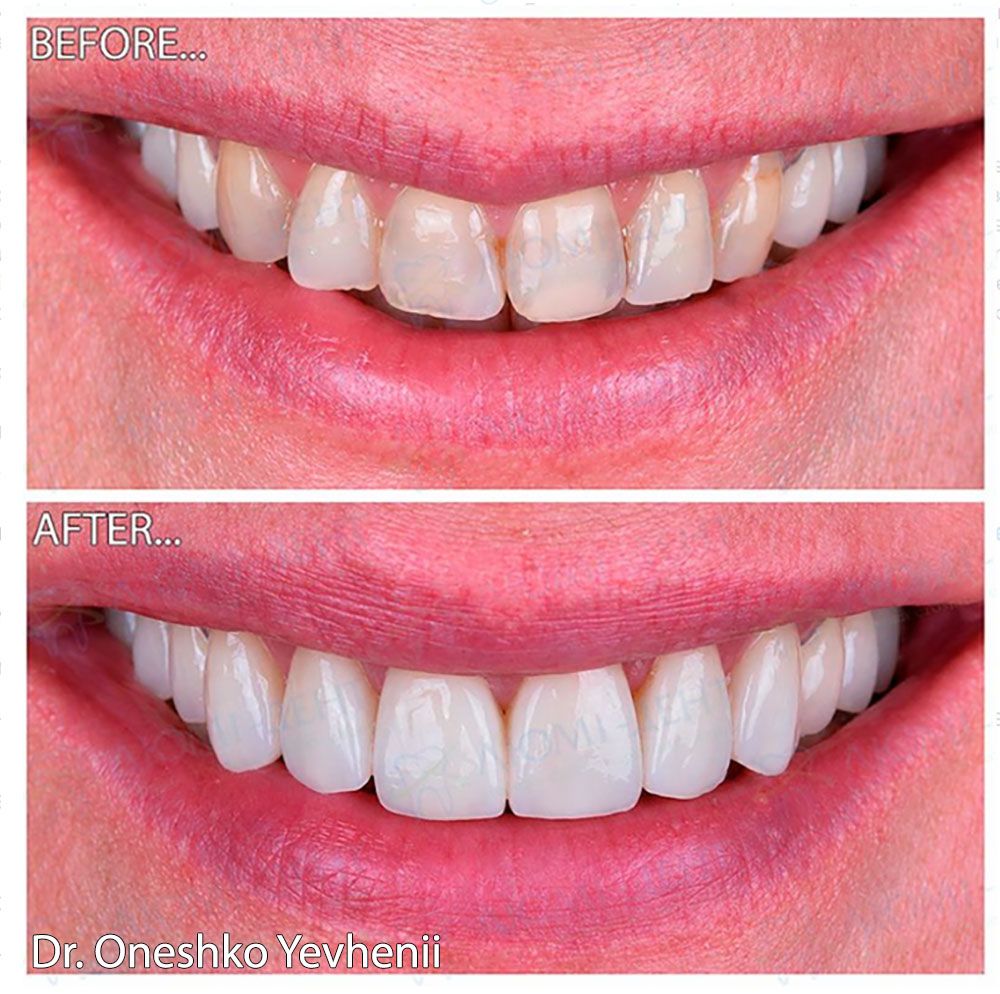
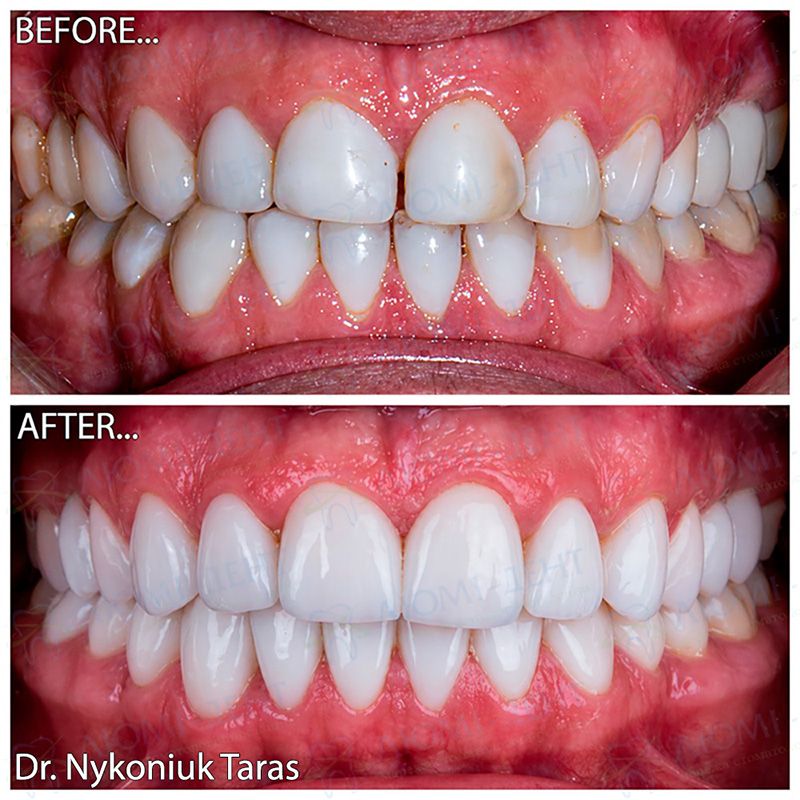
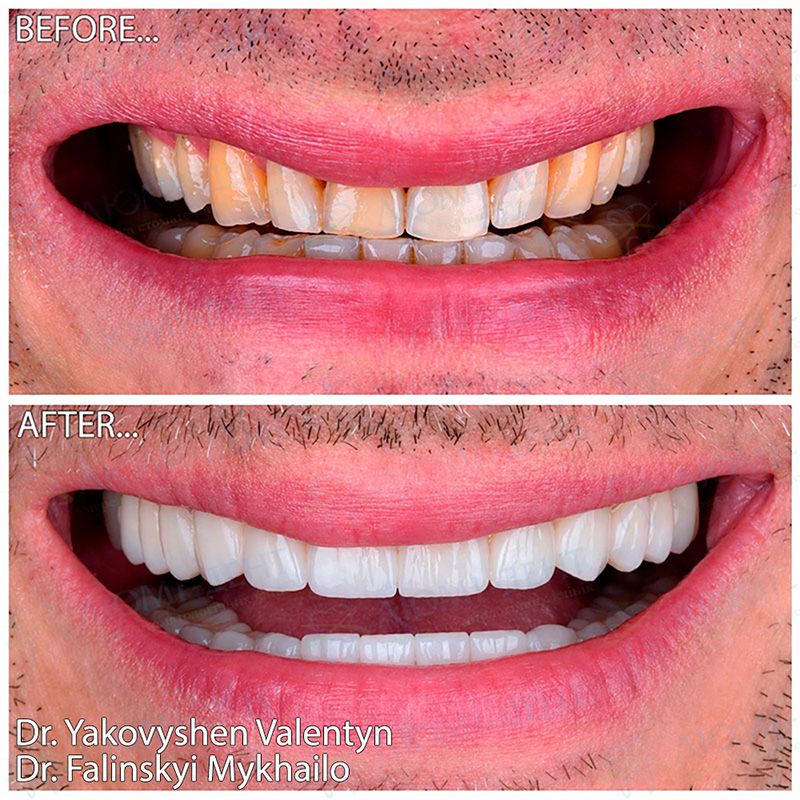
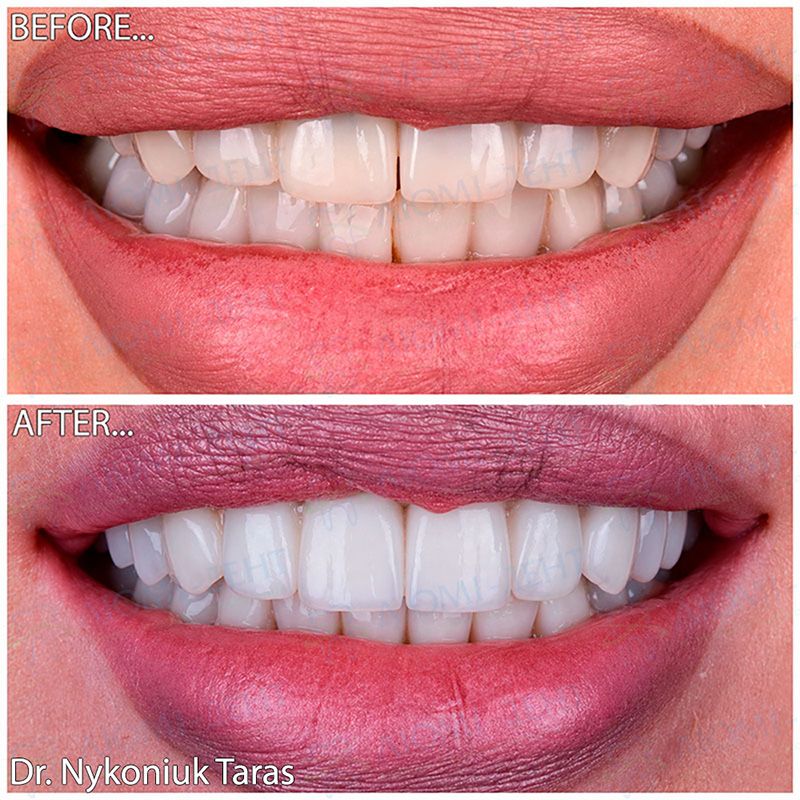
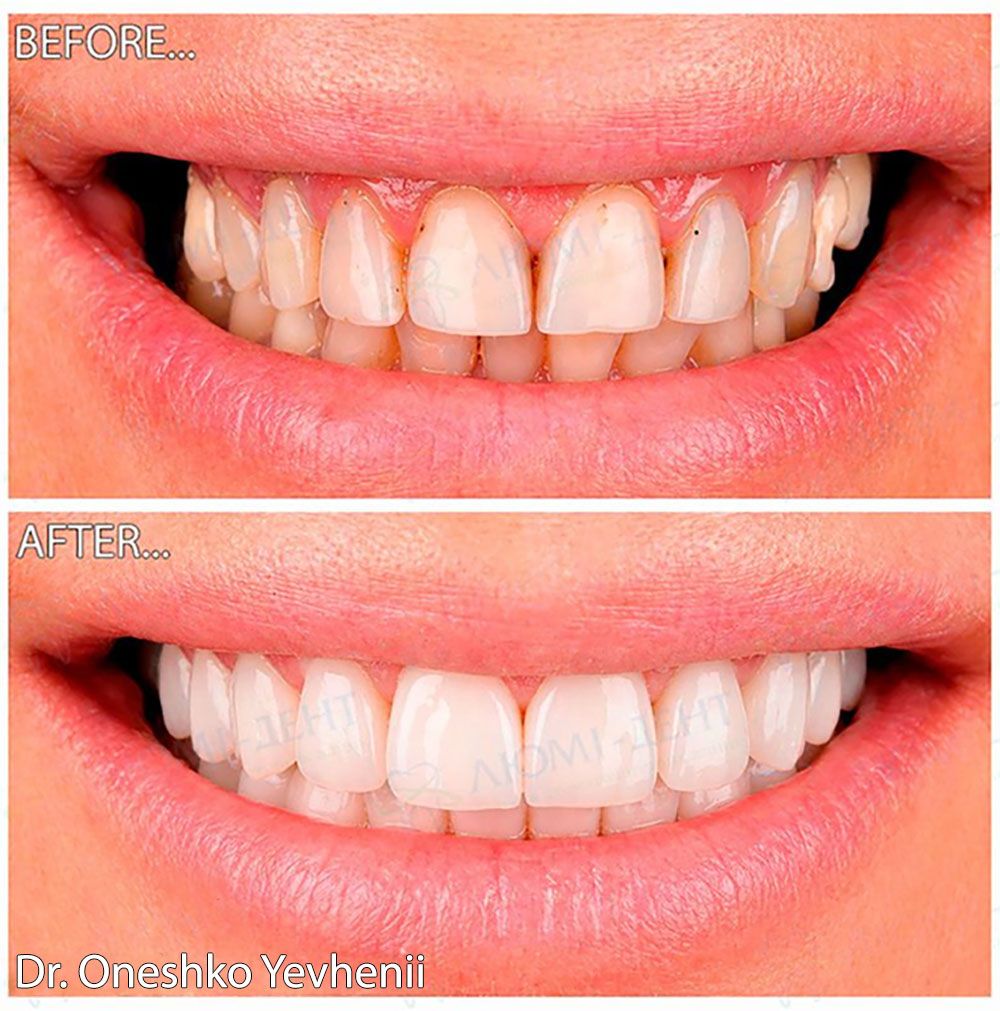
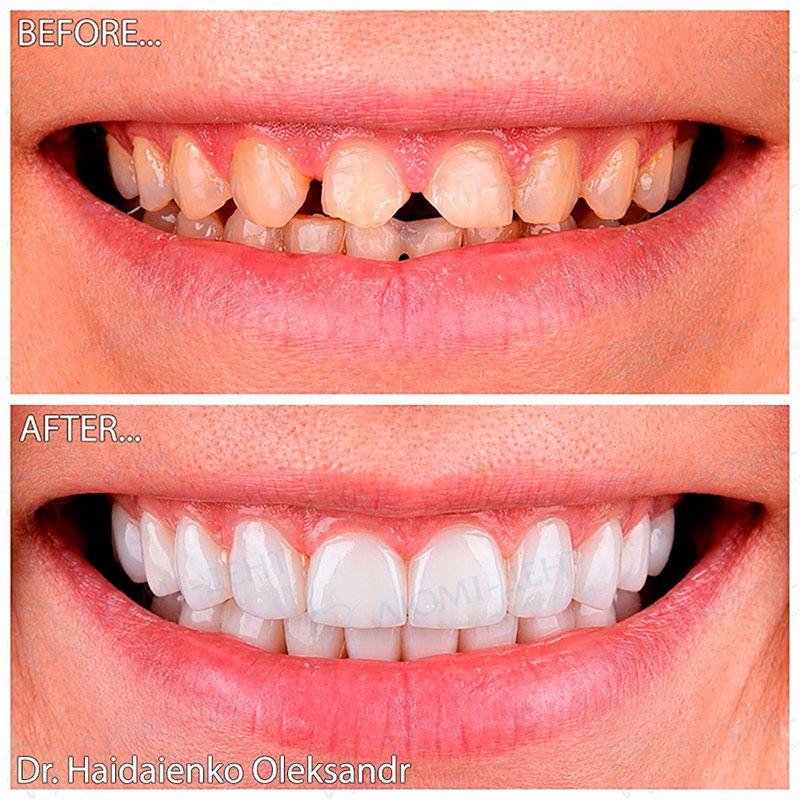
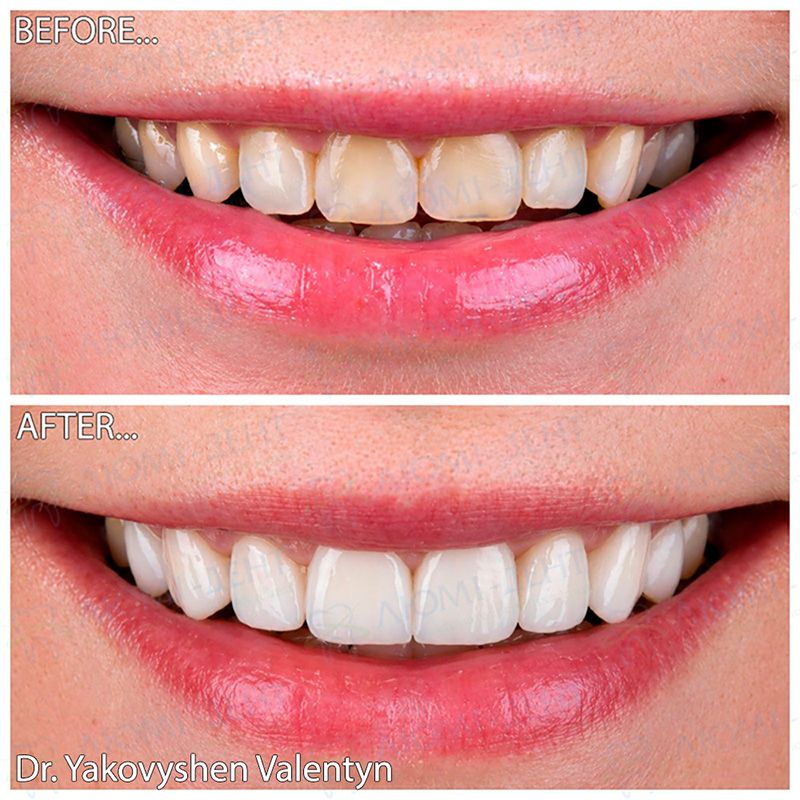
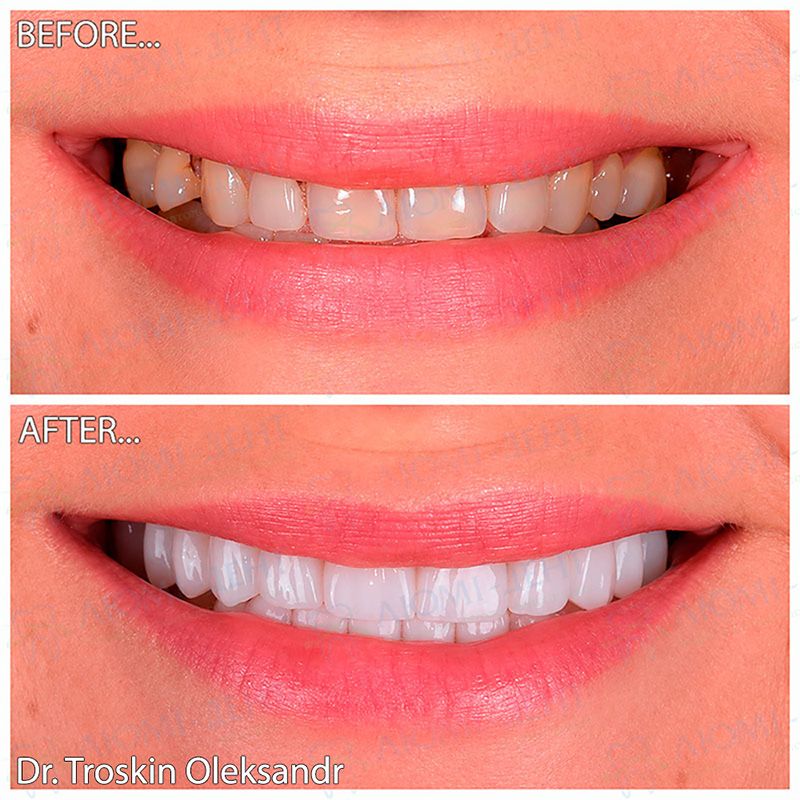
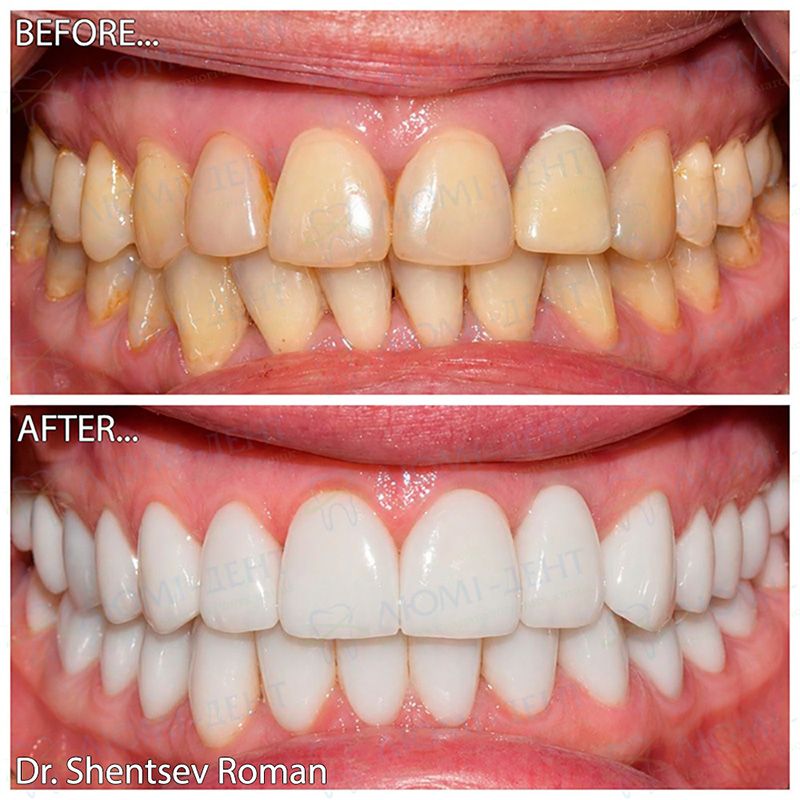
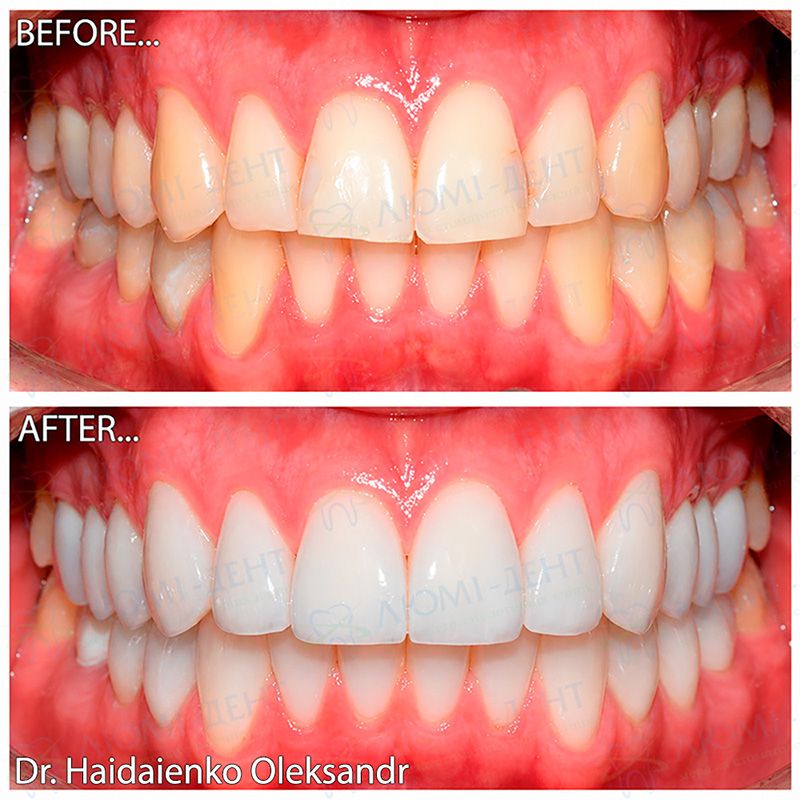
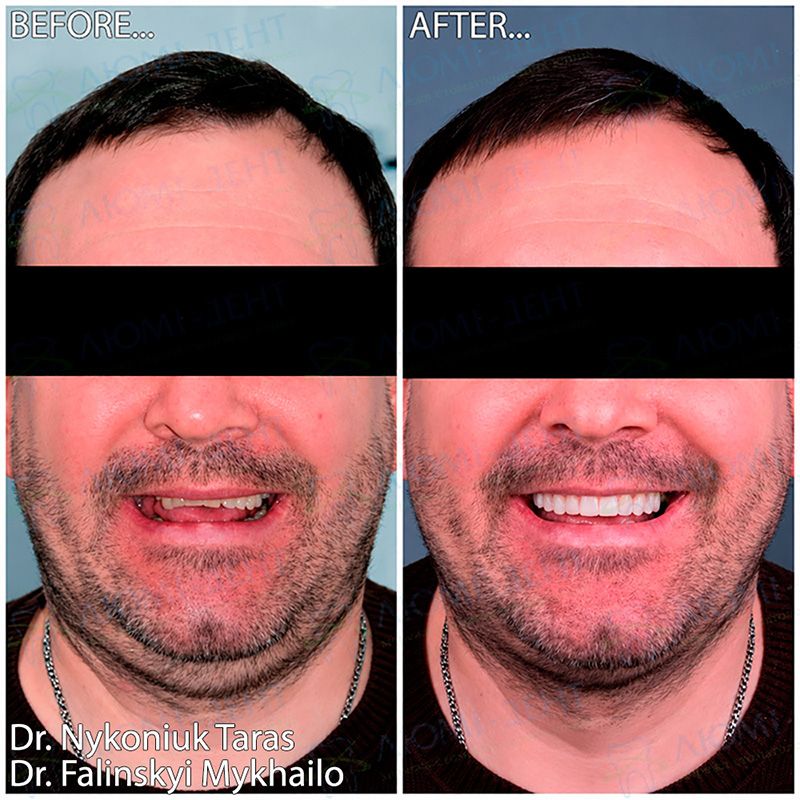
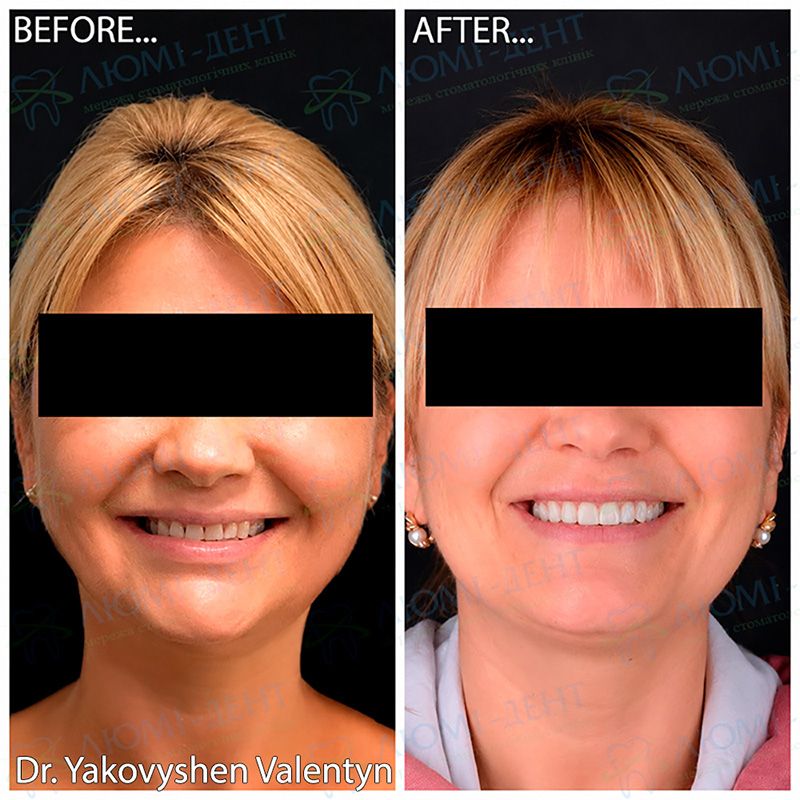
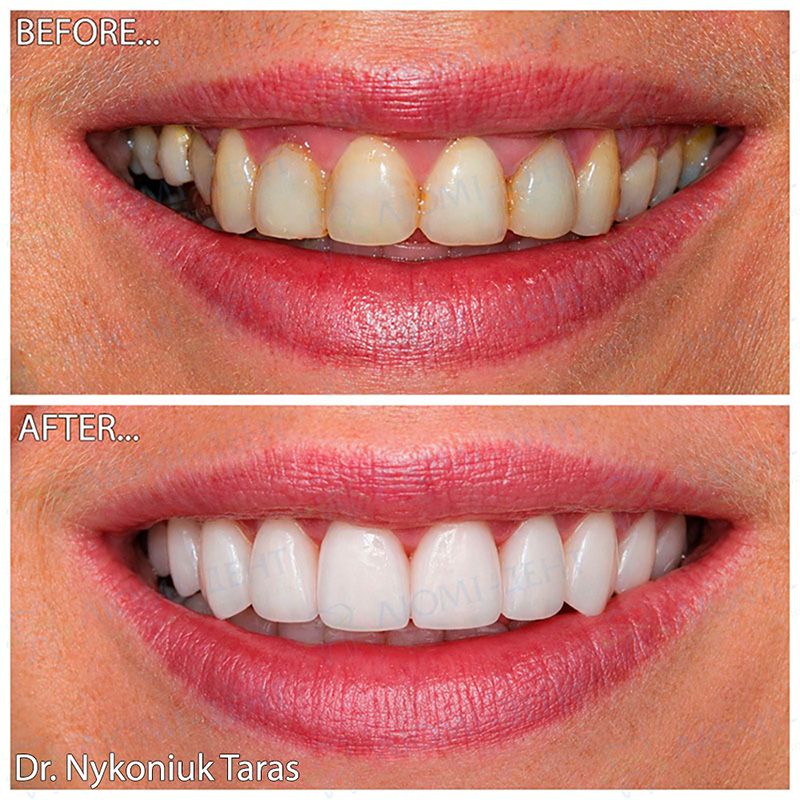
The patient wished to improve the aesthetics of her smile. Her main goals were to achieve a lighter tooth shade and to level the incisal edge of the anterior teeth.
Diagnosis:
Clinical examination revealed aesthetic imperfections of the anterior teeth, including an uneven incisal edge and an insufficiently bright enamel shade. No functional disorders of the stomatognathic system were detected.
Treatment:
Treatment began with professional oral hygiene. Following Digital Smile Design planning, prosthetic treatment using ceramic restorations was performed. The incisal edge of the anterior teeth was corrected, symmetry was improved, and a lighter natural smile shade was achieved. As a result, the smile became more expressive, harmonious, and natural.
In this case, the patient wanted to make her smile brighter and more harmonious, as well as correct irregularities of the incisal edge of the front teeth.
Even minor aesthetic imperfections of the front teeth can affect the overall appearance and attractiveness of a smile.
Before starting treatment, digital planning of the future result was carried out using the Digital Smile Design (DSD) protocol, which made it possible to determine the optimal tooth shape and proportions in advance.
After professional dental cleaning, aesthetic rehabilitation was performed using ceramic veneers.
During treatment, the incisal edge of the front teeth was corrected, their symmetry was improved, and a brighter natural shade of the smile was achieved.
Result:
The aesthetic imperfections of the front teeth were eliminated, the incisal edge was aligned, and the smile proportions were improved.
The smile became more harmonious, expressive, and natural, while the ceramic restorations provided a long-lasting aesthetic result.
Learn more about improving smile aesthetics with ceramic veneers.
The periodontal stage was performed by a periodontist Svitlana Vlasiuk
Clinical case 2
Complaints:
The patient complained of excessive tooth wear, discomfort, and periodic pain in the temporomandibular joint area. He also reported fatigue of the chewing muscles and deterioration of dental aesthetics due to the loss of natural tooth length.
Diagnosis:
Clinical examination revealed generalized wear of the hard dental tissues, reduced clinical crown height, and signs of functional overload of the stomatognathic system. An occlusal disorder associated with muscle and joint dysfunction was diagnosed.
Treatment:
Treatment began with professional oral hygiene and full oral sanitation. This was followed by gnathological treatment using a stabilization occlusal splint to stabilize the mandibular position, reduce stress on the temporomandibular joints, and relax the masticatory muscles. After functional stabilization, prosthetic rehabilitation was performed using ceramic restorations. As a result, pain symptoms were reduced, masticatory muscle function and occlusion were normalized, the anatomical shape and height of the teeth were restored, and both smile aesthetics and chewing load distribution were improved.
In this case, the patient sought treatment due to excessive tooth wear, discomfort in the temporomandibular joints, and a decline in the aesthetics of the smile.
Additionally, the patient was concerned about fatigue of the chewing muscles and the gradual loss of the natural height of the teeth.
During the diagnostic examination, generalized wear of the hard dental tissues, occlusal disorders, and signs of functional overload of the dentofacial system associated with musculoskeletal dysfunction were identified.
Treatment began with professional dental cleaning and complete oral sanitation.
The next stage included gnathological treatment using a customized occlusal splint, which helped stabilize the position of the lower jaw, reduce stress on the temporomandibular joints, and relax the chewing muscles.
After functional stabilization was achieved, prosthetic rehabilitation of the teeth was performed using ceramic veneers.
This made it possible to restore the anatomical shape of the teeth, their height, and proper occlusal contacts.
Result:
Pain symptoms were reduced, chewing muscle function was normalized, and proper tooth occlusion was restored.
The teeth regained their natural shape and height, while the smile became more aesthetic and harmonious. Even distribution of chewing forces created favorable conditions for the long-term stability of the treatment outcome.
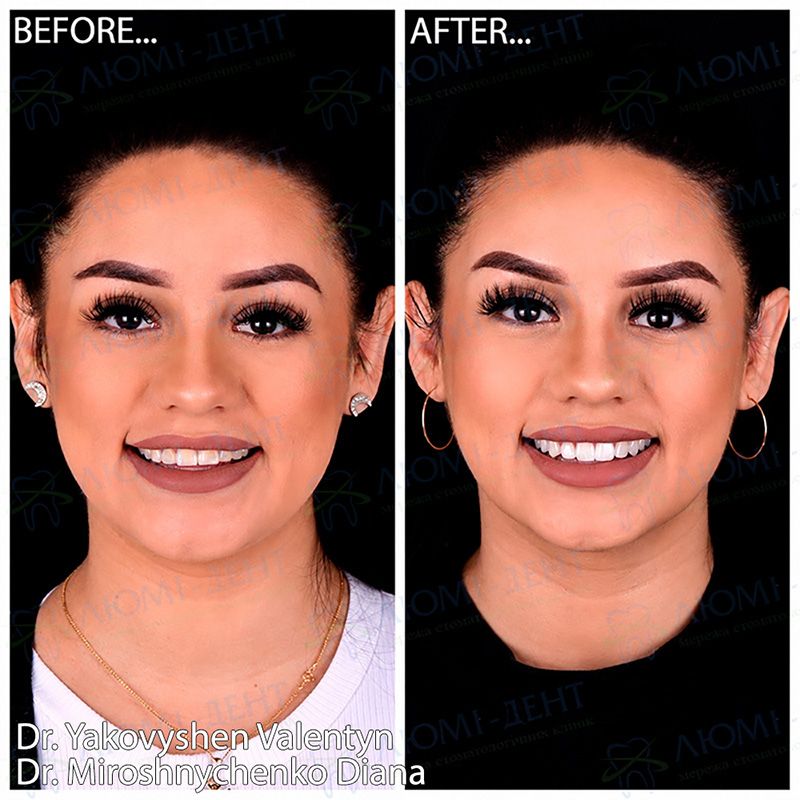
The patient sought to improve the aesthetics of his smile. He was concerned about “short” teeth, excessive gum display when smiling, and asymmetry of the anterior teeth.
Diagnosis:
Clinical examination revealed malposition of teeth 1.1 and 1.2, reduced clinical crown height, and excessive gingival display during smiling. Esthetic and functional issues requiring orthodontic, gnathological, and prosthetic correction were diagnosed.
Treatment:
Treatment began with professional oral hygiene. Orthodontic and gnathological preparation was then carried out, including correction of the position of teeth 1.1 and 1.2 and normalization of occlusal relationships. After Digital Smile Design planning, prosthetic rehabilitation of the anterior teeth was performed using ceramic restorations. As a result, the asymmetry of the anterior teeth was corrected, proper clinical crown length was restored, excessive gum display was reduced, and a more harmonious and proportionate smile was achieved.
In this case, the patient was concerned about “short” teeth, excessive gum display when smiling, and asymmetry of the front teeth, which negatively affected the aesthetics of the smile.
During the diagnostic examination, malposition of teeth 1.1 and 1.2, reduced clinical crown height, and a pronounced gummy smile were identified.
Achieving a predictable result required a comprehensive approach involving several dental specialties.
Treatment began with professional oral hygiene.
This was followed by orthodontic and gnathological preparation to correct tooth positioning and normalize occlusal relationships.
After digital smile planning using the Digital Smile Design (DSD) protocol, prosthetic rehabilitation of the front teeth was performed using ceramic veneers.
Result:
The asymmetry of the front teeth was corrected, proper proportions and clinical crown length were restored, and gum display during smiling was significantly reduced.
The smile became more harmonious, natural, and balanced, while the achieved result helped emphasize the patient’s individual facial features.
Learn more about improving tooth shape and smile aesthetics with ceramic veneers.
Treatment was performed by:
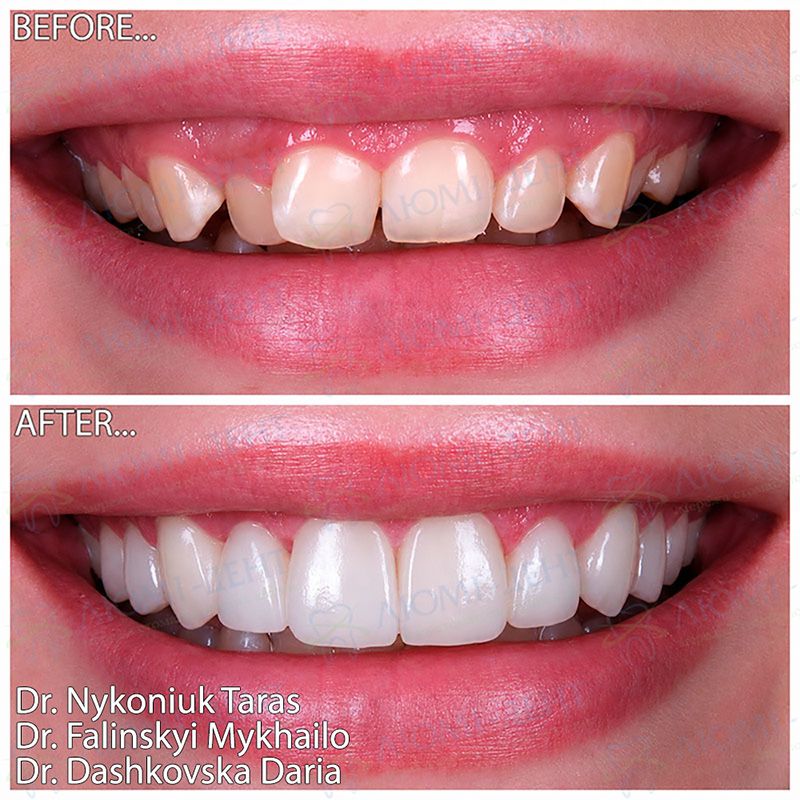
The prosthetic stage was performed by prosthodontist Taras Nykoniuk
Gnathological supervision was provided by gnathologist Mykhailo Falinskyi
The periodontal stage was performed by periodontist Dariia Dashkovska
Clinical case 4
Complaints:
The patient wished to improve the aesthetics of his smile. His main goals were to achieve a lighter tooth shade and to correct the shape of the anterior teeth in the 1.2–2.2 region.
Diagnosis:
Clinical examination revealed aesthetic imperfections of the anterior teeth in the 1.2–2.2 region related to their shape and proportions. A darker-than-desired enamel shade was also noted. No functional disorders of the stomatognathic system were detected.
Treatment:
Treatment began with professional oral hygiene. Following photographic documentation and Digital Smile Design, prosthetic rehabilitation of the upper anterior region was performed using ceramic veneers. The shape of the teeth in the 1.2–2.2 region was corrected, their proportions were improved, and a lighter natural smile shade was achieved. As a result, the smile became more harmonious and fully met the patient's expectations while preserving the natural appearance of the teeth.
In this case, the patient wanted to improve the aesthetics of the smile by brightening the teeth and correcting the shape of the front teeth in the area of teeth 1.2–2.2.
During the examination, specific features of the shape and proportions of the front teeth, as well as an insufficiently bright enamel shade, were identified.
No functional disorders of the dentofacial system were detected.
Treatment began with professional oral hygiene.
After a photographic protocol and digital planning of the future smile using the Digital Smile Design (DSD) protocol, prosthetic rehabilitation of the anterior region of the upper jaw was performed using ceramic veneers.
During treatment, the shape of the teeth in the area of 1.2–2.2 was corrected, their proportions were improved, and a brighter natural smile shade was achieved.
Result:
A harmonious combination of shape, size, and color of the front teeth was achieved while preserving their natural appearance.
The smile became more aesthetic, expressive, and fully met the patient’s expectations.
Learn more about correcting the shape and color of teeth with ceramic veneers.
Treatment was performed by:
The prosthetic stage was performed by prosthodontist Oleksandr Troskin
The periodontal stage was performed by periodontist Dariia Dashkovska
Clinical case 5
Complaints:
The patient sought to improve the aesthetics of his smile. His main concerns were a yellowish tooth shade, pronounced wear of the anterior teeth, and loss of their natural shape.
Diagnosis:
Clinical examination revealed significant wear of the anterior teeth in both the upper and lower jaws, resulting in reduced tooth length and altered anatomical shape. Darkening of the enamel and loss of the smile's natural brightness were also observed. Pathological tooth wear with pronounced aesthetic impairments was diagnosed.
Treatment:
Treatment began with professional oral hygiene. Following comprehensive diagnostics, gnathological analysis, and Digital Smile Design, prosthetic rehabilitation with ceramic veneers was performed. The restorations restored lost tooth structure, compensated for wear, corrected the color, and returned the proper anatomical shape of the anterior teeth. As a result, the yellowish tooth shade was eliminated, tooth length and proportions were restored, and the smile became younger, more harmonious, and natural.
In this case, the patient was concerned about a yellowish tooth shade, significant wear of the front teeth, and the loss of their natural shape.
Due to the reduced tooth length, the smile appeared less attractive and visually older.
During the examination, significant wear of the front teeth of both the upper and lower jaws was identified, accompanied by changes in their anatomical shape and enamel discoloration.
Comprehensive rehabilitation was required to restore both aesthetics and function.
Treatment began with professional oral hygiene.
After comprehensive diagnostics, gnathological analysis, and digital smile design, prosthetic rehabilitation was performed using ceramic veneers.
The restorations made it possible to compensate for the lost tooth structure and restore the proper shape, length, and natural proportions of the teeth.
Result:
The signs of pathological tooth wear were eliminated, the anatomical tooth shape was restored, and a brighter natural smile shade was achieved.
The teeth regained their proper proportions, while the smile became younger, more harmonious, and more aesthetic, while maintaining a natural appearance.
Learn more about restoring tooth shape and color with ceramic veneers.
Gnathological supervision was provided by gnathologist Mykhailo Falinskyi
The periodontal stage was performed by periodontist Veronika Lev
Clinical case 6
Complaints:
The patient presented with aesthetic concerns regarding her smile. She was bothered by wear of a front tooth, uneven positioning of the upper teeth, and aesthetic defects of the premolars on both sides.
Diagnosis:
Clinical examination revealed wear of the incisal edge of tooth 1.1, retrusion of the upper anterior teeth, and aesthetic defects of teeth 1.4, 1.5, 2.4, and 2.5. No functional disorders of the stomatognathic system were detected.
Treatment:
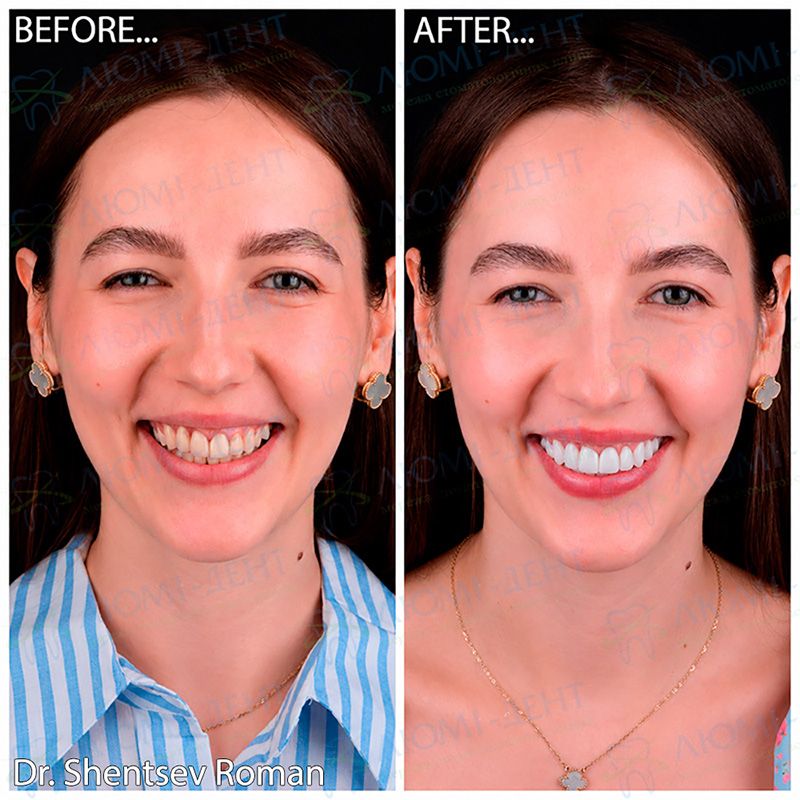
Treatment began with professional oral hygiene. Following photographic documentation, digital smile analysis, and restoration planning, prosthetic rehabilitation with ceramic veneers on the upper jaw was performed. During treatment, the anatomical shape of tooth 1.1 was restored, the visual position of the anterior teeth was corrected, and the aesthetic defects of the premolars were eliminated. As a result, the smile became more harmonious, brighter, and proportionate while maintaining its natural appearance.
In this case, the patient was concerned about aesthetic imperfections of the smile associated with wear of a front tooth, uneven positioning of the upper teeth, and noticeable defects of the premolars.
During the examination, wear of the incisal edge of tooth 1.1, retroposition of the upper front teeth, and aesthetic defects of teeth 1.4, 1.5, 2.4, and 2.5 were identified.
Although no functional disorders were detected, these changes negatively affected the appearance of the smile.
Treatment began with professional oral hygiene.
After a photographic protocol and future smile visualization, prosthetic rehabilitation of the upper jaw was performed using ceramic veneers.
During treatment, the anatomical shape of tooth 1.1 was restored, the visual position of the front teeth was corrected, and the aesthetic defects of the premolars were eliminated.
Result:
It was possible to restore harmonious proportions of the dental arch, improve the shape of the teeth, and eliminate noticeable aesthetic imperfections.
The smile became brighter, more symmetrical, and more natural while preserving the patient’s individual facial characteristics.
The prosthetic stage was performed by prosthodontist Roman Shentsev
The periodontal stage was performed by periodontist Dariia Filipenko
Clinical case 7
Complaints:
The patient wished to improve the aesthetics of her smile. She was dissatisfied with the shape of certain teeth, minor aesthetic imperfections, and the shade of her enamel. The patient wanted a brighter, more harmonious, and proportionate smile while maintaining a natural appearance.
Diagnosis:
Clinical examination revealed no significant functional disorders. Minor irregularities in the shape and proportions of the anterior teeth, as well as insufficient enamel brightness, were noted.
Treatment:
Treatment began with professional oral hygiene. Digital Smile Design was performed to plan the future outcome, followed by prosthetic rehabilitation using ceramic veneers in the anterior region. The restorations corrected the tooth shape, improved the color, and harmonized the smile. As a result, a natural and expressive smile with improved tooth proportions and a brighter enamel shade was achieved while fully preserving the patient's individuality.
In this case, the patient wanted to improve the aesthetics of her smile, correct the shape of individual teeth, and achieve a brighter enamel shade.
The main goal was to create a harmonious smile while maintaining its natural appearance.
No significant functional disorders were detected during the examination.
Certain features of the shape and proportions of the front teeth, as well as insufficient enamel brightness, were noted, which affected the overall appearance of the smile.
Treatment began with professional oral hygiene.
To predict the future outcome, a Digital Smile Design (DSD) was performed, followed by prosthetic rehabilitation of the anterior region using ceramic veneers.
The restorations made it possible to correct the shape of the teeth, improve their color, and create more harmonious smile proportions.
Result:
The aesthetics of the front teeth were improved, making the smile brighter, more balanced, and more expressive.
Ceramic veneers helped preserve the natural appearance of the teeth and highlight the patient’s unique smile characteristics.
Learn more about correcting tooth shape and color with ceramic veneers.
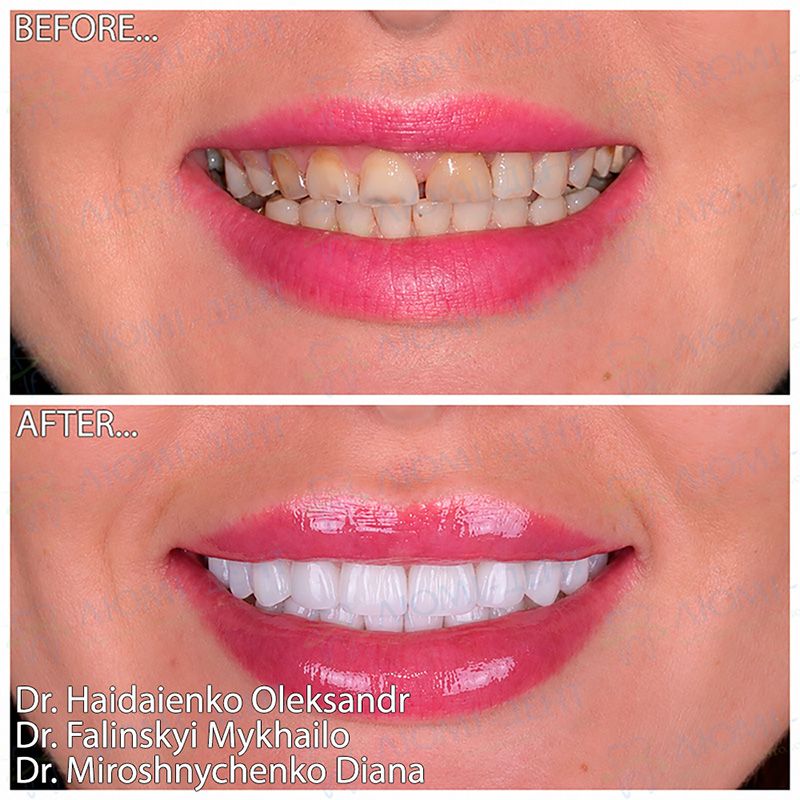
The patient presented with a diastema between the front teeth, increased tooth wear, unsatisfactory enamel color, and a desire to align the teeth and make the smile more harmonious and brighter.
Diagnosis:
Clinical examination revealed a diastema in the anterior region, pathological wear of the hard dental tissues, occlusal discrepancies, and aesthetic defects of the dental arch. Functional disorders of the stomatognathic system requiring preliminary gnathological preparation were diagnosed.
Treatment:
The treatment was comprehensive and included professional oral hygiene, gnathological preparation, and prosthetic rehabilitation. After diagnostics, occlusal analysis, and determination of the correct mandibular position, Digital Smile Design was performed. Ceramic veneers were placed to eliminate the diastema, compensate for tooth wear, and improve dental aesthetics. As a result, the diastema was eliminated, worn tooth structures were restored, the color and shape of the teeth were improved, and a harmonious smile, stable occlusion, and natural aesthetics were achieved.
In this case, the patient was concerned about a diastema between the front teeth, excessive tooth wear, and an unsatisfactory enamel color.
He wanted to achieve a straighter, more harmonious, and brighter smile.
During the examination, a diastema in the anterior region, pathological tooth wear, and occlusal discrepancies were identified.
To achieve a stable and long-lasting result, preliminary gnathological preparation was required.
Treatment was comprehensive and included professional dental cleaning, gnathological treatment, and subsequent prosthetic rehabilitation.
After occlusal analysis and determination of the correct mandibular position, digital smile design was performed, followed by the placement of ceramic veneers, which eliminated both aesthetic and functional deficiencies.
Result:
The diastema was completely closed, areas of the teeth affected by wear were restored, and the shape and color of the teeth were improved.
The smile became more harmonious and natural, while proper distribution of chewing forces ensured long-term stability of the achieved result.
Learn more about diastema closure and smile transformation with ceramic veneers.
Treatment was performed by:
The prosthetic stage was performed by prosthodontist Taras Nykoniuk
Gnathological supervision was provided by gnathologist Mykhailo Falinskyi
The periodontal stage was performed by periodontist Svitlana Vlasiuk
Clinical case 9
Complaints:
Crooked teeth, loss of several teeth, lack of confidence in the smile, joint clicking, and bleeding gums.
Diagnosis:
Distal deep bite, crowding of the anterior teeth, narrow dental arches, pronounced gummy smile, and the presence of old leaking restorations.
Treatment:
A comprehensive diagnostic examination was performed, including a photographic protocol and digital 3Shape scanning. The patient was referred for orthodontic treatment to correct the bite and tooth position before further implant placement and aesthetic rehabilitation. Over the course of 1.5 years, the dental arches were aligned, the midlines were corrected, and the position and inclination of the teeth were adjusted.
After completion of the orthodontic stage, a repeated diagnostic assessment and digital smile design were carried out. Laser gum contouring was performed using a Picasso laser according to an individual gingival guide.
A Wax-Up was created, 3D models were fabricated, and a Mock-Up stage was performed to evaluate the future tooth shape and approve the planned result. Under the control of a Seiler operating microscope, minimally invasive tooth preparation within the enamel was performed. After that, metal-free E-max ceramic restorations in the lightest shade were fabricated and permanently bonded.
In this case, the patient was concerned about crooked teeth, missing teeth, lack of confidence in her smile, clicking in the temporomandibular joints, and bleeding gums.
Achieving the desired result required comprehensive treatment involving specialists from different dental fields.
During the diagnostic examination, a distal deep bite, crowding of the anterior teeth, narrow dental arches, a pronounced gummy smile, and old defective restorations were identified.
All of these factors affected both the aesthetics of the smile and the function of the dentofacial system.
Treatment began with comprehensive diagnostics, a photographic protocol, and digital 3Shape scanning.
For one and a half years, orthodontic treatment was carried out, allowing the dental arches to be aligned, tooth positions to be corrected, and the teeth to be prepared for further rehabilitation.
After the orthodontic stage was completed, digital smile design, laser gum contour correction, and a Mock-Up were performed to evaluate the future result.
Then, under the control of an operating microscope, minimally invasive tooth preparation was performed and metal-free E-max ceramic veneers were placed.
Result:
A harmonious smile was created, proper tooth proportions were restored, and the pronounced gummy smile was eliminated.
The smile became more aesthetic, brighter, and more natural, while the comprehensive approach resulted not only in visual improvements but also in enhanced dentofacial function.
Learn more about comprehensive smile transformation with ceramic veneers.
Treatment was performed by:prosthodontist Roman Shentsev.
Clinical case 10
Complaints:
Compromised smile aesthetics, a chipped front tooth, wear of the incisal edges, masticatory muscle spasm, and headaches.
Diagnosis:
Hard tissue defect of the upper anterior teeth. Aesthetic defect. Traumatic chipping of teeth 1.1 and 2.1. Wear of the incisal edges of the anterior and posterior teeth.
Treatment:
An initial assessment of the masticatory muscles and muscle deprogramming was performed to determine a more stable position of the lower jaw and to facilitate further treatment planning. After that, a digital smile design was carried out, including jaw scanning with a 3Shape intraoral scanner. A prototype of the future smile (Mock-up) was fabricated.
Tooth preparation was performed under the control of a Seiler operating microscope. A second digital scan was completed, and temporary restorations were placed.
Two weeks later, permanent E-Max ceramic veneers were tried in and bonded to the anterior teeth, while ceramic crowns were placed on the posterior teeth.
Smile aesthetics were restored, occlusal contacts in both the anterior and posterior regions were normalized, excessive loading of the front teeth was eliminated, and muscle spasm and headaches were reduced.
In this case, the patient was concerned about impaired smile aesthetics, a chipped front tooth, severe tooth wear, chewing muscle spasms, and recurring headaches.
In addition to aesthetic concerns, the problem also affected the function of the dentofacial system.
During the examination, traumatic fractures of teeth 1.1 and 2.1, defects of the hard tissues of the anterior teeth, and wear of the incisal edges of both anterior and posterior teeth were identified.
The excessive load on the teeth was accompanied by increased tension in the chewing muscles.
Treatment began with an assessment of the chewing muscles and deprogramming to determine a more stable mandibular position.
This was followed by digital smile planning, digital scanning of the dental arches, and fabrication of a Mock-Up, allowing the treatment outcome to be evaluated in advance.
Under the control of an operating microscope, the teeth were prepared, temporary restorations were fabricated, and permanent E-Max ceramic veneers were placed on the anterior teeth, while ceramic crowns were placed on the posterior teeth.
Result:
The aesthetics of the smile were restored, chips and signs of tooth wear were eliminated, and the proper shape of the anterior teeth was re-established.
Thanks to the normalization of occlusal contacts, excessive tooth loading was reduced, chewing muscle tension decreased, and episodes of headache became significantly less frequent.
Learn more about restoring tooth form and function with ceramic veneers.
Gnathological supervision was provided by gnathologist Mykhailo Falinskyi
Clinical case 11
Complaints:
Irregular shape of the front teeth, wear of the anterior teeth, smile asymmetry, unsatisfactory dental aesthetics, and discomfort while chewing.
Diagnosis:
Pathological wear of the anterior teeth, reduced bite height, dysfunction of the stomatognathic system, and aesthetic smile imperfections.
Treatment:
A comprehensive gnathological assessment was performed, including CBCT imaging, a photographic protocol, smile video analysis, 3Shape digital scanning, and evaluation of the temporomandibular joint. An analysis of the masticatory muscles, occlusion, and mandibular movements was carried out to determine a stable functional jaw position.
To stabilize the bite, splint therapy and muscle deprogramming were performed. This was followed by Digital Smile Design and a Mock-up procedure to evaluate the future tooth shape, aesthetics, and comfort.
Minimally invasive tooth preparation was performed under a Seiler operating microscope. After a repeat digital scan, temporary restorations were placed to allow adaptation to the new vertical dimension of occlusion. Following the adaptation period, permanent E-max ceramic restorations were fabricated and bonded with careful control of occlusal contacts and load distribution.
In this case, the patient was concerned about the uneven shape of the front teeth, significant tooth wear, smile asymmetry, and discomfort while chewing.
In addition to aesthetic concerns, there were signs of impaired dentofacial function.
During a comprehensive examination, pathological wear of the anterior teeth, reduced bite height, and functional disorders associated with improper distribution of chewing forces were identified.
To achieve a long-lasting result, it was necessary to restore not only aesthetics but also proper dentofacial function.
Treatment began with gnathological diagnostics, including CT imaging, a photographic protocol, smile video analysis, digital 3Shape scanning, and evaluation of the temporomandibular joints.
After splint therapy and bite stabilization, digital smile design and a Mock-Up were performed to evaluate the future result in advance.
Then, under the control of an operating microscope, minimally invasive tooth preparation was carried out, temporary restorations were fabricated to allow adaptation to the new bite height, and after the adaptation period, permanent E-max ceramic veneers were placed.
Result:
Proper bite height was restored, dentofacial function improved, and the consequences of pathological tooth wear were eliminated.
The tooth shape became more harmonious, the smile became symmetrical and aesthetic, and the even distribution of chewing forces provided comfort and long-term stability of the achieved result.
Learn more about comprehensive smile rehabilitation with ceramic veneers.
Treatment was performed by:
The prosthetic stage was performed by prosthodontist Oleksandr Troskin
Gnathological supervision was provided by gnathologist Mykhailo Falinskyi
Clinical case 12
Complaints:
Irregular shape of the front teeth, uneven enamel color, and the presence of old restorations that disrupted the overall harmony of the smile. Increased wear of the anterior teeth was also noted.
Diagnosis:
Aesthetic defect of the anterior teeth: enamel discoloration, outdated fillings, altered anatomical shape and proportions of the teeth, and increased wear of the anterior teeth.
Treatment:
A comprehensive diagnostic examination was performed, including a photographic protocol, digital tooth scanning with a 3Shape scanner, and computerized occlusal analysis. Based on the findings, a digital smile design was created according to the patient's expectations.
After approval of the tooth shape and color, minimal tooth preparation for ceramic restorations was performed, and temporary restorations were placed for the adaptation period.
At the final stage, permanent E-Max ceramic veneers were fabricated and bonded, restoring the anatomical shape and proportions of the anterior teeth, eliminating enamel discoloration and the effects of old restorations, and creating a more harmonious, natural, and symmetrical smile.
In this case, the patient was concerned about the uneven shape of the front teeth, uneven enamel color, and old restorations that negatively affected the aesthetics of her smile.
In addition, increased wear of the anterior teeth was observed.
During the examination, enamel discoloration, outdated fillings, altered tooth anatomy and proportions, as well as signs of anterior tooth wear were identified.
These changes negatively affected the overall appearance and harmony of the smile.
Treatment began with comprehensive diagnostics, including a photographic protocol, digital tooth scanning, and occlusal analysis.
After future smile visualization and approval of the tooth shape and color, minimal tooth preparation for ceramic restorations was performed.
To ensure comfortable adaptation, temporary restorations were placed, and at the final stage permanent E-Max ceramic veneers were bonded.
Result:
The proper shape and proportions of the anterior teeth were restored, the consequences of old restorations were eliminated, and a uniform bright enamel shade was achieved.
The smile became more harmonious, natural, and symmetrical while preserving the patient’s individual facial characteristics.
Learn more about correcting tooth shape and color with ceramic veneers.
Treatment was performed by:prosthodontist Taras Nykoniuk.
Clinical case 13
Complaints:
Unsatisfactory smile aesthetics, including an uneven contour of the front teeth, insufficient definition of the incisal edge, and an overall “flat” appearance of the smile that did not meet the patient's expectations.
Diagnosis:
Aesthetic defect of the anterior teeth: altered anatomical shape, insufficient surface texture, and individual characteristics of the incisal edge affecting the natural appearance of the smile.
Treatment:
Following a photographic protocol and digital smile analysis, the future tooth shape was designed taking into account the patient's facial proportions and aesthetic expectations. Minimal tooth preparation was performed, followed by aesthetic and functional rehabilitation using E-Max ceramic veneers and overlays.
Special attention was paid to creating a natural incisal edge anatomy, microtexture, and optical properties of the teeth. As a result, a harmonious, more expressive, and natural-looking smile with well-defined tooth contours and improved aesthetics was achieved.
A predictable aesthetic result was achieved: the smile became harmonious, expressive, and natural. Proper proportions of the anterior teeth were restored, while symmetry and the anatomical definition of the incisal edge were improved. The patient reports a high level of satisfaction with the outcome and comfort when smiling.
In this case, the patient was dissatisfied with the uneven contour of the front teeth, the insufficiently defined incisal edge, and the overall “flat” appearance of the smile.
The main goal of treatment was to create a more expressive, natural, and harmonious smile while preserving the patient’s individual facial features.
During the examination, aesthetic imperfections of the anterior teeth were identified, related to the anatomical shape of the teeth, an insufficiently pronounced surface texture, and poorly defined incisal edges.
These features affected the perception and natural appearance of the smile.
After a photographic protocol and smile analysis, future smile simulation was performed, taking into account facial proportions and the patient’s expectations.
This was followed by minimal tooth preparation and aesthetic rehabilitation using E-Max ceramic veneers.
Special attention was paid to creating natural tooth anatomy, refining the incisal edges, and achieving optimal optical properties of the ceramic material.
Result:
The proper proportions of the anterior teeth were restored, smile symmetry was improved, and the incisal edges became more expressive and natural.
The smile became harmonious, vibrant, and aesthetic while preserving the natural appearance of the teeth and the patient’s individuality.
Treatment was performed by:prosthodontist Roman Shentsev.
Clinical case 14
Complaints:
Unsatisfactory smile aesthetics due to a chipped front tooth, discoloration and altered shape of the anterior teeth, as well as missing posterior teeth that impaired chewing and reduced overall comfort.
Diagnosis:
Aesthetic defect of the anterior teeth: fracture of the crown portion of tooth 2.1, enamel wear, and discoloration. Partial edentulism in the posterior regions involving teeth 3.6, 3.7, 4.6, and 4.7, resulting in reduced chewing efficiency.
Treatment:
A comprehensive diagnostic examination was performed, including a photographic protocol, CBCT imaging, and digital 3Shape scanning. Based on the collected data, digital smile planning and functional rehabilitation of the dentition were carried out.
In the anterior region, the teeth were prepared and restored with metal-free E-Max ceramic restorations to recover proper shape, length, and aesthetics while eliminating existing defects.
In the posterior regions, dental implants were placed and restored with zirconia crowns on Straumann implants to restore chewing function and occlusal stability.
In this case, the patient was concerned about a chipped front tooth, changes in the color and shape of the anterior teeth, and the absence of chewing teeth in the posterior regions.
In addition to aesthetic concerns, these issues resulted in reduced chewing efficiency and everyday discomfort.
During the examination, a fracture of the crown portion of tooth 2.1, enamel discoloration and wear of the anterior teeth, as well as partial tooth loss in the posterior regions of the lower jaw were identified.
To achieve full rehabilitation, it was necessary to address both aesthetic and functional problems simultaneously.
Treatment began with comprehensive diagnostics, including a photographic protocol, CT imaging, and digital 3Shape scanning.
After visualization of the future result, aesthetic rehabilitation of the anterior teeth was performed using metal-free E-Max ceramic veneers, restoring the shape, length, and natural appearance of the teeth.
To restore chewing function in the posterior regions, dental implant placement was performed, followed by prosthetic restoration with zirconia crowns on Straumann implants.
Result:
The aesthetic imperfections of the anterior teeth were eliminated, and their shape, color, and natural proportions were restored.
By replacing the missing chewing teeth, normal chewing function was restored, and the smile became harmonious, natural, and complete from both aesthetic and functional perspectives.
The patient presented with concerns about the aesthetics of her smile, including a yellowish tooth shade, uneven enamel color, old restorations in the anterior region, and imperfect shape and proportions of the front teeth.
Diagnosis:
Aesthetic defect of the anterior teeth: enamel discoloration, old restorations with compromised marginal adaptation, and altered anatomical shape and proportions of the teeth.
Treatment:
A comprehensive digital diagnostic assessment was performed using a 3Shape intraoral scanner and 3D smile design. After the shape and shade were approved, a Mock-Up stage was completed to visualize the final outcome. Minimally invasive tooth preparation and removal of old restorations were then performed under the control of a Seiler operating microscope.
At the final stage, highly aesthetic E-max ceramic veneers were bonded, allowing complete correction of discoloration and restoration of the proper anatomical shape, symmetry, and proportions of the anterior teeth.
A complete aesthetic rehabilitation of the anterior teeth was achieved. The smile became brighter and more harmonious, with improved proportions, symmetry, and a stable long-term clinical result.
In this case, the patient was concerned about a yellowish tooth shade, uneven enamel color, old restorations in the anterior region, and the imperfect shape of the front teeth.
These issues negatively affected the aesthetics and harmony of her smile.
During the examination, enamel discoloration, old restorations with compromised marginal integrity, and changes in the shape and proportions of the anterior teeth were identified.
Comprehensive aesthetic rehabilitation was required to achieve the most natural-looking result.
Treatment began with digital diagnostics, including tooth scanning using the 3Shape system and future smile design.
After the shape and color were approved, a Mock-Up was created, allowing the future result to be evaluated in advance.
Then, under the control of an operating microscope, the old restorations were replaced and minimally invasive tooth preparation was performed.
The uneven enamel color was completely corrected, old restorations were replaced, and the proper shape of the anterior teeth was restored.
The smile became brighter, more symmetrical, and more harmonious, while the ceramic veneers provided a natural appearance and a long-lasting aesthetic result.
Learn more about correcting tooth shape and color with ceramic veneers.
Unsatisfactory smile aesthetics, including severe tooth discoloration, uneven tooth shape, chipping in the anterior region, and an overall worn appearance of the teeth. The patient also reported morning fatigue of the masticatory muscles.
Diagnosis:
Aesthetic defect of the anterior teeth: discoloration, wear of the incisal edges, altered tooth anatomy, and enamel microchips. Overloading of the anterior teeth and temporomandibular joint-related muscular dysfunction.
Treatment:
T-Scan analysis was used to assess occlusal overload, and deprogramming was performed to determine the optimal position of the lower jaw. A comprehensive diagnostic assessment was carried out, including a photographic protocol and digital 3Shape scanning. Based on the collected data, a digital smile design was created, the shape of 20 future restorations was planned, and Wax-Up models were fabricated for treatment approval.
Tooth preparation was performed under the control of a Seiler operating microscope. Permanent metal-free E.max ceramic restorations were then fabricated and bonded.
In this case, the patient was concerned about severe tooth discoloration, chips in the anterior region, irregular tooth shape, and a worn appearance of the teeth.
In addition, morning fatigue of the chewing muscles and signs of functional overload of the dentofacial system were noted.
During the examination, enamel discoloration, wear of the incisal edges, microchips, and alterations in the anatomical shape of the teeth were identified.
A temporomandibular joint and muscle dysfunction associated with improper distribution of chewing forces was also diagnosed.
Treatment began with gnathological diagnostics using the T-Scan system and chewing muscle deprogramming to determine the optimal position of the lower jaw.
After a comprehensive examination and digital 3Shape scanning, future smile design was performed, and a Wax-Up was created to approve the shape of the future restorations.
Then, under the control of an operating microscope, the teeth were prepared and permanent metal-free ceramic veneers were bonded.
Result:
The proper tooth shape was restored, chips and enamel discoloration were eliminated, and the smile regained its natural aesthetics and harmonious proportions.
After normalization of the occlusal contacts, the overload on the anterior teeth was reduced, discomfort in the chewing muscles decreased, and the smile gained a younger and healthier appearance.
Learn more about comprehensive smile restoration with veneers.
Gnathological supervision was provided by gnathologist Mykhailo Falinskyi
Clinical case 17
Complaints:
Unsatisfactory appearance of the teeth, including severe discoloration, uneven tooth color, worn incisal edges, altered tooth shape, and a lack of smile harmony. The patient also reported clicking during tooth closure, pain in the left temporomandibular joint, and discomfort when opening the mouth.
Diagnosis:
Aesthetic defect of the dentition: enamel discoloration, increased wear of the anterior teeth, altered tooth anatomy and proportions, and signs of functional overload. Temporomandibular joint dysfunction and distal occlusion.
Treatment:
The initial stage included deprogramming and splint therapy to stabilize TMJ function, eliminate pain symptoms, and restore the correct position of the lower jaw.
Following a comprehensive examination with a photographic protocol and digital 3Shape scanning, a digital smile design was created. Wax-Up and 3D models were fabricated to evaluate the planned result in advance.
Tooth preparation was then performed under the control of a Seiler operating microscope with maximum preservation of natural tooth structure. After the laboratory stage, 28 highly aesthetic E-max ceramic veneers were fabricated and bonded, restoring tooth shape, color, and proportions, eliminating signs of wear, and creating a harmonious smile.
In this case, the patient was concerned about tooth discoloration, uneven enamel color, wear of the incisal edges, and altered tooth shape.
There were also clicking sounds when closing the teeth, pain in the TMJ area, and discomfort when opening the mouth.
During the examination, increased tooth wear, altered tooth proportions, a distal bite, and temporomandibular joint dysfunction were identified.
To achieve a long-lasting result, it was necessary to restore both the aesthetics of the smile and the proper function of the dentofacial system.
Treatment began with gnathological therapy, including splint therapy and chewing muscle deprogramming to stabilize TMJ function.
After a photographic protocol, digital 3Shape scanning, and future smile design, Wax-Up models and 3D models were created.
Then, under the control of an operating microscope, conservative tooth preparation was performed and 28 E-max ceramic veneers were bonded.
Result:
The shape, color, and proportions of the teeth were restored, signs of wear were eliminated, and the aesthetics of the smile were significantly improved.
The smile became harmonious and natural, while normalization of dentofacial function helped reduce discomfort in the TMJ area.
Learn more about comprehensive smile transformation with ceramic veneers.
Gnathological supervision was provided by gnathologist Mykhailo Falinskyi
Clinical case 18
Complaints:
Interdental pigmentation, uneven enamel color, differences in tooth shape, and an unsatisfactory appearance of old restorations on the anterior teeth.
Diagnosis:
Aesthetic defect of the anterior teeth: enamel discoloration, interdental pigmentation, and altered tooth anatomy and proportions.
Treatment:
Following a photographic protocol and digital smile analysis, the future tooth shape was designed according to the patient's facial proportions and aesthetic expectations. Minimal tooth preparation was performed, followed by aesthetic correction with ceramic veneers.
Special attention was paid to creating a natural incisal edge anatomy, microtexture, and optical properties of the teeth. The restorations were fabricated from layered E-max ceramic, allowing correction of pigmentation, tooth shape, and color while achieving a highly natural appearance.
In this case, the patient was concerned about pigmentation between the teeth, uneven enamel color, differences in tooth shape, and the unsatisfactory appearance of old restorations in the anterior region.
All of these factors negatively affected the aesthetics of her smile.
During the examination, enamel discoloration, interproximal pigmentation, and irregularities in the shape and proportions of the anterior teeth were identified.
Comprehensive aesthetic correction was required to achieve a natural-looking result.
After a photographic protocol and future smile visualization, a new tooth shape was designed taking into account the patient’s facial proportions and aesthetic expectations.
This was followed by minimal tooth preparation and aesthetic rehabilitation using E-max ceramic veneers, with special attention paid to natural tooth anatomy, surface texture, and color characteristics.
Result:
The pigmentation was eliminated, the shape and color of the teeth were harmonized, and the imperfections of the old restorations were concealed.
The smile became brighter, more harmonious, and more natural while preserving the patient’s individual facial characteristics.
Learn more about correcting tooth shape and color with ceramic veneers.
Uneven tooth color, enamel stains, irregular shape of the anterior teeth, poorly defined incisal edges, wear of the front teeth, and masticatory muscle spasms.
Diagnosis:
Aesthetic defect of the anterior teeth: enamel discoloration, altered tooth anatomy and proportions, mild incisal edge wear, and overload of the anterior teeth.
Treatment:
A comprehensive diagnostic assessment was performed, including a photographic protocol, digital 3Shape scanning, and occlusal analysis using T-Scan. Based on the collected data, a digital smile design was created according to the patient's individual characteristics.
Wax-Up and 3D models were fabricated, followed by a Mock-Up procedure to evaluate the future tooth shape before treatment. As part of the gnathological stage, a muscle-relaxing splint was provided for 2–4 weeks to stabilize masticatory muscle function.
Tooth preparation was performed under the control of a Seiler operating microscope. Metal-free E-max ceramic veneers were then fabricated and bonded, restoring tooth color, shape, and overall smile harmony.
In this case, the patient was concerned about uneven tooth color, enamel stains, differences in the shape of the front teeth, and wear of the incisal edges.
In addition, chewing muscle spasms and signs of overload of the anterior teeth were noted.
During the examination, enamel discoloration, altered tooth shape and proportions, as well as mild incisal edge wear were identified.
To achieve a long-lasting result, it was necessary not only to improve the aesthetics of the smile but also to stabilize the function of the chewing muscles.
Treatment began with comprehensive diagnostics, including a photographic protocol, digital 3Shape scanning, and analysis of occlusal contacts using T-Scan.
After future smile design, Wax-Up models, 3D models, and a Mock-Up were created to evaluate the expected result in advance.
During the gnathological stage, the patient used a muscle-relaxing splint to normalize the function of the chewing muscles.
Then, under the control of an operating microscope, tooth preparation was performed and metal-free E-max ceramic veneers were bonded.
Result:
The color, shape, and proportions of the teeth were restored, aesthetic imperfections were eliminated, and the smile became more harmonious.
Following stabilization of the chewing muscles and restoration of proper occlusal contacts, both aesthetic and functional improvements were achieved.
Learn more about restoring smile aesthetics with ceramic veneers.
Treatment was performed by:
The prosthetic stage was performed by prosthodontist Roman Shentsev
Gnathological supervision was provided by gnathologist Mykhailo Falinskyi
Clinical case 20
Complaints:
Uneven tooth shade, enamel stains, and differences in the shape of the anterior teeth.
Diagnosis:
Aesthetic defect of the anterior teeth: enamel discoloration, altered tooth anatomy and proportions, and wear of the anterior teeth.
Treatment:
A photographic protocol and digital scanning using a 3Shape intraoral scanner were performed, followed by planning of the future smile. Wax-Up and Mock-Up procedures were completed to allow preliminary evaluation of the tooth shape and approval of the treatment plan by the patient.
Tooth preparation was carried out under the control of a Seiler operating microscope, ensuring precision and a minimally invasive approach. Metal-free E-max ceramic veneers were then fabricated and bonded, allowing correction of tooth shape, improvement of tooth color, and achievement of a harmonious, natural-looking smile.
A significant aesthetic improvement of the smile was achieved. Harmonious proportions of the anterior teeth were restored, tooth color and shape were corrected, enamel stains were eliminated, and the incisal edge definition was enhanced. The patient reports a natural and aesthetically pleasing result that fully met her expectations.
In this case, the patient was concerned about uneven tooth shade, enamel stains, and differences in the shape of the front teeth.
These aesthetic imperfections made the smile less harmonious and did not meet her expectations.
During the examination, enamel discoloration, altered shape and proportions of the anterior teeth, as well as signs of wear of the anterior teeth were identified.
To achieve a natural-looking result, it was important to restore the balance of color, shape, and proportions of the smile.
After a photographic protocol and digital 3Shape scanning, future smile planning was performed.
For preliminary evaluation of the outcome, Wax-Up models were fabricated and a Mock-Up was performed, allowing the future tooth shape to be approved before treatment began.
Then, under the control of an operating microscope, conservative tooth preparation was carried out and E-max veneers were bonded.
Result:
The tooth color was evened out, enamel stains were eliminated, and harmonious proportions of the anterior teeth were restored.
The smile became brighter, more natural, and more aesthetic, fully meeting the patient’s expectations.
Learn more about correcting tooth shape and color with ceramic veneers.
Unesthetic appearance of old composite restorations, irregular tooth shape, and an overall lack of smile harmony.
Diagnosis:
Aesthetic defect of the upper and lower teeth: presence of old composite restorations, altered tooth anatomy and proportions, and mild wear of the incisal edges.
Treatment:
The patient underwent a comprehensive diagnostic assessment, including CBCT imaging, a photographic protocol (evaluation of the pre-treatment condition, occlusion, and facial proportions), and digital scanning of both arches using a 3Shape intraoral scanner.
During the preparation stage, the old composite restorations in the anterior region were removed. A digital smile design was then created, followed by a Mock-Up procedure using a fast-setting resin prototype, allowing the shape and shade of the future restorations to be approved by the patient.
The teeth of both the upper and lower jaws were then prepared for E-Max ceramic veneers. At the final stage, the permanent restorations were tried in and subsequently bonded.
A significant aesthetic improvement of the smile was achieved. Harmonious proportions of the anterior teeth were restored, discoloration and traces of old composite restorations were eliminated, and tooth shape was corrected. The patient reports a natural, aesthetically balanced result and a noticeable improvement in the appearance of the smile.
In this case, the patient was dissatisfied with old composite restorations, differences in tooth shape, and the overall lack of harmony in the smile.
Over time, the restorations had lost their aesthetic appearance and became noticeable when smiling.
During the examination, old composite restorations, irregularities in tooth shape and proportions, as well as minor wear of the incisal edges were identified.
To achieve a natural-looking result, it was decided to replace the old restorations with ceramic veneers.
After diagnostics, a photographic protocol, and digital 3Shape scanning, future smile design and a Mock-Up were performed to approve the future tooth shape.
The teeth of both the upper and lower jaws were then prepared, and E-Max veneers were bonded.
Result:
The shortcomings of the old restorations were eliminated, the tooth shape was improved, and harmonious smile proportions were restored.
The smile became more natural, symmetrical, and aesthetically pleasing.
Treatment was performed by:prosthodontist Taras Nykoniuk.
Clinical case 22
Complaints:
Unsatisfactory smile aesthetics, dark yellowish tooth color, noticeable old restorations on the front teeth, worn incisal edges, and discomfort during chewing and wide mouth opening.
Diagnosis:
Severe enamel discoloration, hard tissue defects caused by deteriorated composite restorations, and pathological tooth wear. Temporomandibular joint dysfunction with left-sided disc displacement with reduction.
Treatment:
Treatment began with deprogramming and splint therapy to normalize the position of the lower jaw and relieve pain symptoms. A comprehensive diagnostic assessment, photographic protocol, and Digital Smile Design were performed to determine the shape, length, and shade of the future restorations.
Following professional oral hygiene, tooth preparation of both arches was carried out within the enamel under the control of a Seiler operating microscope. Temporary restorations were placed during the fabrication of the definitive restorations.
At the final stage, layered E-max ceramic restorations were tried in and adhesively bonded, restoring tooth shape, height, and smile aesthetics.
In this case, the patient was concerned about the dark yellowish color of the teeth, noticeable old restorations, wear of the incisal edges, and discomfort while chewing.
The patient also reported unpleasant sensations in the temporomandibular joint area when opening the mouth widely.
During the examination, pronounced enamel discoloration, tooth defects caused by the poor condition of old restorations, pathological tooth wear, and TMJ dysfunction were identified.
To achieve a stable long-term result, it was necessary to restore both the aesthetics of the smile and the proper function of the dentofacial system.
Treatment began with gnathological therapy, including splint therapy and deprogramming to stabilize the position of the lower jaw.
After comprehensive diagnostics and Digital Smile Design, tooth preparation was performed under the control of a Seiler operating microscope, and temporary restorations were fabricated.
At the final stage, ceramic veneers were bonded, restoring the shape, height, and aesthetics of the teeth.
Result:
The consequences of tooth wear were eliminated, old restorations were replaced, and the color of the teeth was significantly improved.
The smile became more harmonious and natural, while normalization of TMJ function helped reduce discomfort during chewing and mouth opening.
Gnathological supervision was provided by gnathologist Mykhailo Falinskyi
Clinical case 23
Complaints:
Dissatisfaction with smile aesthetics due to a gap between the front teeth, uneven enamel color, and imperfect tooth shape. The patient wished to achieve a harmonious bright smile without gaps while maintaining a natural appearance.
Diagnosis:
Diastema, altered shape and proportions of the anterior teeth, and enamel discoloration.
Treatment:
Digital smile planning was performed using a 3Shape intraoral scanner, followed by the fabrication of a Mock-Up for preliminary evaluation of the expected result.
After approval of the design, tooth preparation was carried out under the control of a Seiler operating microscope within the enamel. A repeat digital scan was performed, and temporary restorations were placed.
Two weeks later, permanent ceramic veneers were tried in and bonded, allowing closure of the diastema, correction of tooth shape and proportions, and improvement of smile color.
In this case, the patient was concerned about a gap between the front teeth, uneven enamel color, and imperfections in tooth shape.
Her main goal was to achieve a harmonious, bright white smile without gaps while maintaining a natural appearance.
During the examination, a diastema, irregularities in the shape and proportions of the anterior teeth, and enamel discoloration were identified.
To achieve a predictable result, digital smile planning and a Mock-Up were performed to evaluate the expected outcome in advance.
After conservative tooth preparation, ceramic veneers were fabricated and bonded, allowing correction of tooth shape, closure of the gap, and improvement of the smile’s color.
Result:
The diastema was completely closed, tooth proportions were improved, and a brighter, more uniform enamel shade was achieved.
The smile became harmonious, natural, and fully met the patient’s expectations.
Treatment was performed by:prosthodontist Taras Nykoniuk.
Clinical case 24
Complaints:
The patient was concerned about the overall unaesthetic appearance of the smile. The main issues were old restorations that had become yellowed and lost their shape over time, as well as noticeable dark lines along the gum margin.
Diagnosis:
Unsatisfactory condition of old composite restorations that had lost their marginal seal and caused localized gingival inflammation. Altered anatomical tooth shape.
Treatment:
Treatment began with digital scanning and 3D smile design. After conservative tooth preparation under a Seiler operating microscope, temporary crowns were placed. This allowed complete resolution of the inflammation and the formation of a healthy, even, pale pink gingival contour. At the final stage, new custom-made metal-free E-Max ceramic restorations in a lighter shade were adhesively bonded.
A complete aesthetic and functional rehabilitation of the smile was achieved. Discoloration and the consequences of old restorations were eliminated, while a natural gingival contour and proper tooth proportions were restored. The patient obtained a harmonious, brighter, and highly aesthetic smile with healthy-looking soft tissues and a stable long-term result.
In this case, the patient was dissatisfied with old restorations that had changed color over time, lost their original shape, and become noticeable when smiling.
Additional discomfort was caused by dark lines along the gum margin and the overall unaesthetic appearance of the teeth.
During the examination, the old composite restorations were found to be in poor condition, with altered tooth anatomy and localized gingival inflammation around the restorations.
A complete aesthetic rehabilitation was required to achieve a long-lasting result.
Treatment began with digital scanning and future smile design.
After conservative tooth preparation under microscope control, temporary restorations were placed, allowing the soft tissues to recover and a harmonious gingival contour to be established.
Custom metal-free ceramic veneers were then fabricated and bonded.
Result:
The shortcomings of the old restorations were completely eliminated, the correct tooth shape was restored, and the aesthetics of the smile were significantly improved.
The smile became brighter, more harmonious, and more natural, while the gums achieved a healthy and aesthetic appearance.
The patient was dissatisfied with the appearance of the smile due to large gaps between the front teeth, small tooth size, irregular tooth shape, worn incisal edges, and a yellowish enamel shade.
Diagnosis:
Aesthetic defect of the anterior teeth: microdontia, presence of diastemas and spacing, altered tooth anatomy and proportions, and pronounced enamel discoloration.
Treatment:
A comprehensive diagnostic assessment was performed, including a photographic protocol and digital 3Shape scanning. Based on the collected data, a future smile design was created with complete closure of the interdental spaces in mind.
Wax-Up and 3D models were fabricated, followed by a Mock-Up procedure to evaluate the future tooth shape before treatment.
Tooth preparation was carried out under a Seiler operating microscope with minimally invasive enamel preparation. Metal-free E-max ceramic restorations in the lightest shade were then fabricated and bonded, allowing closure of the gaps, restoration of proper tooth size and shape, and achievement of a harmonious smile.
In this case, the patient was concerned about significant gaps between the front teeth, their small size, irregular shape, and a yellowish shade of the enamel.
These features noticeably affected the aesthetics of the smile and prevented achieving the desired harmony of the dental arch.
During the examination, microdontia, diastemas and spacing between the teeth, altered tooth shape and proportions, as well as pronounced enamel discoloration were identified.
To achieve a predictable aesthetic result, preliminary digital smile planning was performed.
After a photographic protocol and digital 3Shape scanning, future smile design and a Mock-Up were carried out to approve the expected result.
Then, under the control of an operating microscope, minimally invasive tooth preparation was performed and ceramic veneers were bonded.
Result:
The gaps between the teeth were completely closed, the shape, size, and color of the teeth were improved, and more harmonious smile proportions were achieved.
The smile became brighter, more natural, and more aesthetic, fully meeting the patient’s expectations.
Learn more about closing diastemas and transforming a smile with ceramic veneers.
The patient presented with concerns about the aesthetics of her smile, including uneven yellowish tooth color, imperfect shape of the anterior teeth, and an irregular incisal edge.
Diagnosis:
Aesthetic defect of the anterior teeth: pronounced discoloration of the enamel and old restorations, hard tissue defects, and altered tooth anatomy and proportions.
Treatment:
A digital diagnostic assessment was performed using a 3Shape intraoral scanner and 3D smile design. After trying in the prototype smile (Mock-Up stage), conservative tooth preparation and replacement of old restorations were carried out under the control of a Seiler operating microscope.
At the final stage, highly aesthetic E-max ceramic veneers were bonded, making it possible to conceal all imperfections and restore an ideal bright shade, proper tooth shape, and overall smile harmony.
A complete aesthetic rehabilitation of the anterior teeth was achieved. Discoloration was eliminated, and the proper anatomical shape and proportions of the teeth were restored. The smile became more symmetrical, harmonious, and natural, with a significant aesthetic improvement and a stable long-term clinical result.
In this case, the patient was concerned about the uneven yellowish color of her teeth, imperfect shape of the front teeth, and an irregular incisal edge.
Old restorations were also noticeable and negatively affected the overall appearance of the smile.
During the examination, pronounced discoloration of the enamel and old restorations, defects of the hard dental tissues, as well as altered shape and proportions of the anterior teeth were identified.
To achieve a predictable result, preliminary digital smile planning was performed.
After digital diagnostics and 3D modeling, a Mock-Up stage was carried out for visualization of the future result.
Then, under the control of an operating microscope, conservative tooth preparation, replacement of old restorations, and placement of highly aesthetic E-max ceramic veneers were performed.
Result:
The discoloration was completely eliminated, the tooth shape was corrected, and harmonious smile proportions were restored.
The smile became brighter, more symmetrical, and more natural, while the ceramic veneers provided a long-lasting aesthetic result.
Learn more about correcting tooth shape and color with ceramic veneers.
The patient was dissatisfied with the appearance of the smile due to a yellowish tooth shade, uneven enamel color, minor shape defects, and small chips along the incisal edges of the anterior teeth.
Diagnosis:
Enamel discoloration and aesthetic defects of the anterior teeth. No functional disorders were detected.
Treatment:
Professional oral hygiene was performed, followed by digital smile design and individualized planning of tooth shape based on facial proportions and smile line characteristics.
The next stage included minimally invasive tooth preparation with maximum enamel preservation and digital scanning for the fabrication of custom ceramic veneers. Temporary veneers were placed during the laboratory phase.
After try-in and necessary adjustments, the ceramic veneers were adhesively bonded. This allowed correction of tooth color, restoration of proper tooth shape and proportions, and achievement of a harmonious natural-looking smile.
In this case, the patient was concerned about the yellowish shade of the teeth, uneven enamel color, minor shape imperfections, and small chips along the incisal edges of the anterior teeth.
Although there were no functional disorders, these features noticeably affected the aesthetics of the smile.
During the examination, enamel discoloration and aesthetic imperfections of the anterior teeth were identified.
To achieve the most natural-looking result, individual smile planning was performed, taking into account the patient's facial proportions and smile line.
After professional dental cleaning, digital smile design and minimally invasive tooth preparation were carried out.
Custom ceramic veneers were then fabricated, and temporary restorations were placed while the final restorations were being produced.
After the try-in and necessary adjustments, the permanent veneers were bonded.
Result:
The tooth color was evened out, the small chips were eliminated, and the shape of the anterior teeth was corrected.
The smile became brighter, more harmonious, and more natural while preserving the patient's individual facial characteristics.
Learn more about correcting tooth shape and color with ceramic veneers.
The patient presented with concerns about the aesthetics of the smile, including a pronounced yellow-brown tooth shade, uneven tooth color, old composite restorations in the anterior region, their pigmentation and loss of gloss, wear of the incisal edges, and disharmony in tooth shape.
Diagnosis:
Enamel discoloration, pigmented old composite restorations of the anterior teeth, presence of dental deposits, signs of pathological tooth wear, and altered anatomical tooth shape.
Treatment:
A comprehensive professional oral hygiene procedure was performed, including ultrasonic removal of dental deposits, Air Flow cleaning, and polishing of the tooth surfaces.
Tooth preparation was carried out under binocular magnification to ensure maximum precision and a minimally invasive approach to tissue management.
Following this, aesthetic rehabilitation was completed using E.max lithium disilicate ceramic veneers with individually selected shape, texture, and shade.
In this case, the patient was concerned about the pronounced yellow-brown discoloration of the teeth, pigmented old restorations, wear of the incisal edges, and irregular tooth shape.
These changes made the smile less aesthetic and significantly affected its overall appearance.
During the examination, enamel discoloration, old composite restorations with signs of pigmentation, dental deposits, and altered tooth anatomy were identified.
To achieve a harmonious result, a comprehensive aesthetic rehabilitation was planned.
Treatment began with professional dental cleaning, including ultrasonic scaling, Air Flow cleaning, and tooth polishing.
Then, under optical magnification, conservative tooth preparation was performed, and custom-made E.max ceramic veneers were fabricated with individually selected shape, texture, and shade.
Result:
The uneven tooth color was corrected, old restorations were replaced, and the natural tooth shape was restored.
The smile became brighter, more harmonious, and more natural, while the ceramic veneers provided a long-lasting aesthetic result.
Learn more about correcting tooth shape and color with ceramic veneers.
Treatment was performed by:prosthodontist Roman Shentsev.
Clinical case 29
Complaints:
The patient presented with concerns about the aesthetics of the smile, including uneven tooth shade, yellowish discoloration, disharmony in the shape of the anterior teeth, and asymmetry of the incisal edges.
Diagnosis:
Enamel discoloration, altered anatomical shape of the anterior teeth, mild tooth rotation and crowding, uneven incisal edge length, and early signs of enamel wear.
Treatment:
A digital diagnostic assessment was performed using a 3Shape intraoral scanner and 3D smile design. After approval and try-in of the prototype smile (Mock-Up stage), conservative tooth preparation of both the upper and lower jaws was carried out under the control of a Seiler operating microscope within the enamel. At the final stage, highly aesthetic metal-free E-max ceramic veneers were bonded. This made it possible to fully restore lost tooth volume, create a harmonious incisal edge, and provide the patient with a flawless, bright smile featuring natural enamel translucency.
In this case, the patient was concerned about the uneven shade of the teeth, yellowish enamel color, disharmony in the shape of the anterior teeth, and asymmetry of the incisal edges.
These features noticeably affected the aesthetics of the smile.
During the examination, enamel discoloration, altered anatomical shape of the anterior teeth, mild tooth crowding, and early signs of enamel wear were identified.
After digital diagnostics and 3D smile design, a Mock-Up was performed to approve the shape of the future restorations.
Then, under the control of an operating microscope, conservative tooth preparation was carried out and metal-free E-max ceramic veneers were bonded.
Result:
The correct tooth proportions were restored, the incisal edge was aligned, and the color of the smile was significantly improved.
The smile became more harmonious, brighter, and more natural.
Learn more about correcting tooth shape and color with ceramic veneers.
Severe wear of the anterior teeth, compromised smile aesthetics, increased tooth sensitivity, and discomfort while chewing.
Diagnosis:
Pathological wear of the anterior teeth, reduced vertical dimension and dysfunction of the stomatognathic system, and partial edentulism in the posterior regions.
Treatment:
A comprehensive diagnostic assessment was performed, including a photographic protocol, digital 3Shape scanning, and evaluation of temporomandibular joint function. To stabilize the bite, implant placement, deprogramming, and splint therapy were carried out.
After stabilization, digital smile design was completed, followed by tooth preparation under the control of a Seiler operating microscope. Temporary restorations were placed after repeat scanning to allow adaptation to the new vertical dimension of occlusion.
At the final stage, E-max ceramic restorations were bonded in the anterior region and zirconia crowns were placed on implants in the posterior regions, restoring tooth form, normalizing the bite height, and improving both smile aesthetics and chewing comfort.
In this case, the patient was concerned about severe wear of the front teeth, increased sensitivity, impaired smile aesthetics, and discomfort while chewing.
In addition, several missing posterior teeth affected the function of the dentofacial system.
During the examination, pathological tooth wear of the anterior teeth, reduced bite height, and partial edentulism in the posterior regions were identified.
To achieve a stable result, comprehensive restoration of both function and aesthetics was required.
Treatment included dental implantation of the missing teeth, splint therapy to stabilize the bite, and digital smile design.
After adaptation to the new bite height, E-max ceramic veneers were bonded in the anterior region, while zirconia crowns were placed on implants in the posterior areas.
Result:
The shape of the teeth was restored, the bite height was normalized, and full chewing function was regained.
The smile became more harmonious and aesthetic, while chewing discomfort and tooth sensitivity were eliminated.
Learn more about comprehensive smile restoration with ceramic veneers.
Treatment was performed by:
Prosthodontic treatment was performed by prosthodontist Taras Nykoniuk
Gnathological supervision was provided by gnathologist Mykhailo Falinskyi
Clinical case 31
Complaints:
The patient was dissatisfied with the appearance of her smile due to darkened and uneven tooth color, worn incisal edges, old restorations, and altered shape and proportions of the anterior teeth.
Diagnosis:
Aesthetic defect of the anterior teeth: enamel discoloration, age-related wear of hard dental tissues, altered tooth anatomy and proportions, and unaesthetic restorations.
Treatment:
A comprehensive digital diagnostic assessment was performed using a 3Shape intraoral scanner and 3D smile design. After approval of the tooth shape and shade, a Mock-Up was completed to evaluate the expected outcome.
The next stage involved minimally invasive preparation of the anterior teeth under the control of a Seiler operating microscope and replacement of the existing restorations.
At the final stage, highly aesthetic E-max ceramic veneers were bonded, allowing correction of discoloration, restoration of proper tooth shape, length, and proportions, and achievement of a harmonious smile.
In this case, the patient was concerned about tooth darkening, uneven enamel color, wear of the incisal edges, and the presence of old restorations.
She was also dissatisfied with the shape and proportions of the anterior teeth, which affected the overall appearance of her smile.
During the examination, enamel discoloration, age-related wear of the hard dental tissues, altered tooth anatomy, and unaesthetic restorations were identified.
To achieve a predictable result, digital smile planning was performed.
After digital diagnostics and a Mock-Up stage, minimally invasive tooth preparation under an operating microscope and replacement of old restorations were carried out.
Unsatisfactory smile aesthetics, including uneven tooth color, pigmentation, variations in tooth shape, and an irregular incisal edge contour in the anterior region.
Diagnosis:
Aesthetic defect of the anterior teeth: enamel discoloration, irregular tooth shape, and altered anatomy and proportions of the teeth.
Treatment:
A comprehensive diagnostic assessment was performed, including a photographic protocol and digital scanning with a 3Shape intraoral scanner. Based on the collected data, the future smile was designed according to the patient's individual features.
The shape of the future restorations was planned, and Wax-Up 3D models were fabricated for preliminary visualization. Tooth preparation was performed under the control of a Seiler operating microscope.
At the final stage, metal-free E-max ceramic veneers were fabricated and bonded, making it possible to correct tooth color and shape, eliminate discoloration, and achieve a harmonious and natural-looking smile.
In this case, the patient was concerned about uneven tooth color, pigmentation, varying tooth shapes, and an irregular contour of the incisal edge in the anterior region.
These features negatively affected the aesthetics of the smile and its overall appearance.
During the examination, enamel discoloration, altered tooth anatomy and proportions, as well as aesthetic imperfections of the anterior teeth were identified.
To achieve the most natural-looking result, preliminary smile planning was carried out.
After a photographic protocol and digital 3Shape scanning, future restorations were designed, and a Wax-Up was created to visualize the expected outcome.
Then, under the control of an operating microscope, conservative tooth preparation was performed, and metal-free E-max ceramic veneers were bonded.
Result:
The color and shape of the teeth were improved, pigmentation was eliminated, and harmonious smile proportions were restored.
The smile became more natural, symmetrical, and aesthetically pleasing.
Learn more about correcting tooth shape and color with ceramic veneers.
Treatment was performed by:prosthodontist Taras Nykoniuk.
Clinical case 33
Complaints:
Unsatisfactory smile aesthetics, difficulty maintaining oral hygiene, and the presence of numerous dental fillings.
Diagnosis:
Aesthetic defect, tooth discoloration, and reduced chewing efficiency.
Treatment:
Twenty-eight ceramic restorations were fabricated and placed, providing enhanced smile aesthetics and preserving full functionality in everyday life.
In this case, the patient was concerned about the appearance of the teeth, the presence of numerous old fillings, and reduced chewing efficiency.
Over time, multiple restorations may differ in color, compromise the overall aesthetics of the smile, and affect the functionality of the dental arches.
Before treatment began, comprehensive planning of the future result was performed, including approval of the tooth shape, proportions, and shade.
To restore both aesthetics and function, a full-mouth rehabilitation with ceramic restorations was selected.
During treatment, 28 ceramic veneers were fabricated and bonded, making it possible to restore the integrity of the dental arches, improve the appearance of the smile, and ensure comfort while chewing.
Result:
The aesthetic imperfections were eliminated, old fillings were concealed, proper tooth proportions were restored, and chewing efficiency was improved.
The smile became more harmonious, while the ceramic restorations provided a natural appearance and a long-lasting result.
A large number of old fillings does not always mean that multiple individual repairs are required.
Learn more about comprehensive smile restoration with ceramic veneers.
Unsatisfactory smile aesthetics and difficulty maintaining proper oral hygiene.
Diagnosis:
Aesthetic defect, reduced chewing efficiency, and tooth discoloration.
Treatment:
A comprehensive examination was performed, including a CT scan of the jaws and full oral sanitation.
The shape of 28 future restorations was planned, and 3D Wax-Up models were fabricated.
A trial smile was carried out to evaluate the future tooth shape. The teeth in both the upper and lower jaws were then prepared for ceramic veneers, and temporary restorations were fabricated and placed for the period of permanent restoration production.
The final stage included the placement of permanent ceramic veneers.
In this case, the patient was concerned about unsatisfactory smile aesthetics, tooth discoloration, and difficulties maintaining proper oral hygiene.
In addition, the condition of the teeth negatively affected chewing efficiency and overall comfort.
Before the aesthetic stage of treatment, a CT scan of the jaws and comprehensive oral sanitation were performed.
After addressing all existing dental issues, digital jaw scanning and Digital Smile Design (DSD) were carried out.
Based on the collected data, Wax-Up models were fabricated and a trial smile was performed, allowing the shape, proportions, and appearance of the future teeth to be approved before the main stage of treatment began.
The teeth in both the upper and lower jaws were then prepared for ceramic veneers, and temporary restorations were fabricated for the period of dental laboratory work.
After the final restorations were completed, permanent ceramic veneers were bonded.
Result:
The shape, color, and proportions of the teeth were improved, while smile harmony and chewing efficiency were restored.
The ceramic veneers provided a natural appearance and everyday comfort.
When the appearance of the teeth is no longer satisfactory, it is important to consider not only aesthetics but also the function of the dental arches.
Learn more about treatment with ceramic veneers and comprehensive smile transformation.
Complaints: Dissatisfaction with worn teeth and unaesthetic composite restorations.
Diagnosis:
Diagnosis: Tooth wear and unaesthetic composite restorations.
Treatment:
Treatment: Comprehensive prosthetic rehabilitation was performed to restore both aesthetics and function. Twenty teeth were prepared for ceramic restorations. First-stage temporary restorations were placed, followed by the fixation of permanent ceramic restorations.
The patient presented with complaints about unsatisfactory composite restorations and tooth wear.
The examination revealed tooth wear and unaesthetic composite restorations in the anterior teeth.
For treatment planning, digital 3Shape scanning, a photo protocol, and digital smile visualization were performed.
Comprehensive prosthetic rehabilitation was carried out to restore both aesthetics and function. Twenty teeth were prepared for ceramic veneers, and temporary restorations were placed.
After the adaptation period, permanent ceramic restorations were fitted and bonded.
Result:
Smile aesthetics, proper tooth anatomy, and harmonious dental proportions were restored.
Learn more about modern aesthetic dental restoration options in our article about ceramic veneers, lumineers.
Unsatisfactory aesthetic appearance of the teeth requiring correction.
Treatment:
Periodontal treatment and full oral sanitation were performed. Twenty teeth were prepared for ceramic veneer placement. Temporary plastic restorations were fabricated for the patient to wear until completion of treatment. Two weeks later, the ceramic veneers were tried in and subsequently permanently fixed.
The patient presented with complaints about unsatisfactory smile aesthetics.
The examination revealed an unsatisfactory appearance of the teeth that required comprehensive aesthetic correction.
For treatment planning, digital 3Shape scanning, a photo protocol, and digital smile visualization were performed.
Periodontal treatment and full oral sanitation were completed. Twenty teeth were prepared for ceramic veneers, and temporary restorations were fabricated.
Two weeks later, the permanent ceramic veneers were tried in and adhesively bonded.
Result:
Smile harmony, natural dental aesthetics, and the patient’s confidence in their smile were restored.
Learn more about modern aesthetic dental restoration options in our article about ceramic veneers, lumineers.
Treatment was performed by: prosthodontist Taras Nykoniuk.
Clinical case 37
Complaints:
Unsatisfactory smile aesthetics, a large number of dental fillings, and difficulty maintaining proper oral hygiene.
Diagnosis:
Aesthetic defect, tooth discoloration, and reduced chewing efficiency.
Treatment:
Caries treatment and professional dental cleaning were performed.
Twenty-eight teeth were prepared for ceramic veneers. Temporary acrylic restorations were fabricated and placed to be worn until treatment completion.
Two weeks later, the ceramic veneers were tried in and subsequently bonded.
In this case, the patient was concerned about unsatisfactory smile aesthetics, a large number of old fillings, and difficulties maintaining proper oral hygiene.
Over time, multiple restorations may differ in color and shape, affecting both the appearance of the teeth and everyday comfort.
Before the aesthetic stage of treatment, caries treatment and professional oral hygiene were performed.
After preparing the teeth for ceramic restorations, temporary acrylic restorations were fabricated and placed, allowing the patient to maintain aesthetics and comfort while the permanent veneers were being manufactured.
Two weeks later, a try-in of the ceramic restorations was performed, followed by the placement of permanent veneers.
Thanks to the individualized selection of tooth shape and shade, it was possible to create a harmonious smile and restore the natural appearance of the dental arches.
Result:
The aesthetic imperfections were eliminated, old fillings were concealed, and the shape and color of the teeth were improved.
The smile became more harmonious, while the ceramic veneers provided a long-lasting aesthetic and functional result.
A large number of fillings can often be replaced with modern ceramic restorations that provide a more natural appearance.
Who performed the treatment: Prosthodontist Roman Shentsev.
Clinical case 38
Complaints:
Aesthetic defect, gaps between the teeth, and short teeth.
Diagnosis:
Intact teeth, presence of diastemas and spacing between the teeth (tremas). Periodontal status was healthy and without complications.
Treatment:
The teeth in both the upper and lower jaws were prepared for veneers. Impressions were taken, and temporary restorations were fabricated directly in the oral cavity.
The final stage included the try-in and bonding of ceramic veneers.
In this case, the patient was concerned about gaps between the teeth and insufficient tooth length, which made the smile appear less harmonious.
At the same time, the teeth were healthy, and the condition of the periodontal tissues allowed aesthetic correction without additional treatment.
Before treatment, digital jaw scanning and Digital Smile Design (DSD) were performed, allowing the shape, proportions, and appearance of the future teeth to be approved in advance.
After the treatment plan was approved, the teeth in both the upper and lower jaws were prepared for veneers.
Impressions were then taken and temporary restorations were fabricated, allowing the patient to evaluate the future tooth shape before the placement of the permanent restorations.
After the try-in, ceramic veneers were bonded, making it possible to close the gaps between the teeth, correct their length, and create a more proportionate smile.
Result:
The diastemas and spacing between the teeth were eliminated, the tooth proportions were improved, and the aesthetics of the smile were enhanced. The ceramic veneers provided a natural appearance and harmonious balance of all smile elements.
Gaps between the teeth do not always require lengthy orthodontic treatment.
Learn more about correcting diastemas and spacing with ceramic veneers.
Who performed the treatment:Prosthodontist Taras Nykoniuk.
Clinical case 39
Complaints:
Complaints: Tooth wear, impaired aesthetics, and speech difficulties.
Diagnosis:
Diagnosis: Pathological mixed-type tooth wear resulting in a reduction of tooth height and thinning of the teeth due to the loss of hard dental tissues in both the upper and lower jaws.
Treatment:
Treatment: A comprehensive digital diagnostic protocol was performed, including a Wax-Up model produced using a 3D printer. The patient underwent rehabilitation with temporary crowns and veneers for two months to evaluate function, aesthetics, and occlusion. After successful adaptation, the treatment was completed with the placement of permanent ceramic crowns and veneers.
The patient presented with complaints of tooth wear, impaired smile aesthetics, and speech changes.
The examination revealed pathological mixed-type tooth wear accompanied by a reduction in tooth height and thinning of the teeth in both the upper and lower jaws.
For treatment planning, digital 3Shape scanning, a photo protocol, digital smile visualization, and gnathological diagnostics were performed. Based on the digital data, a 3D-printed Wax-Up model was created.
The patient underwent rehabilitation with temporary crowns and veneers for two months to evaluate comfort, function, and the new bite height.
After the adaptation period, the temporary restorations were replaced with permanent ceramic crowns and veneers.
Result:
Bite height, smile aesthetics, proper tooth anatomy, and speech clarity were successfully restored.
Complaints: Dissatisfaction with the appearance of the teeth and smile.
Diagnosis:
Diagnosis: Tooth wear associated with traumatic occlusion and excessive loading of the anterior teeth.
Treatment:
Treatment: Full-mouth rehabilitation was performed using ceramic and metal-free restorations (E-max and zirconia crowns). Teeth on both the upper and lower jaws were prepared. Impressions were taken, and temporary restorations were fabricated and placed. After try-in, the permanent restorations were fixed.
The patient presented with complaints about the unsatisfactory appearance of the teeth and smile.
The examination revealed tooth wear, traumatic occlusion, and excessive loading of the anterior teeth.
For treatment planning, digital 3Shape scanning, a photo protocol, digital smile visualization, and gnathological diagnostics were performed.
A full-mouth rehabilitation was carried out using E-max ceramic restorations and zirconia crowns. Temporary restorations were fabricated, and the teeth were prepared for definitive prosthetic treatment.
After the adaptation period, the permanent restorations were tried in and bonded.
Result:
Smile aesthetics, proper bite height, and harmonious dental proportions were restored.
Impaired smile aesthetics and gaps between the front teeth.
Diagnosis:
Presence of diastema and spacing between the teeth.
Treatment:
Fabrication of 10 ceramic veneers. Tooth preparation for ceramic veneers, digital scanning and fabrication of temporary plastic veneers, try-in of ceramic veneers, ceramic veneers after adhesive fixation.
The patient presented with complaints about smile aesthetics and spaces between the front teeth.
The examination revealed a diastema and spacing between the anterior teeth.
For treatment planning, digital 3Shape scanning, a photo protocol, and digital smile design were performed.
The teeth were prepared for ceramic veneers, temporary restorations were fabricated, and the final restorations were tried in.
Ten ceramic veneers were bonded to the upper jaw using adhesive fixation.
Result:
The gaps between the teeth were eliminated, smile harmony was restored, and the natural aesthetics of the anterior teeth were achieved.
Learn more about modern aesthetic dental restoration options in our article about ceramic veneers, lumineers.
Complaints: Dissatisfaction with the aesthetics of the smile.
Diagnosis:
Diagnosis: Unsatisfactory appearance of the teeth requiring aesthetic correction.
Treatment:
Treatment: Complete oral sanitation was performed prior to treatment. Twenty teeth were prepared for the placement of ceramic veneers. Temporary acrylic restorations were fabricated and worn during the treatment period. Two weeks later, the ceramic veneers were tried in and subsequently bonded in place.
The patient presented with complaints about unsatisfactory smile aesthetics.
The examination revealed an unsatisfactory appearance of the teeth that required comprehensive aesthetic correction.
For treatment planning, digital 3Shape scanning, a photo protocol, and digital smile visualization were performed.
Full oral sanitation was completed, and 20 teeth were prepared for ceramic veneers. Temporary restorations were fabricated for comfortable wear during the treatment period.
Two weeks later, the permanent ceramic veneers were tried in and bonded.
Result:
Smile harmony, natural dental aesthetics, and the patient’s confidence in their smile were restored.
Treatment was performed by: prosthodontist Roman Shentsev.
Clinical case 44
Complaints:
Complaints: Uneven and worn teeth in the upper jaw, as well as inclination of the dental arch.
Diagnosis:
Diagnosis: Generalized horizontal tooth wear, Grade I.
Treatment:
Treatment: Digital Smile Design (DSD) was performed to plan the future smile. Laser gum contouring was carried out in the areas of teeth 2.3, 2.4, and 2.5. Under local anesthesia, 10 upper-jaw teeth were prepared, and 10 E-max ceramic veneers were fabricated and subsequently bonded into place.
The patient presented with complaints of uneven and worn teeth in the upper jaw, as well as an inclined dental arch.
The examination revealed generalized horizontal tooth wear of Grade I severity.
For treatment planning, digital 3Shape scanning, a photo protocol, digital smile visualization, and gnathological diagnostics before veneer placement were performed.
Laser gum contouring was carried out in the area of teeth 2.3, 2.4, and 2.5. Under local anesthesia, 10 upper teeth were prepared for ceramic veneers, and 10 E-max veneers were fabricated.
After the try-in stage, the permanent E-max ceramic veneers were bonded.
Result:
The correct incisal edge level, smile harmony, and natural aesthetics of the anterior teeth were restored.
Learn more about modern aesthetic dental restoration options in our article about ceramic veneers, lumineers.
Complaints: Dissatisfaction with existing composite restorations and tooth wear.
Diagnosis:
Diagnosis: Tooth wear and unaesthetic composite restorations.
Treatment:
Treatment: Comprehensive prosthetic rehabilitation was performed to restore the aesthetics and functionality of the teeth. Twenty teeth were prepared for ceramic restorations. Temporary restorations were placed first, followed by the fixation of permanent ceramic restorations.
The patient presented with complaints about unattractive composite restorations and tooth wear.
The examination revealed tooth wear and the unsatisfactory aesthetic condition of old composite restorations.
For treatment planning, digital 3Shape scanning, a photo protocol, digital smile visualization, and gnathological diagnostics were performed.
A comprehensive prosthetic rehabilitation was carried out to restore both aesthetics and function. Twenty teeth were prepared for ceramic veneers and other ceramic restorations, followed by the placement of temporary restorations.
After the adaptation period, the permanent ceramic restorations were bonded.
Result:
Natural dental aesthetics, proper smile anatomy, and full functional efficiency of the dentition were restored.
Treatment was performed by: prosthodontist Roman Shentsev.
Clinical case 46
Complaints:
The patient sought treatment with the goal of achieving a so-called “Hollywood smile.”
Diagnosis:
Clinical examination revealed the absence of several teeth in both the upper and lower jaws, resulting in disruption of the continuity of the dental arch. Secondary partial edentulism was diagnosed in the 1st and 4th segments.
Treatment:
The rehabilitation was carried out as a comprehensive, multi-stage treatment plan in a complex clinical situation involving malocclusion, missing teeth, and the need to combine surgical and prosthetic approaches.
The first stage included orthodontic treatment to correct the bite, as well as the extraction of wisdom teeth. The next step involved bone grafting procedures using guided bone regeneration with a Ti-Mesh titanium mesh and Straumann Xenograft bone substitute material in the area of a long-term missing tooth in the upper jaw. This allowed for the creation of sufficient bone volume for subsequent implant placement.
After establishing the necessary anatomical conditions, dental implants from the Straumann system (BLT, SLA, Roxolid Active) were placed in both jaws using surgical navigation guides. This was considered a complex clinical case due to anatomical limitations, the need for preliminary bone augmentation, and the staged restoration of proper occlusion.
The final stage consisted of prosthetic rehabilitation. Ceramic restorations in the form of veneers were placed on both the upper and lower jaws following Digital Smile Design planning. In addition, zirconia crowns were installed on the implants to achieve a stable functional and aesthetic outcome.
In this case, simply placing veneers was not enough to achieve a harmonious “Hollywood smile”.
Due to missing teeth and a bite disorder, the treatment required a comprehensive approach.
First, orthodontic preparation and bone grafting were performed using a Ti-Mesh titanium mesh and Straumann Xenograft material to create the necessary conditions for implant placement.
Next, Straumann implants were placed using surgical navigation guides.
Before prosthetic treatment, a Digital Smile Design (DSD) was performed, allowing the shape and proportions of the future teeth to be planned in advance. The final stage included the placement of ceramic veneers and zirconia crowns on the implants.
Result:
Missing teeth were restored, the bite was normalized, and a harmonious smile with natural aesthetics and full functionality of the dentofacial system was achieved.
Veneers and dental implants help restore the beauty and function of a smile, providing a natural-looking result for many years.
Unsatisfactory smile aesthetics, difficulty maintaining oral hygiene due to missing posterior teeth, and the presence of numerous dental fillings.
Diagnosis:
Aesthetic defect, tooth discoloration, and partial loss of posterior teeth.
Treatment:
A comprehensive diagnostic evaluation was performed, including computed tomography (CT), a photographic protocol, and digital jaw scanning using a 3Shape intraoral scanner. This allowed for detailed treatment planning tailored to the patient’s expectations.
The future smile was then digitally designed, and the shape and shade of the teeth were approved. The teeth were prepared for ceramic restorations, after which temporary restorations were placed and worn by the patient for 3 months to adapt to the new occlusion.
After the adaptation period, permanent metal-free restorations in the form of ceramic veneers were fabricated and placed, providing a stable functional and aesthetic result.
In this case, the patient was concerned not only about the appearance and discoloration of her teeth, but also about the absence of posterior teeth, which over time affected oral hygiene comfort and the distribution of chewing forces.
Before treatment, a comprehensive diagnostic assessment was performed, including CT imaging, a photographic protocol, and digital 3Shape scanning.
Based on the collected data, a Digital Smile Design (DSD) was created, allowing the shape, proportions, and shade of the future teeth to be approved in advance.
After tooth preparation, temporary restorations were fabricated and worn by the patient for three months to adapt to the new occlusion.
Once comfort and stability of the result had been confirmed, the temporary restorations were replaced with permanent metal-free ceramic veneers.
Result:
The smile gained a harmonious shape and natural color, the aesthetics of the teeth were significantly improved, and the new ceramic veneers provided comfort, functionality, and a long-lasting aesthetic result.
Would you like to improve the shape and color of your teeth while maintaining a natural-looking smile?
Desire to improve smile aesthetics, dental crowding, and difficulty maintaining oral hygiene.
Diagnosis:
Aesthetic defect and tooth discoloration.
Treatment:
Digital jaw scanning was performed using a 3Shape intraoral scanner, followed by Digital Smile Design, allowing the shape and appearance of the future teeth to be approved in advance.
Next, minimally invasive tooth preparation was carried out with maximum preservation of natural tooth structure. A second digital scan was performed, and temporary restorations were placed, allowing the patient to evaluate the expected result.
After 2 weeks, permanent ceramic veneers were fabricated and placed, providing harmonious aesthetics and a natural-looking smile.
In this case, the patient wanted to improve the aesthetics of her smile, eliminate the appearance of crowded teeth, and achieve a more harmonious tooth shape.
After digital scanning and smile design planning, minimally invasive tooth preparation for veneers was performed.
Temporary restorations were then fabricated, allowing the patient to evaluate the future result and ensure comfort with the new occlusion.
Two weeks later, the temporary restorations were replaced with permanent ceramic veneers.
Thanks to the individualized selection of tooth shape and shade, a natural and harmonious smile aesthetic was achieved.
Result:
The smile became more symmetrical and expressive, while the shape, color, and proportions of the teeth were improved. Ceramic veneers provided a natural appearance and a long-lasting aesthetic result.
Would you like to improve the shape, color, or appearance of your teeth without lengthy treatment?
Who performed the treatment:Prosthodontist Taras Nykoniuk.
Clinical case 49
Complaints:
Aesthetic smile defect.
Diagnosis:
Extrusion (protrusion) of the four upper incisors, the presence of old zirconia crowns on teeth 1.1 and 2.1, and a gummy smile.
Treatment:
At the first stage, digital jaw scanning was performed using a 3Shape intraoral scanner, followed by Digital Smile Design, which allowed the shape of the teeth and the gum level to be approved in advance.
Next, tooth preparation was carried out under the control of a Seiler operating microscope to ensure maximum precision and preservation of natural tooth structure. A second digital scan was then performed, and temporary veneers and crowns were placed, allowing the patient to immediately evaluate the future result.
Two weeks later, permanent ceramic veneers and zirconia crowns were fabricated and bonded, providing harmonious smile aesthetics and a natural appearance of the teeth.
In this case, the patient was concerned about the aesthetics of his smile due to protruding front teeth, a gummy smile, and the presence of old crowns in the smile zone.
To achieve a harmonious result, it was important to correct not only the shape of the teeth but also their visual proportions in relation to the gum line.
After digital scanning and future smile design, precise tooth preparation was performed under the control of a Seiler operating microscope, allowing maximum preservation of the natural tooth structure.
Temporary veneers and crowns were then fabricated, enabling the patient to evaluate the future appearance of the smile in advance and make any necessary adjustments before the permanent restorations were produced.
Two weeks later, the temporary restorations were replaced with permanent ceramic veneers and zirconia crowns.
The individualized selection of tooth shape made it possible to achieve a more harmonious smile line and natural aesthetics of the anterior teeth.
Result:
The aesthetic smile defect was eliminated, the proportions of the front teeth were corrected, and the relationship between the teeth and gums was improved.
The smile became more harmonious, natural, and attractive.
Would you like to make your smile more harmonious and natural?
Learn more about modern smile restoration methods using ceramic veneers and dental crowns.
Complaints: Tooth sensitivity, chipping, and dissatisfaction with the appearance of the smile.
Diagnosis:
Diagnosis: Pathological tooth wear, cracks, and chips affecting the incisal edges and cervical areas of the teeth.
Treatment:
Treatment: A comprehensive diagnostic assessment was performed, including digital Wax-Up smile planning. A Mock-Up try-in was carried out to evaluate and approve the future tooth shape and aesthetics. Following approval, the permanent porcelain veneers were fabricated and bonded into place.
The patient presented with complaints of increased tooth sensitivity, chipped enamel, and unsatisfactory smile aesthetics.
The examination revealed pathological tooth wear, enamel cracks, and chipping of the incisal edges and cervical areas of the teeth.
For treatment planning, digital 3Shape scanning, a photo protocol, digital Wax-Up modeling, and digital smile visualization were performed.
A Mock-Up try-in was carried out to approve the new tooth shape, after which the teeth were prepared for ceramic veneers.
Once the esthetic outcome had been approved, the permanent porcelain veneers were bonded.
Result:
Tooth sensitivity was eliminated, enamel integrity was restored, and a natural-looking smile with harmonious tooth proportions was achieved.
Learn more about modern aesthetic dental restoration options in our article about ceramic veneers, lumineers.
Impaired smile aesthetics and unsatisfactory condition of old composite veneers.
Diagnosis:
Secondary caries of tooth 1.3 and an aesthetic defect of the dental arches.
Treatment:
At the first stage, digital jaw scanning was performed using a 3Shape intraoral scanner, followed by Digital Smile Design, which allowed the shape and appearance of the future teeth to be approved in advance.
Next, tooth preparation was carried out under the control of a Seiler operating microscope to ensure maximum precision and minimally invasive treatment of the tooth structure. A second digital scan was then performed, and temporary veneers were placed, allowing the patient to evaluate the future result while maintaining aesthetics throughout the treatment period.
Two weeks later, 20 ceramic veneers were fabricated and adhesively bonded, providing strength, durability, and the most natural-looking smile possible.
In this case, the patient was dissatisfied with the appearance of her old composite veneers, which had gradually lost their original aesthetics over time.
In addition, secondary caries was detected, so the treatment plan included not only improving the appearance of the smile but also preliminary dental caries treatment.
After digital scanning and future smile design, minimally invasive tooth preparation was performed under the control of a Seiler operating microscope.
Temporary veneers were then fabricated, allowing the patient to evaluate the future tooth shape while maintaining the aesthetics of her smile throughout the treatment period.
Two weeks later, 20 ceramic veneers were fabricated and bonded.
The use of modern ceramic materials and adhesive bonding techniques made it possible to achieve high restoration strength, natural enamel translucency, and a harmonious smile appearance.
Result:
The aesthetic shortcomings of the old restorations were eliminated, and the shape, color, and proportions of the teeth were restored.
The new ceramic veneers created a natural, harmonious smile and provided a long-lasting aesthetic result.
Over time, composite veneers may change color, lose their shine, and provide lower aesthetic performance compared to ceramic restorations.
Learn more about modern ceramic veneers and the possibilities of aesthetic smile enhancement.
Who performed the treatment:Prosthodontist Taras Nykoniuk.
Clinical case 52
Complaints:
Impaired smile aesthetics, increased tooth sensitivity, and wear of the incisal edges of the anterior teeth.
Diagnosis:
Aesthetic defect and wedge-shaped defects in the areas of teeth 1.7–1.4 and 2.4–2.7.
Treatment:
At the first stage, digital jaw scanning was performed using a 3Shape intraoral scanner, followed by Digital Smile Design, which allowed the shape and appearance of the future teeth to be approved in advance.
Next, minimally invasive tooth preparation was carried out under the control of a Seiler operating microscope to ensure maximum precision and preservation of natural tooth structure. A second digital scan was then performed, and temporary veneers were placed, allowing the patient to immediately improve smile aesthetics and reduce tooth sensitivity.
Two weeks later, permanent ceramic veneers were fabricated and adhesively bonded, providing structural strength, comfort, and a natural-looking smile.
In this case, the patient was concerned not only about the aesthetic imperfections of the smile but also about increased tooth sensitivity associated with worn incisal edges and the presence of wedge-shaped defects.
Over time, such changes can lead to further loss of tooth structure and increased discomfort.
After digital scanning and future smile design, minimally invasive tooth preparation was performed under the control of a Seiler operating microscope.
Temporary veneers were then fabricated, allowing the patient to immediately improve the appearance of the teeth and reduce sensitivity during the treatment period.
Two weeks later, the temporary restorations were replaced with permanent ceramic veneers bonded using adhesive fixation.
This treatment approach made it possible to restore the shape of the teeth, protect weakened enamel areas, and achieve a natural smile aesthetic.
Result:
The aesthetic defects were eliminated, the incisal edges of the teeth were restored, sensitivity was reduced, and the proportions of the smile were improved.
The ceramic veneers provided a natural appearance and comfort in everyday life.
Are your front teeth wearing down or have you developed increased tooth sensitivity?
Impaired smile aesthetics and discoloration of the front teeth.
Diagnosis:
Aesthetic defect, tooth discoloration, composite restorations in the area of teeth 1.3–2.3, and secondary caries affecting teeth 1.3–2.3.
Treatment:
At the first stage, digital jaw scanning was performed using a 3Shape intraoral scanner, followed by Digital Smile Design (prototype), which allowed the shape and appearance of the future teeth to be approved in advance.
Next, tooth preparation was carried out under the control of a Seiler operating microscope to ensure maximum precision and preservation of natural tooth structure. A second digital scan was then performed, and temporary veneers and crowns were placed, allowing the patient to immediately improve smile aesthetics while the permanent restorations were being fabricated.
Two weeks later, permanent ceramic veneers and crowns were fabricated and bonded using adhesive fixation, providing strength, durability, and the most natural-looking appearance possible.
In this case, the patient was concerned about the discoloration of the front teeth and the unsatisfactory appearance of old composite restorations.
Over time, they had lost their aesthetic appearance, and secondary caries had developed beneath some of them.
For precise treatment planning, digital 3Shape scanning and Digital Smile Design (DSD) were performed.
This made it possible to pre-plan the shape, proportions, and appearance of the future restorations.
After caries treatment, minimally invasive tooth preparation was carried out under the control of a Seiler operating microscope.
Temporary veneers and crowns were placed while the permanent restorations were being fabricated, allowing the patient to maintain smile aesthetics and everyday comfort throughout the treatment period.
Two weeks later, permanent ceramic veneers and crowns were placed using adhesive bonding.
Modern ceramic materials made it possible to achieve a natural tooth color, high restoration strength, and harmonious smile aesthetics.
Result:
Secondary caries and the shortcomings of old restorations were eliminated, while the shape, color, and natural aesthetics of the teeth were restored. The new ceramic veneers and crowns created a harmonious smile with a long-lasting aesthetic result.
Learn more about the possibilities of aesthetic dental restoration with ceramic veneers.
Who performed the treatment: Prosthodontist Roman Shentsev.
Clinical case 54
Complaints:
Impaired smile aesthetics, trauma to the incisal edge of a central incisor, and wear of the incisal edges.
Diagnosis:
Defect of the hard tissues of the upper anterior teeth. Aesthetic defect and non-carious hard tissue defects of teeth 2.1 and 1.1.
Treatment:
Digital jaw scanning was performed using a 3Shape intraoral scanner, followed by the creation of a future smile prototype. Twenty-eight teeth were prepared under the control of a Seiler operating microscope. After a second digital scan, temporary restorations were placed.
Two weeks later, ceramic veneers were tried in and permanently bonded.
In this case, the reason for seeking treatment was trauma to the incisal edge of a front tooth, increased tooth wear, and impaired smile aesthetics.
Over time, such changes can become more noticeable and affect the appearance of the front teeth.
For treatment planning, digital jaw scanning was performed using a 3Shape scanner, and a future smile prototype was created.
After approving the shape and proportions of the teeth, tooth preparation was carried out under the control of a Seiler operating microscope, allowing the treatment to be performed with maximum precision while preserving as much natural tooth structure as possible.
Following a second digital scan, temporary restorations were fabricated and placed. Two weeks later, a try-in and final placement of ceramic veneers were completed.
Result:
The damaged incisal edges were restored, aesthetic defects and signs of tooth wear were eliminated.
The smile gained a more harmonious and natural appearance, while the teeth regained proper shape and proportions.
Chipped teeth, tooth wear, and uneven incisal edges can significantly affect the appearance of your smile.
Learn more about restoring tooth shape with ceramic veneers.
Complaints: Dissatisfaction with existing composite restorations, tooth discoloration, and tooth wear.
Diagnosis:
Diagnosis: Complications of dental caries, tooth discoloration, and poor-quality composite restorations affecting both aesthetics and function.
Treatment:
Treatment: Full-mouth rehabilitation was performed with an increase in the vertical dimension of occlusion to achieve optimal functional and aesthetic results. Twenty-eight teeth were prepared for ceramic restorations. First-stage temporary restorations were placed, followed by the fixation of permanent ceramic restorations.
The patient presented with complaints of unsatisfactory composite restorations, tooth discoloration, and tooth wear.
The examination revealed complications of dental caries, enamel discoloration, and poor-quality composite restorations that negatively affected both aesthetics and functionality.
For treatment planning, digital 3Shape scanning, a photo protocol, digital smile visualization, and gnathological diagnostics were performed to determine the new vertical dimension of occlusion.
A full-mouth rehabilitation with an increased bite height was carried out to restore both esthetics and function. Twenty-eight teeth were prepared for ceramic restorations, and temporary restorations were placed.
After the adaptation period, the permanent ceramic restorations were bonded.
Result:
Smile aesthetics, proper bite height, dental function, and harmonious tooth proportions were successfully restored.
Treatment was performed by: prosthodontist Taras Nykoniuk.
Clinical case 56
Complaints:
Unsatisfactory smile aesthetics, crowded teeth, and difficulty maintaining oral hygiene.
Diagnosis:
Aesthetic defect and tooth discoloration.
Treatment:
Comprehensive oral sanitation was performed, including caries treatment, root canal therapy, and periodontal treatment.
The shape of 20 future restorations (veneers) was digitally planned, and 3D Wax-Up models were fabricated.
A trial smile was performed to evaluate the future tooth shape, after which the shape and shade of the restorations were approved.
The teeth in both the upper and lower jaws were prepared for ceramic veneers, and temporary restorations were fabricated and placed.
Two weeks later, the permanent ceramic restorations (veneers) were bonded.
In this case, the patient was concerned about the unsatisfactory appearance of her teeth, a feeling of a constrained smile, and difficulties maintaining proper oral hygiene.
To achieve a predictable result, treatment began with the elimination of all existing dental problems.
Before the aesthetic stage, comprehensive oral rehabilitation was performed: dental caries treatment, endodontic treatment of the affected teeth, and periodontal therapy.
After stabilizing the condition of the teeth and gums, digital jaw scanning and Digital Smile Design (DSD) were performed.
Based on the collected data, 3D Wax-Up models were fabricated and a trial smile was carried out, allowing the shape, proportions, and color of the future teeth to be approved before the main stage of treatment began.
The teeth in both the upper and lower jaws were then prepared for ceramic veneers, and temporary restorations were fabricated and placed.
Two weeks later, the temporary restorations were replaced with permanent ceramic veneers.
Result:
The aesthetic imperfections were eliminated, the shape and color of the teeth were improved, and the smile became more harmonious and natural.
The new ceramic veneers provided comfort, a natural appearance, and a long-lasting aesthetic result.
Sometimes, achieving a beautiful smile requires restoring the health of the teeth and gums before proceeding with veneers.
Who performed the treatment:Prosthodontist Taras Nykoniuk.
Clinical case 57
Complaints:
Complaints: Tooth wear, unsatisfactory tooth color, and recurring enamel chipping.
Diagnosis:
Diagnosis: Generalized horizontal tooth wear, Grade I.
Treatment:
Treatment: Following a comprehensive functional occlusal assessment, the vertical dimension of occlusion was increased by 2 mm using a therapeutic splint. A digital design of 28 teeth was created for ceramic restorations, taking into account the corrected bite height. Tooth preparation was performed under general anesthesia. Twenty-eight E-max veneers with individually layered ceramic characterization were fabricated and permanently bonded.
The patient presented with complaints of tooth wear, unsatisfactory enamel color, and recurring chipping of the teeth.
The examination revealed generalized horizontal tooth wear of Grade I severity.
For treatment planning, digital 3Shape scanning, a photo protocol, gnathological diagnostics, and digital smile visualization were performed.
Following a functional bite analysis, the vertical dimension of occlusion was increased by 2 mm using a splint. Digital planning of 28 teeth for ceramic veneers and restorations was carried out with consideration of the new occlusal parameters.
Under general anesthesia, the teeth were prepared and 28 individually crafted E-max veneers with custom ceramic layering were bonded.
Result:
The proper bite height, natural tooth color, smile aesthetics, and protection against further tooth wear were successfully restored.
Treatment was performed by: prosthodontist Roman Shentsev.
Clinical case 58
Complaints:
Complaints: Cosmetic defects, dissatisfaction with old composite restorations, and dissatisfaction with tooth color.
Diagnosis:
Diagnosis: Cosmetic defects of the teeth.
Treatment:
Treatment: Computer-assisted diagnostics and comprehensive treatment planning were performed. Professional dental cleaning was carried out prior to treatment. Twenty-four Mock-Up trial veneers were fabricated to evaluate the future smile design. Tooth preparation was then completed with simultaneous placement of temporary restorations, followed by the fabrication and bonding of permanent ceramic veneers.
The patient presented with complaints of cosmetic dental defects, unsatisfactory old composite restorations, and dissatisfaction with the color of the teeth.
The examination revealed cosmetic dental defects and unaesthetic composite restorations that required replacement.
For treatment planning, digital 3Shape scanning, a photo protocol, and digital smile visualization were performed.
A comprehensive diagnostic evaluation was completed, an individualized treatment plan was developed, and professional dental cleaning was performed. To preview the future result, 24 Mock-Up trial veneers were fabricated.
After approval of the new smile design, the teeth were prepared for ceramic veneers, temporary restorations were fabricated, and the final ceramic restorations were bonded.
Result:
Cosmetic defects were eliminated, the natural tooth color was restored, and a harmonious, esthetic smile was achieved.
Learn more about modern esthetic dental restoration options in our articles about lumineers and esthetic dentistry.
Complaints: Cosmetic defects, dissatisfaction with old composite restorations, and dissatisfaction with tooth color.
Diagnosis:
Diagnosis: Cosmetic defects of the teeth.
Treatment:
Treatment: Computer-assisted diagnostics and treatment planning were performed. Professional dental cleaning was carried out prior to treatment. Twenty-four Mock-Up trial veneers were fabricated to preview the future smile. Tooth preparation was then completed with the simultaneous fabrication and placement of temporary restorations, followed by the bonding of permanent ceramic veneers.
The patient presented with complaints of cosmetic dental defects, unsatisfactory old composite restorations, and dissatisfaction with the color of the smile.
The examination revealed cosmetic dental defects that required comprehensive esthetic correction.
For treatment planning, digital 3Shape scanning, a photo protocol, and digital smile visualization were performed.
A comprehensive diagnostic evaluation and professional dental cleaning were completed. To preview the future outcome, 24 Mock-Up trial veneers were fabricated.
After approval of the new smile design, the teeth were prepared for ceramic veneers, temporary restorations were fabricated, and the final ceramic restorations were bonded.
Result:
Cosmetic defects were corrected, tooth color was improved, and a harmonious, natural-looking smile was achieved.
Learn more about modern esthetic correction techniques in our articles about lumineers and ceramic veneers.
Treatment was performed by: prosthodontist Taras Nykoniuk.
Clinical case 60
Complaints:
Complaints: Cosmetic defects, dissatisfaction with tooth color, and the presence of old restorations.
Diagnosis:
Diagnosis: Defective old composite restorations.
Treatment:
Treatment: Comprehensive diagnostics and treatment planning were performed, followed by professional dental cleaning. Six Mock-Up trial veneers were fabricated to evaluate the future aesthetic result. Tooth preparation was carried out with simultaneous fabrication of temporary restorations, followed by the placement and bonding of permanent ceramic veneers.
The patient presented with complaints of cosmetic dental defects, dissatisfaction with the color of the teeth, and old composite restorations.
The examination revealed defects of old composite restorations that negatively affected the appearance of the smile.
For treatment planning, digital 3Shape scanning, a photo protocol, and digital smile visualization were performed.
A comprehensive professional dental cleaning was carried out, an individualized treatment plan was developed, and 6 Mock-Up trial veneers were fabricated to evaluate the future result.
After approval of the tooth shape, the teeth were prepared for ceramic veneers, temporary restorations were fabricated, and the final ceramic restorations were bonded.
Result:
Defects of the old restorations were eliminated, tooth color was improved, and the natural esthetics of the smile were restored.
Treatment was performed by: prosthodontist Roman Shentsev.
Clinical case 61
Complaints:
For uneven teeth and minor chips.
Diagnosis:
Aesthetic defect. The teeth are intact, but there are cracks and chips.
Treatment:
A digital wax-up diagnostic, mock-up try-in, preparation for permanent veneers, temporary veneers, and replacement with permanent ultra-thin veneers using an adhesive protocol. The treatment was performed under sedation.
In this case, the patient was concerned about uneven teeth, minor enamel chips, and cracks that negatively affected the esthetics of the smile. Although the teeth were intact and did not require complex restorative treatment, these imperfections influenced the appearance of the dental arch and the overall harmony of the smile.
The primary goal of treatment was to improve esthetics as conservatively as possible while preserving the natural tooth structure. To achieve this, a digital Wax-Up analysis was performed, allowing the shape, size, and position of the future restorations to be planned in advance.
The next stage involved a Mock-Up try-in, which enabled the patient to preview the expected result before treatment began and approve every detail of the future smile design.
To ensure maximum comfort, all procedures were performed under sedation. Afterward, minimal tooth preparation was carried out for the placement of ultra-thin ceramic veneers. Temporary veneers were bonded while the definitive restorations were being fabricated.
At the final stage, the temporary restorations were replaced with permanent ultra-thin veneers, bonded using a modern adhesive protocol. This approach allowed maximum preservation of the natural tooth structure while ensuring long-term durability of the restorations.
Result:
The unevenness of the teeth, enamel cracks, and chips were corrected, while the shape and proportions of the teeth were improved. Thanks to ultra-thin ceramic veneers, a natural and harmonious smile was achieved with minimal intervention to the patient's own teeth.
Ultra-thin ceramic veneers provide an effective solution for correcting esthetic imperfections while preserving the maximum amount of healthy tooth structure and ensuring a natural-looking smile.
Crowded teeth, traumatic fractures. Teeth are intact, periodontal status is not complicated.
Treatment:
Scanning, digital protocol, temporary veneers, replacement with permanent ceramic veneers.
In this case, the patient was concerned about the dark shade of the teeth and differences in their shape, which made the smile look less attractive and harmonious. During the diagnostic stage, dental crowding and minor traumatic enamel chips were also identified, further affecting the esthetics of the dental arch.
Since the teeth were intact and did not require caries treatment or other major interventions, the primary goal was to comprehensively improve the smile esthetics while preserving as much natural tooth structure as possible.
Treatment began with digital tooth scanning and a complete digital planning protocol. To accurately predict the final outcome, digital smile design was performed, allowing the optimal shape, size, and color of the future restorations to be determined in advance.
After the future smile design was approved, temporary veneers were fabricated, enabling the patient to evaluate the appearance of the future teeth and adapt to the new smile parameters.
At the final stage, the temporary restorations were replaced with permanent ceramic veneers, which corrected the tooth color, masked the visual effects of crowding and enamel chips, and created a harmonious smile with natural esthetics.
Result:
The color, shape, and proportions of the teeth were corrected, and the esthetic imperfections associated with crowding and enamel chips were eliminated. Thanks to ceramic veneers, a beautiful and natural-looking smile with long-lasting esthetic results was achieved.
Ceramic veneers make it possible to effectively improve tooth color and shape, conceal minor enamel defects, and create a harmonious smile without lengthy orthodontic treatment in selected clinical cases.
For changes in tooth color, minor chips and tooth shape.
Diagnosis:
Aesthetic defect, teeth are intact, periodontal status is not complicated.
Treatment:
Dental scanning, wax-up diagnostics, mock-up fitting, treatment plan discussion, tooth preparation for veneers, temporary veneers placement, replacement with permanent ceramic veneers.
In this case, the patient was concerned about tooth discoloration, minor enamel chips, and the unsatisfactory shape of certain teeth. Although the teeth were healthy and free from significant damage, these esthetic imperfections affected the overall appearance of the smile and prevented the patient from achieving the desired look.
Since the teeth were intact, the main goal was to improve esthetics as conservatively as possible while preserving the natural tooth structure. Treatment began with digital tooth scanning and Wax-Up diagnostics, which made it possible to plan the future smile design according to the patient’s individual characteristics.
The next stage involved a Mock-Up try-in, allowing the patient to preview the expected result and provide feedback regarding the shape and size of the future teeth before the main treatment began.
After the treatment plan was approved, minimally invasive tooth preparation was performed for the placement of ceramic veneers. Temporary veneers were placed while the final restorations were being fabricated, preserving the esthetics of the smile and ensuring comfort in everyday life.
Once the laboratory stage was completed, the temporary restorations were replaced with permanent ceramic veneers, manufactured according to the approved digital smile design.
Result:
The color, shape, and proportions of the teeth were corrected, minor enamel chips were eliminated, and a harmonious smile esthetics was achieved. Thanks to ceramic veneers, it was possible to create a natural-looking smile and achieve a long-lasting esthetic result.
Ceramic veneers allow effective correction of tooth color and shape, elimination of minor esthetic imperfections, and the creation of a beautiful smile with the most natural appearance possible.
For aesthetic defects, tooth wear, change in tooth size.
Diagnosis:
Aesthetic defect, abrasion of dental arches.
Treatment:
Photographic protocol (data collection and transfer to a digital lab), preparation of teeth for ceramic veneers on the upper and lower jaws (minimal preparation), impression taking, fabrication of temporary restorations for 7 days. Permanent ceramic veneers are then applied (the shape and color of the teeth are determined according to the patient's wishes).
In this case, the patient was concerned not only about the esthetic imperfections of the smile but also about significant tooth wear, which had led to changes in the size and shape of the teeth and disrupted the harmony of the dental arches. As a result, the teeth appeared shorter, and the smile lost its natural attractiveness.
To achieve a predictable esthetic outcome, treatment began with a photographic protocol and the transfer of diagnostic data to a digital laboratory. Based on the collected information, digital smile planning was performed, making it possible to determine the optimal shape, size, and color of the future restorations according to the patient’s wishes.
After the planning stage, minimally invasive tooth preparation was performed for the placement of ceramic veneers on both the upper and lower jaws. Thanks to the conservative preparation approach, the maximum amount of natural tooth structure was preserved.
After impressions were taken, temporary restorations were fabricated for a period of 7 days, allowing the patient to maintain smile esthetics and evaluate the future tooth parameters. Once the laboratory stage was completed, the permanent ceramic veneers were bonded. Their shape and color were individually selected and approved by the patient.
Result:
The effects of tooth wear were eliminated, and the correct size, shape, and proportions of the teeth were restored. Thanks to ceramic veneers, it was possible to create a harmonious smile with natural esthetics and long-lasting results that fully met the patient’s expectations.
Ceramic veneers are an effective solution for restoring dental esthetics in cases of tooth wear, correcting tooth shape and color, and creating an individualized smile with the most natural appearance possible.
Aesthetic defects, tooth wear, changes in tooth size.
Diagnosis:
Aesthetic defects, abrasion of dental arches.
Treatment:
Photo protocol, preparation of teeth for ceramic veneers on the upper and lower jaws (minimal tooth preparation). Removal of old fillings and fabrication of temporary crowns. Cementation of permanent ceramic veneers.
In this case, the patient was concerned not only about the esthetic imperfections of the smile but also about significant tooth wear, which had led to changes in tooth size and disruption of the natural proportions of the dental arches. As a result, the teeth appeared shorter, and the smile lost its harmonious and attractive appearance.
To restore the esthetics and proper anatomy of the teeth, treatment began with a photographic protocol and detailed smile planning. This made it possible to determine the optimal shape, length, and proportions of the future restorations in advance.
After the diagnostic stage, minimally invasive tooth preparation was performed for the placement of ceramic veneers on both the upper and lower jaws. During treatment, old fillings that had lost their seal and esthetic appearance were removed, and temporary restorations were fabricated while the permanent restorations were being produced.
Once the laboratory stage was completed, the permanent ceramic veneers were bonded, fully restoring the esthetics of the smile, the shape of the teeth, and their natural proportions.
Result:
The effects of tooth wear were eliminated, the correct tooth size and shape were restored, and the esthetics of the smile were significantly improved. Thanks to ceramic veneers, it was possible to create a harmonious smile with a natural appearance and long-lasting results.
Ceramic veneers are an effective solution for restoring dental esthetics in cases of enamel wear, correcting tooth shape, and bringing back the natural harmony of the smile.
On the unsatisfactory aesthetic appearance of the smile due to a pronounced diastema between the front teeth.
Diagnosis:
Diastema, tremas. The need for oral sanitation to improve dental aesthetics was identified.
Treatment:
The oral cavity was sanitized. The teeth were prepared for the placement of ceramic veneers. The patient received temporary plastic restorations until the treatment was completed. Two weeks later, the ceramic veneers were tried in and finalized.
In this case, the patient was concerned about the unattractive appearance of her smile due to a pronounced diastema between the front teeth and visible gaps within the dental arch. These features noticeably affected the harmony of the smile and her self-confidence during communication.
To achieve a predictable esthetic result, treatment began with comprehensive oral sanitation. This made it possible to eliminate existing dental problems and prepare the teeth for further esthetic rehabilitation.
After the preparatory stage, all necessary procedures for the placement of ceramic veneers were completed. To accurately plan the future smile, digital smile design was performed to determine the optimal tooth proportions, allowing the diastema and spacing to be closed in the most natural way possible.
Temporary acrylic restorations were placed while the final restorations were being fabricated, preserving the esthetics of the smile and allowing the patient to adapt to the new tooth dimensions. Two weeks later, a try-in of the ceramic veneers was performed, followed by their final bonding.
Result:
The diastema and spaces between the teeth were eliminated, the shape and proportions of the teeth were corrected, and a harmonious, natural-looking smile was created. Ceramic veneers made it possible to achieve a significant esthetic improvement without lengthy orthodontic treatment.
Ceramic veneers are an effective solution for closing spaces between teeth, correcting tooth shape, and creating a beautiful smile with natural esthetics.
For unsatisfactory shape, size and color of teeth, the presence of old fillings on teeth.
Diagnosis:
Old composite restorations on 1.7, 1.6, 1.5, 1.4, 1.1, 2.1, 2.4, 2.5, 2.6, 2.7, chipped cutting edge on tooth 2.1.
Treatment:
Professional oral hygiene, removal of four wisdom teeth, fabrication of 28 E-max ceramic restorations.
In this case, the patient was concerned about the unsatisfactory shape, size, and color of the teeth, as well as the presence of numerous old fillings that had lost their esthetic appearance over time and compromised the harmony of the smile. In addition, a chipped incisal edge of a front tooth was identified, further affecting the appearance of the dental arch.
To achieve a long-lasting esthetic result, treatment began with professional oral hygiene, which allowed the removal of dental deposits and prepared the teeth for further rehabilitation.
The next stage involved the removal of wisdom teeth, which were not involved in chewing function and could potentially compromise the long-term stability of the treatment outcome.
Following preparation, a comprehensive esthetic rehabilitation was performed using E-max ceramic restorations. For precise treatment planning, a digital 3Shape scan and digital smile design were carried out, making it possible to determine the ideal proportions, shape, and color of the future teeth in advance.
A total of 28 E-max ceramic restorations were fabricated and bonded, providing excellent esthetics, natural enamel translucency, and long-term durability.
Result:
The esthetic shortcomings of the old restorations were eliminated, and the proper proportions, shape, and color of the teeth were restored. Thanks to comprehensive rehabilitation with E-max ceramics, a harmonious smile with a highly natural appearance and excellent functionality was achieved.
E-max ceramic restorations are an effective solution for restoring dental esthetics, correcting tooth shape and color, and achieving long-lasting results even in cases involving numerous old fillings and restorations.
For aesthetic defects, tooth wear, and changes in tooth size.
Diagnosis:
Aesthetic defects, abrasion of dental arches.
Treatment:
A photographic protocol was performed, followed by minimally invasive preparation under local anesthesia. The old structures were removed, and temporary microprostheses were fabricated for 7 days. Permanent ceramic veneers were then installed.
In this case, the patient was concerned not only about the esthetic imperfections of the smile but also about significant tooth wear, which had led to changes in the shape and size of the teeth. As a result, the smile lost its harmony, and the teeth appeared shorter and less attractive.
To restore the natural proportions of the teeth, treatment began with a photographic protocol and detailed smile planning. This made it possible to determine the optimal shape and dimensions of the future restorations in advance.
The next step involved minimally invasive tooth preparation for the placement of ceramic veneers under local anesthesia. The old restorations were removed, and temporary restorations were fabricated for 7 days to maintain esthetics and comfort while the final restorations were being produced.
After the laboratory stage was completed, the permanent ceramic veneers were bonded, fully restoring the esthetics of the smile and the natural appearance of the teeth.
Result:
The correct tooth size and shape were restored, the effects of tooth wear were eliminated, and the esthetics of the smile were significantly improved. Ceramic veneers made it possible to create a harmonious smile with a natural appearance and long-lasting results.
Ceramic veneers are an effective solution for restoring teeth affected by enamel wear, changes in tooth shape, and other esthetic imperfections of the smile.
For aesthetic defects, tooth wear, and changes in their size.
Diagnosis:
Aesthetic defects, abrasion of dental arches.
Treatment:
Preparation of teeth for the installation of ceramic veneers on the upper and lower jaws (photographic protocol and minimally invasive preparation under local anesthesia). Preparation was performed under a microscope to a depth of 0.6 mm, and temporary microprostheses (temporary veneers) were installed for 7 days. Permanent ceramic veneers were then cemented.
In this case, the patient was concerned not only about the esthetic imperfections of the smile but also about significant tooth wear, which had altered the shape, size, and harmony of the dental arches. To restore an attractive smile, it was important not only to improve the appearance of the teeth but also to re-establish their proper anatomical proportions.
Treatment began with a photographic protocol and detailed smile planning. This made it possible to evaluate the characteristics of the dental arches and determine the optimal shape of the future restorations in advance.
After the treatment plan was finalized, minimally invasive tooth preparation was performed for the placement of ceramic veneers on both the upper and lower jaws. The procedure was carried out under local anesthesia using a dental microscope, with a preparation depth of only about 0.6 mm, allowing maximum preservation of the natural tooth structure.
Temporary veneers were placed while the final restorations were being fabricated, allowing the patient to evaluate the future tooth shape and maintain smile esthetics. Seven days later, the permanent ceramic veneers were bonded.
Result:
The proper tooth size and shape were restored, the effects of tooth wear were eliminated, and the esthetics of the smile were significantly improved. Ceramic veneers made it possible to create a harmonious smile with a natural appearance and long-lasting results.
Ceramic veneers are an effective solution for restoring teeth affected by enamel wear, changes in tooth shape, and other esthetic imperfections of the smile.
On the unaesthetic appearance and yellow tint of old composite restorations.
Diagnosis:
Abrasion of the cutting edge of teeth 1.4, 1.3, 1.2, 1.1, 2.1, 2.2, 2.2, 2.3, 2.4.
Treatment:
Removal of old composite restorations, preparation of teeth for veneers, scanning, fabrication and fixation of 8 ceramic veneers on the front group of teeth of the upper jaw.
In this case, the patient was concerned not only about the discoloration of old composite restorations but also about the compromised appearance of the front teeth caused by wear of the incisal edges. Over time, the composite materials had lost their original appearance, and the teeth looked less attractive and harmonious.
To achieve a long-lasting esthetic result, the first step was the removal of the old composite restorations, followed by a detailed assessment of the condition of the teeth.
The teeth were then prepared for the placement of ceramic veneers. For accurate smile planning, a digital 3Shape scan and virtual restoration design were performed, making it possible to select the ideal tooth shape and length according to the patient's facial and smile characteristics.
At the final stage, 8 ceramic veneers were fabricated and bonded to the upper front teeth. The ceramic material provided natural enamel translucency and a stable shade that will not discolor over time.
Result:
The esthetic shortcomings of the old restorations were eliminated, the correct shape and length of the front teeth were restored, and the overall smile color was improved. Thanks to ceramic veneers, a natural-looking, harmonious, and highly durable result was achieved.
Ceramic veneers are an effective solution for replacing old composite restorations, restoring smile esthetics, and protecting teeth from further wear.
Physiological discoloration of teeth, traumatic chipping of enamel of teeth 1.1, 2.1.
Treatment:
Digital tooth shaping was performed for 20 ultra-thin veneers.
The teeth were prepared under local anesthesia. Twenty ceramic veneers in Bleach 1 shade were fabricated and cemented.
In this case, the patient was concerned not only about the yellowish shade of the teeth but also about chips on the front teeth, which noticeably affected the appearance of the smile. To achieve the desired result, it was important not only to improve the tooth color but also to restore proper tooth shape and proportions.
Treatment began with digital smile design. This made it possible to plan the future tooth shape, size, and position in advance and to approve the expected esthetic outcome before treatment started.
After the planning stage, the teeth were prepared for the placement of ultra-thin ceramic veneers under local anesthesia. Thanks to the minimally invasive preparation, the maximum amount of natural tooth structure was preserved.
Once the restorations had been fabricated, 20 ceramic veneers in Bleach 1 shade were bonded, creating a bright, harmonious, and natural-looking smile.
Result:
The chips on the front teeth were eliminated, and the color, shape, and proportions of the teeth were corrected. Thanks to the ultra-thin ceramic veneers, the smile became more esthetic, while the teeth achieved a natural and attractive appearance.
Ultra-thin ceramic veneers are an effective way to improve tooth color, conceal chips and other esthetic imperfections, while preserving the maximum amount of natural tooth structure.
On chipped old restorations on teeth 1.1 and 2.1, disproportionate sizes of teeth 1.2 and 2.2.
Diagnosis:
Deep caries of teeth 1.1 and 2.1, abrasion and chips of teeth 1.3, 1.1 and 2.1.
Treatment:
Endodontic treatment of teeth 1.1 and 2.1 was performed, teeth 1.2, 1.1, and 2.1 were prepared for ceramic crowns. Teeth 1.3, 2.2, and 2.3 were prepared for ceramic veneers, scanning, and crown and veneer placement.
In this case, the patient was concerned not only about chipped old restorations on the front teeth, but also about the disproportionate shape of the adjacent teeth, which made the smile appear visually unbalanced. In addition, deep caries and significant wear of several teeth were detected during the diagnostic examination.
To preserve the patient's natural teeth, endodontic treatment of teeth 1.1 and 2.1 affected by deep caries was performed first. This made it possible to eliminate the infection and prepare the teeth for further restoration.
After that, comprehensive preparation of the teeth for aesthetic rehabilitation was carried out. Ceramic crowns were fabricated for teeth 1.1, 1.2, and 2.1, while ceramic veneers were created for teeth 1.3, 2.2, and 2.3. For precise treatment planning, digital scanning with 3Shape and future smile design were performed, allowing the ideal tooth proportions to be selected in advance and a harmonious result to be achieved.
Once the restorations had been fabricated, the ceramic crowns and veneers were bonded, making it possible to restore the damaged teeth and improve the smile aesthetics at the same time.
Result:
The consequences of deep caries and old damaged restorations were eliminated, the shape and dimensions of the front teeth were restored, and a harmonious smile aesthetic was achieved. The combination of ceramic crowns and veneers provided a natural appearance and a long-lasting result.
Modern ceramic restorations make it possible to restore damaged teeth, correct their shape, and create a beautiful smile with the most natural-looking aesthetics.
For aesthetic defects, significant gaps between teeth.
Diagnosis:
Aesthetic defects, diastemas and tremas.
Treatment:
A photo protocol was completed, data was transferred to the digital lab, and preparation was completed for creating a model of the future smile. Teeth were prepared for the placement of upper dental ceramic veneers. Hard tissue preparation was performed under local anesthesia using a microscope. Temporary microprostheses were installed to last until the final restorations were fabricated. Permanent ceramic veneers were installed.
In this case, the main reason for treatment was the presence of pronounced gaps between the front teeth, which disrupted the harmony of the smile and caused esthetic concerns.
To achieve the most natural-looking result, treatment began with a photographic protocol and digital smile design. This made it possible to determine the future tooth shape, size, and proportions in advance and to approve the expected result before treatment began.
After the smile design stage, conservative tooth preparation was performed for the placement of ceramic veneers on the upper jaw. Tooth preparation was carried out under local anesthesia using a dental microscope to ensure maximum precision and preservation of healthy tooth structure.
Temporary restorations were placed during the fabrication of the final restorations, allowing the patient to maintain smile esthetics and evaluate the future result. After completion of the laboratory stage, the permanent ceramic veneers were bonded.
Result:
The diastemas and spacing between the teeth were eliminated, proper tooth proportions were restored, and a harmonious smile with natural esthetics was achieved. Ceramic veneers made it possible to correct the tooth shape without orthodontic treatment and achieve a long-lasting esthetic result.
Ceramic veneers are an effective solution for closing gaps between teeth, improving tooth shape, and creating a beautiful smile with a highly natural appearance.
The crown fell off the front tooth due to an unaesthetic smile.
Diagnosis:
Primary adentia of teeth 1.3 and 2.3, abrasion of the lateral group of teeth.
Treatment:
Repeated endodontic treatment of tooth 2.1 was performed, all teeth of the lower and upper jaws were prepared for ceramic crowns, veneers and ceramic onlays, scanning and fixation of ceramic structures.
In this case, the problem was not limited to the unsatisfactory appearance of the smile and the loss of a crown from a front tooth. During the examination, congenital absence of certain teeth and excessive wear of the posterior teeth were also identified, affecting bite stability and requiring comprehensive rehabilitation.
To successfully restore the dentition, retreatment of the root canal of tooth 2.1 was first performed, allowing the tooth to be preserved and prepared for further prosthetic treatment.
The next stage involved comprehensive preparation of the upper and lower teeth for ceramic veneers, ceramic crowns, and ceramic overlays. For precise treatment planning, a digital 3Shape scan and digital smile design were performed, allowing the future shape, size, and proportions of the restorations to be planned in advance.
After fabrication, all ceramic restorations were securely fixed onto the prepared teeth, restoring both esthetics and function of the stomatognathic system.
Result:
The smile esthetics were restored, the effects of tooth wear were eliminated, and full chewing function was regained. Comprehensive prosthetic rehabilitation made it possible to create a harmonious smile with a natural appearance and a stable bite.
Ceramic restorations make it possible to restore the shape, color, and function of teeth even in complex cases involving tooth wear, missing teeth, and the need for complete esthetic rehabilitation.
Cervical caries of tooth 1.1, multiple chips of teeth 1.1, 1.2.
Treatment:
The removal of old composite restorations, treatment of caries, preparation of teeth 1.2, 1.1, 2.1, 2.2 for ceramic veneers, scanning and fixation of structures were carried out.
In this case, the reason for treatment was chipping of old restorations on the front teeth and the development of dental caries, which negatively affected the esthetics of the smile.
The first step was the removal of the old composite restorations and treatment of dental caries, creating a healthy foundation for further prosthetic rehabilitation.
After that, teeth 1.1, 1.2, 2.1, and 2.2 were prepared for the placement of ceramic veneers.
To ensure precise fabrication of the restorations, a digital 3Shape scan and digital smile design were performed, allowing the optimal tooth shape and proportions to be planned in advance. Once fabricated, the veneers were securely bonded to the prepared teeth.
Result:
The effects of caries and damaged restorations were eliminated, the integrity of the front teeth was restored, and a harmonious smile esthetics was achieved. Ceramic veneers provided a natural appearance and a long-lasting result.
Ceramic veneers are an effective solution for restoring the esthetics of front teeth affected by chips, cracks, or changes in shape.
You can read our "Privacy policy and cookies policy". By clicking on the "Asquainted" button or continuing to use this site, you agree to the rules and consent to the use of cookies.
See our cookies and privacy policy


 Google Maps

 Waze Maps
 Apple Maps
 All calls are free of charge
 765 22 88
 765 22 88
 765 22 88