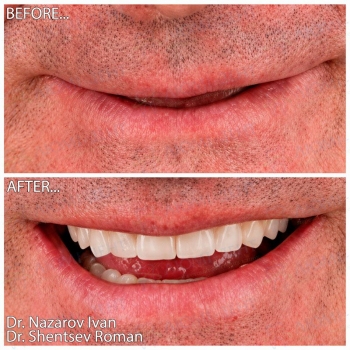
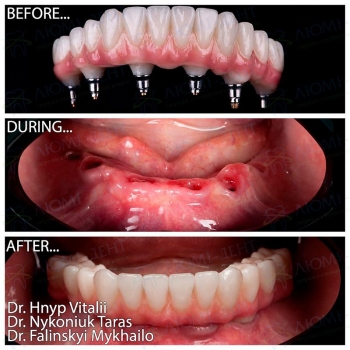
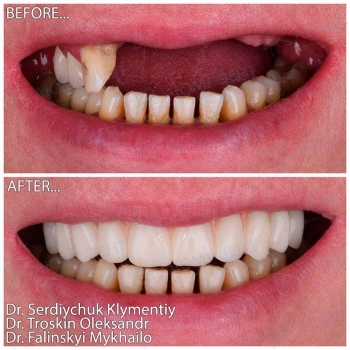
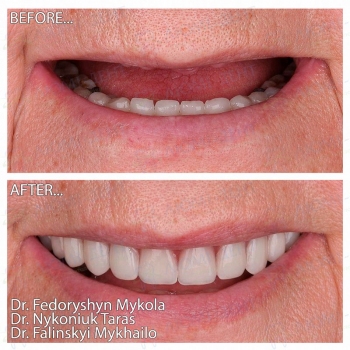
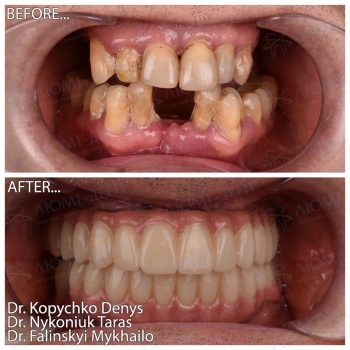
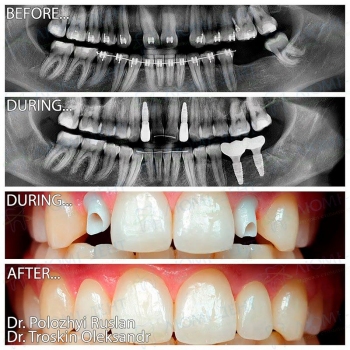
2. Production on the basis of 3-D scanning of an individual surgical template for precise insertion of dental implants into the jaw bone. Insertion of dental implants using a surgical template.
3. In the absence of the necessary amount of bone at the area of the insertion of the implants - the production of platelet clots from the patient's own blood (IPRF technology, upper image) is used, and artificial bone can be infused (bone grafting, lower image).
4. Overlaying the membrane and suturing the mucous membrane at the area of operation. After a couple of months, the patient will already chew with these teeth.
5. Final result after 2,5 months. Total collage of all steps
Clinical case 1
Complaints:
The patient presented with an inability to chew food properly, significant psychological discomfort while speaking and smiling, and poor retention of removable dentures. The instability of the prostheses considerably reduced the patient’s quality of life.
Diagnosis:
Complete secondary edentulism of both the upper and lower jaws.
Treatment:
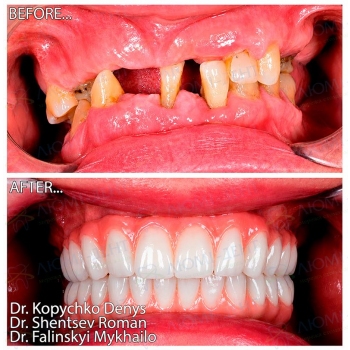
After comprehensive diagnostics, including CBCT imaging, a digital photo protocol, and 3Shape intraoral scanning, a decision was made to perform full-mouth rehabilitation of both jaws using the All-on-6 concept. The surgical stage was carried out under intravenous sedation with continuous anesthesiologist supervision. Twelve Straumann implants were placed — six in each jaw — providing excellent stability for the future restorations. On the day of surgery, temporary prostheses supported by custom titanium bars were delivered according to the immediate loading protocol, allowing the patient to restore chewing function immediately. Six months later, after complete osseointegration of the implants, definitive full-arch zirconia restorations reinforced with custom titanium bars were fabricated and fixed. To achieve a natural aesthetic outcome, a pink esthetics approach was used, restoring harmonious smile contours and facial proportions.
In this case, the patient was unable to comfortably use removable dentures because they lacked proper retention, made chewing difficult, and caused psychological discomfort during conversations and smiling.
Following comprehensive diagnostics, including CBCT imaging, a digital photo protocol, and 3Shape scanning, a decision was made to fully restore both dental arches using the All-on-6 concept.
12 Straumann implants were placed — six in each jaw — and temporary fixed prostheses supported by custom titanium bars were attached on the day of surgery.
After successful osseointegration, the temporary restorations were replaced with permanent zirconia prostheses secured with screw retention.
Pink aesthetic elements were incorporated to achieve a natural appearance and restore harmonious smile contours.
Result:
The patient received fixed dental arches in both jaws, restored chewing function, improved smile aesthetics, and renewed confidence in everyday communication.
If removable dentures do not fit securely and make eating difficult, implant-supported fixed teeth may be a reliable alternative.
Learn more about full-mouth rehabilitation with the All-on-6 protocol.
Treatment performed by:
Surgical treatment performed by implant surgeon Ivan Nazarov.
Prosthetic treatment performed by prosthodontist Roman Shentsev.
Clinical case 2
Complaints:
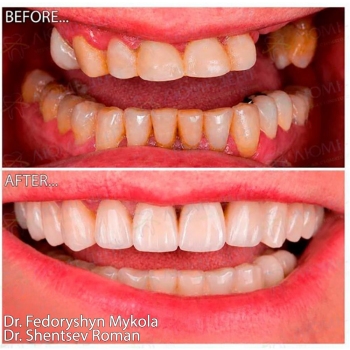
Unsatisfactory smile esthetics, excessive tooth wear, and missing posterior teeth resulting in significantly impaired chewing function.
Diagnosis:
Secondary partial edentulism (teeth 2.6, 3.6, and 4.6). Pathological wear of the hard dental tissues. Occlusal disharmony of the stomatognathic system.
Treatment:
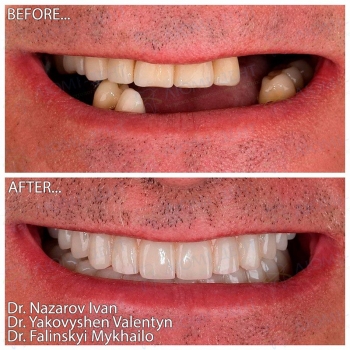
To address this complex clinical case, a comprehensive treatment approach combining surgical, prosthetic, and gnathological therapy was implemented. During the planning stage, a detailed gnathological assessment was performed to determine the correct centric jaw relationship, analyze mandibular movements, and accurately calculate the new vertical dimension of occlusion (bite elevation). During the surgical stage, Swiss Nobel Biocare implants were placed in the areas of the missing teeth (2.6, 3.6, and 4.6). Soft tissue augmentation was also performed using connective tissue grafts (CTG) to increase gingival thickness. After 4 months, implant osseointegration was confirmed, and healing abutments were placed. During the final prosthetic stage, ceramic veneers were fabricated to restore the natural teeth, while zirconia crowns were fixed onto the implants. Full-mouth prosthetic rehabilitation was completed according to the findings of the gnathological analysis, including restoration of the vertical dimension of occlusion. This approach restored proper chewing function and achieved ideal articulation and occlusal harmony.
In this case, the patient was concerned not only about the absence of several chewing teeth but also about severe tooth wear of the remaining teeth, which had led to bite dysfunction and reduced chewing efficiency.
For this reason, treatment required a comprehensive approach involving a gnathologist, implant surgeon, and prosthodontist.
Before treatment, a gnathological assessment was performed to determine the correct jaw position and plan restoration of the proper bite height.
To replace the missing teeth, Nobel Biocare implants were placed in the areas of teeth 2.6, 3.6, and 4.6. At the same time, soft tissue augmentation with connective tissue grafts was performed to improve the condition of the gums around the future restorations.
After successful osseointegration, full-mouth prosthetic rehabilitation was completed: the patient's natural teeth were restored with ceramic veneers, while zirconia crowns were fixed on the implants.
The treatment was carried out according to the findings of the gnathological assessment and included restoration of the proper vertical dimension of occlusion.
Result:
Missing teeth, chewing function, and smile aesthetics were successfully restored.
It was also possible to normalize the function of the stomatognathic system, restore the correct bite height, and establish harmonious occlusal contacts.
If your teeth are wearing down and missing chewing teeth are affecting your bite, it is important to address not only the visible defects but also the underlying cause of functional problems.
Learn more about implant-supported tooth restoration and comprehensive prosthetic rehabilitation.
Treatment performed by:
Surgical treatment performed by oral and implant surgeon Mykola Fedoryshyn
Prosthetic treatment performed by prosthodontist Taras Nykoniuk
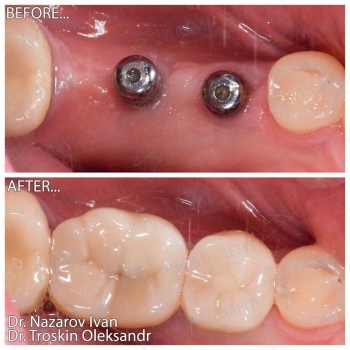
During the diagnostic stage, a computed tomography (CT) scan was performed. Based on the diagnostic findings, 3D treatment planning was completed. An intraoral digital scan of the jaws was performed using a 3Shape scanner, and a surgical navigation guide was fabricated. During the surgical stage, Korean MegaGen AnyRidge implants were placed in the areas of the missing teeth (3.5 and 3.6). During the same procedure, healing abutments were installed, and soft tissue grafting was performed to ensure long-term functionality and optimal esthetics of the future prosthetic restorations. After 3 months, implant osseointegration and soft tissue stability were evaluated. During the prosthetic stage, permanent laboratory-fabricated zirconia crowns were fixed onto the implants.
In this case, the absence of two chewing teeth in the lower jaw led to reduced chewing efficiency and uneven distribution of load on the remaining teeth.
To restore function, it was decided to replace the missing teeth using dental implants.
After CBCT imaging, 3Shape digital scanning, and 3D treatment planning, a surgical navigation guide was fabricated, allowing precise placement of MegaGen AnyRidge implants in the areas of teeth 3.5 and 3.6.
At the same time as implant placement, soft tissue augmentation was performed, and healing abutments were installed to create optimal conditions for future prosthetic restoration.
After successful osseointegration, permanent laboratory-fabricated zirconia crowns were fixed onto the implants.
Result:
The missing chewing teeth were restored, chewing load was normalized, and further disruption of the stomatognathic system was prevented.
The new implant-supported crowns provided comfort, stability, and a natural appearance.
Even the loss of just a few chewing teeth can eventually affect the load distribution throughout the entire dental system.
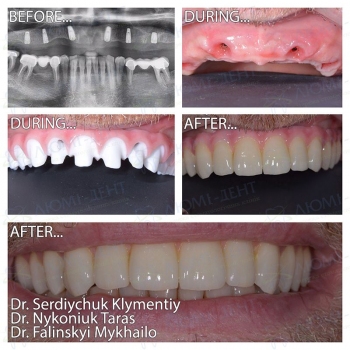
Complete absence of teeth in the upper jaw, impaired chewing ability, difficulty eating hard foods, esthetic concerns, and intermittent discomfort and tension in the temporomandibular joints (TMJs).
Diagnosis:
Secondary edentulism of the upper jaw. Reduced vertical dimension of occlusion. Disturbed occlusal relationships. Functional disorders of the temporomandibular joints.
Treatment:
The diagnostic phase included CBCT imaging, 3Shape intraoral scanning, occlusal analysis, and a gnathological assessment. Based on the findings, digital 3D implant planning was performed and a customized surgical guide was fabricated. Under general anesthesia, full rehabilitation of the upper jaw was completed using the All-on-6 concept with MegaGen AnyRidge implants. A temporary fixed prosthesis reinforced with a titanium bar was delivered on the day of surgery according to the immediate loading protocol, restoring both smile aesthetics and chewing function immediately. After 6 months of successful osseointegration, a definitive zirconia restoration reinforced with a custom titanium bar and screw-retained fixation was placed. The treatment restored proper occlusion, improved TMJ function, and achieved a stable aesthetic result.
In this case, complete tooth loss in the upper jaw resulted not only in impaired chewing function and smile aesthetics but also in a reduced vertical dimension of occlusion, creating additional stress on the temporomandibular joints.
Therefore, special attention was paid to gnathological assessment and occlusal analysis before treatment.
Following CBCT imaging, 3Shape digital scanning, and 3D treatment planning, upper jaw rehabilitation was performed using the All-on-6 protocol with MegaGen AnyRidge implants.
To ensure precise implant placement, an individual surgical navigation guide was fabricated.
A temporary fixed prosthesis on a titanium bar was delivered on the day of surgery, allowing the patient to immediately regain chewing function and smile aesthetics.
Six months after successful osseointegration, the temporary restoration was replaced with a permanent zirconia prosthesis on a custom titanium bar with screw retention.
Result:
The upper dentition, proper vertical dimension of occlusion, chewing function, and smile aesthetics were fully restored.
It was also possible to normalize occlusal relationships and improve temporomandibular joint function.
When all teeth are missing, it is important to restore not only the smile but also the proper function of the entire stomatognathic system.
Learn more about tooth restoration with the All-on-6 protocol.
Who performed the treatment:
Surgical treatment was performed by oral surgeon and implantologist Klymentii Serdiichuk
Prosthetic treatment was performed by prosthodontist Taras Nykoniuk
Gnathological supervision was provided by gnathologist Mykhailo Falinskyi
Clinical case 5
Complaints:
Missing teeth and inability to chew food properly.
Diagnosis:
Acquired edentulism of the upper and lower jaws.
Treatment:
During the diagnostic stage, a computed tomography (CT) scan was performed. Based on the diagnostic findings, the patient was offered full-mouth rehabilitation with implant placement and removable overdentures supported by bar-retained attachments. 3D treatment planning was completed, intraoral digital scanning of the jaws was performed using a 3Shape scanner, and surgical navigation guides were fabricated. During the surgical stage, under general anesthesia, Korean MegaGen AnyRidge implants were placed (four implants in each jaw). After 3 months, the implants were evaluated for successful osseointegration, multi-unit abutments were installed, and the stability of the surrounding soft tissues was assessed. Custom milled titanium bars were fixed, and acrylic removable overdentures were fabricated. This retention system provides secure stability of the prostheses during chewing and speaking while also ensuring a natural and esthetic appearance.
In this case, the complete absence of teeth in both jaws prevented the patient from chewing properly and significantly reduced their quality of life.
To restore function and ensure reliable denture retention, a full-mouth rehabilitation supported by dental implants was chosen.
Following CBCT imaging, 3Shape digital scanning, and 3D treatment planning, four MegaGen AnyRidge implants were placed in each jaw under general anesthesia.
After osseointegration was completed, custom-milled titanium bars were fixed onto the implants, supporting removable overdentures.
This type of restoration combines secure implant retention, comfort while eating and speaking, and convenient daily hygiene.
Result:
The patient received stable implant-retained dentures, restored chewing function, and a natural-looking smile.
If conventional removable dentures are unstable and uncomfortable, implant-supported restorations may provide a more reliable solution.
Learn more about implant-supported prosthetics for complete tooth loss.
Who performed the treatment:
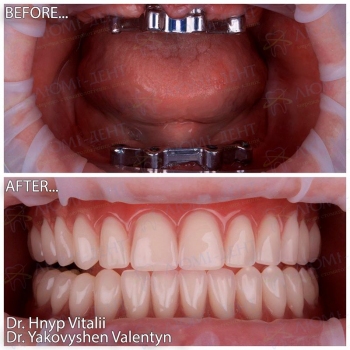
The surgical stage was performed by implantologist Hnyp Vitalii.
Inability to chew food properly and unsatisfactory esthetics.
Diagnosis:
Secondary edentulism of the upper jaw.
Treatment:
During the diagnostic stage, a computed tomography (CT) scan was performed, based on which the patient was offered full-arch implant rehabilitation using the All-on-6 concept. Digital 3D smile planning was completed, intraoral scanning of the jaws was performed using a 3Shape scanner, and a custom surgical navigation guide was fabricated. To eliminate emotional stress and ensure complete physical comfort, the surgical stage was carried out under general anesthesia with continuous monitoring by an anesthesiologist. Korean Neobiotech implants were placed according to the All-on-6 protocol, combined with simultaneous bone augmentation to create a stable foundation for the future prosthetic restoration. After 6 months, implant osseointegration and soft tissue stability were evaluated. Following successful healing, a permanent high-quality fixed zirconia prosthesis (FP3 type), reinforced with a custom laboratory-fabricated titanium bar, was delivered. The use of these precision technologies made it possible to achieve excellent esthetics and complete restoration of masticatory function.
In this case, the complete absence of teeth in the upper jaw not only caused severe chewing difficulties but also negatively affected the appearance of the patient's smile.
To restore both function and aesthetics, a full-arch implant rehabilitation using the All-on-6 concept was selected.
Following CBCT imaging, 3Shape digital scanning, and 3D treatment planning, a custom surgical navigation guide was fabricated.
The surgical procedure was performed under sedation with placement of six Neobiotech implants.
At the same time, bone grafting was carried out to create sufficient tissue volume and a stable foundation for the future restoration.
Six months after osseointegration, a permanent fixed FP3 zirconia prosthesis on a custom titanium bar was fabricated and delivered.
Result:
The patient regained teeth in the upper jaw, full chewing function, and an attractive smile.
The fixed restoration provided reliable stability, comfort, and a natural appearance.
Even in cases of complete tooth loss and significant bone deficiency, fixed implant-supported teeth can often be restored.
Learn more about treatment with the All-on-6 protocol and implant-supported prosthetics.
Treatment team:
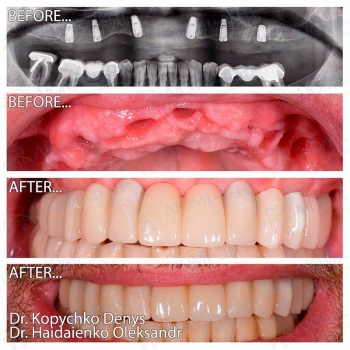
Surgical treatment was performed by implant surgeon Denys Kopychko.
Inability to chew food properly, reduced vertical dimension of occlusion, tooth mobility, bad breath, and an unesthetic smile.
Diagnosis:
Stage II–III periodontitis, acquired edentulism of the upper and lower jaws, impaired occlusal stability, and dysfunction of the stomatognathic system.
Treatment:
The diagnostic phase included CBCT imaging, a gnathological assessment, 3Shape intraoral scanning, and digital 3D treatment planning. Custom surgical guides were fabricated for full-mouth rehabilitation of both jaws using the All-on-4 concept. Under sedation, all hopeless teeth were extracted and eight Straumann implants were placed immediately according to the All-on-4 protocol. Temporary prostheses supported by titanium bars were delivered on the day of surgery, restoring both smile aesthetics and chewing function. After 6 months of successful osseointegration, the temporary prostheses were replaced with definitive zirconia restorations reinforced with custom titanium bars and screw-retained fixation. As a result, full oral function, TMJ performance, and smile aesthetics were successfully restored.
In this case, the patient was affected not only by missing teeth and the inability to chew properly, but also by severe consequences of periodontitis, including tooth mobility, reduced bite height, persistent bad breath, and a significant deterioration of smile aesthetics.
Preserving the remaining teeth and restoring function through localized treatment was no longer possible.
Following CBCT imaging, gnathological evaluation, 3Shape digital scanning, and 3D treatment planning, a full rehabilitation of both jaws using the All-on-4 concept was selected.
Under sedation, hopeless teeth were extracted and eight Straumann implants were placed immediately using custom surgical navigation guides.
Temporary fixed prostheses on titanium bars were delivered on the same day as the surgery.
Six months after osseointegration, the temporary restorations were replaced with permanent zirconia prostheses on custom titanium bars with screw retention.
Result:
The patient received fully restored dental arches, proper bite height, stable chewing function, and an attractive smile.
The treatment also helped normalize temporomandibular joint function and eliminate discomfort associated with periodontitis.
Even in severe cases of periodontitis and extensive tooth loss, successful rehabilitation is possible.
Learn more about the All-on-4 protocol and full-mouth implant rehabilitation.
Treatment team:
Surgical treatment was performed by implant surgeon Andrii Zraievskyi
Prosthetic treatment was performed by prosthodontist Roman Shentsev
Gnathological supervision was provided by gnathologist Mykhailo Falinskyi
Clinical case 8
Complaints:
Unesthetic appearance of the smile, difficulty chewing food, tooth mobility, and reduced vertical dimension of occlusion.
Diagnosis:
Generalized Stage II–III periodontitis affecting both the upper and lower jaws, impaired occlusal stability, and functional imbalance of the stomatognathic system.
Treatment:
The diagnostic phase included CBCT imaging, a gnathological assessment, 3Shape intraoral scanning, and digital 3D planning. Custom surgical guides were fabricated to ensure precise implant placement. Under sedation, teeth affected by periodontitis were extracted and Neobiotech implants were placed immediately according to the All-on-4 concept. Temporary fixed prostheses reinforced with a titanium bar were delivered on the day of surgery, restoring both smile aesthetics and chewing function. After 6 months of successful osseointegration, the temporary restorations were replaced with definitive zirconia prostheses reinforced with custom titanium bars and screw-retained fixation. As a result, full oral function and smile aesthetics were successfully restored.
In this case, the patient sought treatment not only because of aesthetic concerns, but also due to the severe consequences of generalized periodontitis, including tooth mobility, reduced bite height, and impaired chewing function.
Due to the extensive periodontal destruction, preserving the remaining teeth and restoring function with localized treatment was no longer possible.
After CBCT imaging, gnathological analysis, 3Shape digital scanning, and 3D treatment planning, a full-arch rehabilitation of both jaws using the All-on-4 concept was selected.
Under sedation, the periodontally compromised teeth were extracted and Neobiotech implants were placed immediately using custom surgical guides.
Temporary fixed prostheses on titanium bars were delivered on the day of surgery.
Six months after successful osseointegration, the temporary restorations were replaced with permanent zirconia prostheses on custom titanium bars with screw-retained fixation.
Result:
The dental arches, chewing function, proper bite height, and smile aesthetics were fully restored.
The patient received stable fixed restorations and regained the ability to eat comfortably without limitations.
Even in cases of advanced periodontitis, modern implant treatment protocols can restore teeth after the removal of hopeless teeth.
Learn more about All-on-4 treatment and implant-supported prosthetics.
Treatment team:
Surgical treatment was performed by oral and implant surgeon Ivan Nazarov.
Gnathological supervision was provided by gnathologist Mykhailo Falinskyi.
Clinical case 9
Complaints:
The patient complained about the absence of teeth on the lower jaw after the preliminary removal of all teeth. He noted the impossibility of chewing food normally, impaired masticatory function, discomfort while eating and increased load on the temporomandibular joints. The aesthetic defect of the lower third of the face and the lack of stable fixation of prosthetics were also of concern.
Diagnosis:
Complete secondary adentia of the lower jaw. Atrophic changes in the bone tissue of the lower jaw. Occlusion disorders and reduced chewing efficiency with functional overload of the temporomandibular joints.
Treatment:
This clinical case required a multidisciplinary approach involving an implant surgeon, prosthodontist, and gnathologist. Due to the long-term absence of teeth, special attention was paid to the analysis of occlusion and temporomandibular joint function. Following a comprehensive diagnostic evaluation, including computed tomography (CT) and digital 3D treatment planning, full rehabilitation of the lower jaw using the All-on-6 concept with Straumann BLX Roxolid implants was selected. To ensure maximum accuracy, a custom surgical navigation guide was used. Six implants were placed in strategically planned positions, and a temporary fixed prosthesis with artificial gingiva was delivered immediately after surgery, allowing the patient to regain esthetics and masticatory function on the same day. Six months later, after successful osseointegration and confirmation of soft tissue stability, the temporary restoration was replaced with a permanent zirconia prosthesis reinforced with a custom titanium bar and supported by six implants. As a result, masticatory function was fully restored, occlusal relationships were normalized, and a harmonious esthetic smile was achieved.
In this case, long-term tooth loss in the lower jaw led not only to the inability to chew food properly but also to bite dysfunction, overload of the temporomandibular joints, and changes in the proportions of the lower third of the face.
Therefore, treatment required a comprehensive approach involving a gnathologist, implant surgeon, and prosthodontist.
After CBCT imaging and digital 3D planning, full rehabilitation of the lower jaw was performed using the All-on-6 concept on Straumann BLX Roxolid implants.
An individual surgical navigation guide was used for precise implant placement.
A temporary fixed prosthesis with artificial gum was secured on the day of surgery, allowing immediate restoration of aesthetics and chewing function.
Six months after successful osseointegration, the temporary restoration was replaced with a permanent zirconia prosthesis on an individual titanium bar with screw retention.
Result:
Teeth in the lower jaw, chewing function, proper occlusal relationships, and smile aesthetics were restored.
The patient received a stable fixed restoration and the ability to eat comfortably without restrictions.
In cases of complete tooth loss in one jaw, modern implant protocols make it possible to restore function and aesthetics even with severe tissue atrophy.
Learn more about tooth restoration using the All-on-6 protocol.
Treatment team:
Surgical treatment was performed by oral and implant surgeon Vitalii Hnyp
Prosthetic treatment was performed by prosthodontist Taras Nykoniuk
Gnathological supervision was provided by gnathologist Mykhailo Falinskyi
Clinical case 10
Complaints:
Lack of teeth in the upper jaw, mobility of teeth, difficulty chewing food.
Diagnosis:
Generalized periodontitis of the II–III degree on the upper and lower jaws.
Treatment:
During the diagnostic stage, the patient underwent computed tomography (CT), a gnathological analysis to determine the centric jaw relationship, intraoral digital scanning with a 3Shape scanner, and 3D planning of the future rehabilitation. Based on the collected data, a surgical navigation guide was fabricated. The surgical stage was performed under general anesthesia. Following the atraumatic extraction of all periodontally compromised teeth in the upper jaw, six Neodent implants were placed immediately according to the All-on-6 concept using the navigation guide. To improve esthetics and soft tissue stability, soft tissue grafting was performed using a connective tissue graft (CTG). Immediately after surgery, a temporary fixed prosthesis supported by a titanium bar was delivered, allowing the patient to regain esthetics and basic chewing function on the same day. Six months later, after successful osseointegration and soft tissue maturation, the temporary restoration was replaced with a permanent zirconia prosthesis reinforced with a custom titanium bar and fixed on six implants. As a result, full masticatory function was restored, temporomandibular joint function was harmonized, and a stable esthetic outcome was achieved.
In this case, the patient sought treatment due to tooth mobility, difficulty chewing, and severe destruction of the periodontal tissues.
Because of advanced periodontitis, preserving the upper jaw teeth and restoring function with localized treatment was no longer possible.
Following CT diagnostics, gnathological analysis, 3Shape digital scanning, and 3D treatment planning, a full upper jaw rehabilitation using the All-on-6 concept was selected.
Under general anesthesia, teeth affected by periodontitis were extracted and six Neodent implants were placed immediately using a custom surgical guide.
To improve soft tissue conditions, additional gum augmentation with a connective tissue graft was performed.
A temporary fixed prosthesis on a titanium bar was delivered on the day of surgery, and after 6 months it was replaced with a permanent zirconia restoration on a custom titanium bar with screw retention.
Result:
The patient received stable fixed teeth in the upper jaw, restored chewing function, and improved smile aesthetics.
Proper occlusal relationships were re-established, creating favorable conditions for comfortable function of the entire stomatognathic system.
Even in severe cases of periodontitis, modern implant treatment protocols can restore teeth after extraction of hopeless teeth.
Learn more about treatment with the All-on-6 protocol and implant rehabilitation for periodontitis.
Treatment team:
Surgical treatment was performed by oral and implant surgeon Klymentii Serdiichuk
Prosthetic treatment was performed by prosthodontist Oleksandr Troskin
Gnathological supervision was provided by gnathologist Mykhailo Falinskyi
Clinical case 11
Complaints:
Missing teeth, inability to chew food properly, and pain in the temporomandibular joint.
Diagnosis:
Secondary edentulism of the upper jaw.
Treatment:
During the diagnostic stage, a computed tomography (CT) scan was performed. Based on the findings, the patient was offered full-arch implant rehabilitation using the All-on-4 concept. A 3D treatment plan was created. Intraoral digital scanning of the jaws was performed using a 3Shape scanner, and a surgical navigation guide was fabricated. In addition, a gnathological analysis was carried out to correct occlusal relationships, stabilize the mandibular position, and reduce excessive loading on the temporomandibular joint. Korean MegaGen AnyRidge implants were placed according to the All-on-4 protocol. Immediate loading of the four implants was performed using a temporary prosthesis reinforced with a titanium bar during the osseointegration period, allowing the patient to immediately regain esthetics and masticatory function. After 6 months, implant osseointegration and soft tissue stability were evaluated. Following successful implant integration, a permanent zirconia prosthesis reinforced with a custom titanium bar was fixed using screw-retained fixation and supported by four implants.
In this case, the absence of teeth in the upper jaw was accompanied not only by an inability to chew food properly, but also by pain in the temporomandibular joint area.
Therefore, the treatment was aimed not only at restoring the teeth, but also at normalizing occlusal relationships.
After CT imaging, 3Shape digital scanning, 3D treatment planning, and gnathological analysis, rehabilitation was performed according to the All-on-4 concept using MegaGen AnyRidge implants.
An individual surgical guide was fabricated to ensure precise implant placement.
On the day of surgery, the patient received a temporary fixed prosthesis on a titanium bar, which immediately restored both smile aesthetics and chewing function.
After 6 months of successful osseointegration, the temporary restoration was replaced with a permanent zirconia prosthesis on a custom titanium bar with screw retention.
Result:
The upper jaw teeth, chewing function, and smile aesthetics were fully restored.
It was also possible to stabilize the bite and reduce the load on the temporomandibular joint.
TMJ pain and missing teeth are often interconnected and require a comprehensive treatment approach.
Learn more about tooth restoration with the All-on-4 protocol.
Esthetic defect, missing teeth, difficulty biting food, and tooth mobility.
Diagnosis:
Generalized Stage II–III periodontitis affecting both the upper and lower jaws, impaired occlusal stability, and functional imbalance of the stomatognathic system.
Treatment:
During the diagnostic stage, a computed tomography (CT) scan and a gnathological assessment were performed to analyze jaw relationships, determine a functionally stable mandibular position, and predict the occlusal balance of the future restorations. Based on the collected data, 3D treatment planning, intraoral scanning with a 3Shape scanner, and fabrication of custom surgical navigation guides for both jaws were completed. The surgical stage was performed under sedation. Following the atraumatic extraction of all teeth affected by periodontitis, Neobiotech implants were placed immediately according to the All-on-4 protocol using surgical navigation guides. Temporary fixed prostheses supported by titanium bars were delivered immediately after surgery, allowing the patient to fully regain esthetics and chewing function on the same day. After 6 months, successful osseointegration and soft tissue stability were confirmed. The temporary restorations were replaced with permanent zirconia prostheses reinforced with custom titanium bars and secured with screw-retained fixation. This approach restored functional balance of the stomatognathic system, improved temporomandibular joint function, and achieved a stable esthetic outcome in both jaws.
In this case, the patient's concerns included tooth mobility, missing teeth, and a significant deterioration in smile aesthetics caused by severe generalized periodontitis.
Due to the extensive destruction of the periodontal tissues, preserving the remaining teeth and restoring function with conservative treatment methods was no longer possible.
Following CT imaging, gnathological diagnostics, 3Shape digital scanning, and 3D treatment planning, full rehabilitation of both jaws using the All-on-4 concept was selected.
Under sedation, atraumatic tooth extraction was performed for teeth affected by periodontitis, followed by immediate placement of Neobiotech implants using custom surgical guides.
Temporary fixed prostheses on titanium bars were secured on the day of surgery, immediately restoring smile aesthetics and chewing function.
After 6 months of successful osseointegration, the temporary restorations were replaced with permanent zirconia prostheses on custom titanium bars with screw retention.
Result:
The dental arches of both jaws, chewing function, smile aesthetics, and proper occlusal relationships were restored.
The patient received stable fixed restorations and regained comfort in everyday life.
Even in cases of severe periodontitis and multiple tooth loss, modern treatment protocols can provide successful rehabilitation in complex clinical situations.
Learn more about treatment with the All-on-4 protocol and implant rehabilitation for periodontitis.
Unesthetic appearance of the smile and reduced chewing efficiency.
Diagnosis:
Partial acquired edentulism of the upper and lower jaws.
Treatment:
During the consultation stage, a computed tomography (CT) scan was performed using a Vatech dental CT scanner. Based on the diagnostic findings, the patient was offered a comprehensive rehabilitation combining surgical and prosthetic treatment. In addition, a gnathological analysis was carried out to evaluate intermaxillary relationships, determine a stable occlusal position, and predict an even distribution of masticatory forces. An intraoral digital scan of the jaws was performed using a 3Shape scanner, followed by 3D planning of the future smile. Custom surgical navigation guides were fabricated. During the surgical stage, Brazilian Neodent implants were placed in the regions of teeth 1.7, 1.5, 1.4, 1.3, 1.1, 4.4, and 4.6. Where indicated, bone augmentation was performed, including a closed crestal sinus lift using Bio-Oss xenogeneic bone graft material. After 6 months, the implants were evaluated for successful osseointegration and soft tissue stability. Healing abutments were placed, followed by comprehensive prosthetic rehabilitation involving both implants and natural teeth. Ceramic restorations were fabricated for the anterior teeth, while zirconia crowns were placed on the implants.
In this case, the patient was concerned about several missing teeth, reduced chewing efficiency, and an unsatisfactory smile appearance.
To restore both function and aesthetics, comprehensive treatment combining dental implants and prosthetic rehabilitation of the natural teeth was required.
Following CBCT imaging, gnathological analysis, 3Shape digital scanning, and 3D treatment planning, individual surgical guides were fabricated.
To replace the missing teeth, Neodent implants were placed in both the posterior and anterior regions of the jaws.
In areas with insufficient bone volume, a closed sinus lift was additionally performed using Bio-Oss bone grafting material.
After successful osseointegration, healing abutments were installed and comprehensive prosthetic treatment was completed.
Ceramic restorations were fabricated for the natural teeth, while zirconia crowns were placed on the implants, restoring complete dental arches and smile harmony.
Result:
Missing teeth, chewing function, and smile aesthetics were successfully restored.
The combination of implant treatment and modern prosthetics provided a stable functional and aesthetic outcome.
When several teeth are missing, treatment may involve not only implant placement but also comprehensive rehabilitation of the entire dental system.
Learn more about dental implants and implant-supported prosthetics.
Who performed the treatment:
Surgical treatment was performed by oral and implant surgeon Vitalii Hnyp
Prosthetic treatment was performed by prosthodontist Oleksandr Troskin
Gnathological supervision was provided by gnathologist Mykhailo Falinskyi
Clinical case 14
Complaints:
Unsatisfactory smile esthetics and missing teeth.
Diagnosis:
Secondary partial edentulism (teeth 2.4 and 2.5).
Treatment:
During the consultation stage, a computed tomography (CT) scan was performed. Based on the diagnostic findings, the patient was offered a comprehensive rehabilitation combining surgical and prosthetic treatment. An intraoral digital scan of the jaws was performed using a 3Shape scanner, and a 3D design of the future smile was created. A surgical navigation guide was fabricated. During the surgical stage, Swiss Straumann BLT Roxolid implants were placed in the areas of the missing teeth (2.4 and 2.5). Soft tissue grafting was performed during the procedure to ensure long-term functionality and optimal esthetics of the future prosthetic restorations. After 4 months, the implants were evaluated for successful osseointegration, and gingival formers (healing abutments) were placed. At the final stage, comprehensive prosthetic rehabilitation was completed: ceramic veneers were fabricated to restore the natural teeth, while zirconia crowns were fixed on the implants.
In this case, the patient was concerned about missing teeth and compromised smile aesthetics.
To achieve the most natural-looking result, treatment was planned to address both the replacement of missing teeth and the improvement of the appearance of the remaining natural teeth.
After CT imaging, 3Shape digital scanning, and 3D treatment planning, an individual surgical guide was fabricated.
Straumann BLT Roxolidimplants were placed in the areas of teeth 2.4 and 2.5, while soft tissue grafting was performed simultaneously to create a harmonious gingival contour.
After successful osseointegration, healing abutments were installed and comprehensive prosthetic rehabilitation was completed.
The patient's natural teeth were restored with ceramic veneers, while zirconia crowns were placed on the implants, creating a unified smile appearance and a natural-looking result.
Result:
Missing teeth, chewing function, and smile harmony were successfully restored.
The combination of implant treatment and ceramic restorations provided a natural-looking and long-term aesthetic outcome.
To achieve a beautiful smile, it is often important to restore not only missing teeth but also the harmony of the entire dental arch.
Surgical treatment was performed by oral and implant surgeon Andrii Zraievskyi
Prosthetic treatment was performed by prosthodontist Roman Shentsev
Clinical case 15
Complaints:
Unesthetic appearance of the smile, tooth mobility in both the upper and lower jaws, and bad breath.
Diagnosis:
Generalized Stage III periodontitis, acquired secondary edentulism, and impaired functional balance of the stomatognathic system.
Treatment:
During the diagnostic stage, the patient underwent computed tomography (CT) and a gnathological assessment with analysis of jaw positioning. This evaluation revealed unstable occlusal contacts and helped determine the functionally optimal mandibular position for the future rehabilitation. Based on the diagnostic findings and digital 3D planning, full-arch rehabilitation of both the upper and lower jaws using the All-on-6 concept with Swiss Straumann implants was selected as the treatment approach. To ensure highly accurate implant placement, intraoral digital scanning of the jaws was performed using a 3Shape scanner, and custom surgical navigation guides were fabricated. The entire surgical procedure was carried out under intravenous sedation with continuous monitoring by an anesthesiologist, providing the patient with complete physical and emotional comfort throughout the extensive treatment. The procedure began with the atraumatic extraction of all teeth affected by periodontitis in both jaws, followed by thorough antiseptic treatment of the surgical sites and immediate placement of 12 implants. Immediately after surgery, an immediate-loading protocol was implemented by fixing temporary fixed prostheses reinforced with titanium bars, allowing the patient to restore esthetics and function on the same day.
In this case, the patient sought treatment due to severe periodontitis, tooth mobility, persistent bad breath, and significant impairment of smile aesthetics.
Due to extensive loss of supporting tissues, preserving the remaining teeth and restoring function with conservative treatment methods was no longer possible.
Following CT imaging, gnathological diagnostics, 3Shape digital scanning, and 3D treatment planning, a full rehabilitation of both jaws was planned using the All-on-6 concept supported by Straumann implants.
Custom surgical guides were fabricated to ensure precise implant placement.
Under intravenous sedation, the teeth affected by periodontitis were atraumatically extracted and 12 implants were placed immediately — six implants in each jaw.
Temporary fixed prostheses supported by titanium bars were delivered on the day of surgery according to the immediate loading protocol, allowing immediate restoration of smile aesthetics and chewing function.
Result:
The patient received fixed teeth in both the upper and lower jaws, restored chewing function, and an attractive smile.
The consequences of advanced periodontitis were eliminated, creating a stable foundation for long-term oral rehabilitation.
Even in severe cases of periodontitis, modern implant dentistry can restore teeth after complete tooth loss.
Learn more about treatment with the All-on-6 protocol and dental implant rehabilitation for periodontitis.
Who performed the treatment:
Surgical treatment was performed by oral and implant surgeon Ivan Nazarov.
Gnathological supervision was provided by gnathologist Mykhailo Falinskyi.
Clinical case 16
Complaints:
The patient presented with concerns about an esthetic defect caused by misaligned teeth, missing posterior teeth in the lower jaw, and missing anterior teeth in the upper jaw. The patient also reported pain and clicking in the temporomandibular joint (TMJ) area.
Diagnosis:
Secondary edentulism of teeth 1.2, 2.2, 3.6, and 3.7. Disruption of dental arch integrity, reduced masticatory efficiency, and functional disorders of the temporomandibular joints.
Treatment:
A comprehensive treatment plan was developed and carried out in several stages. The first stage included a thorough oral examination, computed tomography (CT) to assess the condition of the bone tissue, and acquisition of digital models using a 3Shape scanner for planning the future smile. Following the diagnostic stage, orthodontic treatment was performed in collaboration with a gnathologist and an orthodontist to align the teeth, normalize occlusal relationships, and eliminate functional disorders of the temporomandibular joints. The next stage involved extraction of the wisdom tooth and placement of Straumann implants in the areas of the missing teeth (1.2, 2.2, 3.6, and 3.7). To ensure maximum accuracy and a predictable outcome, a custom surgical navigation guide was used. The final stage consisted of prosthetic rehabilitation with zirconia restorations supported by the implants. As a result, full restoration of masticatory efficiency and dental arch integrity was achieved. Pain and clicking in the temporomandibular joint area were eliminated, and the patient obtained a harmonious, esthetic, and natural-looking smile.
In this case, the patient was concerned about several missing teeth, impaired smile aesthetics, and discomfort in the temporomandibular joint area.
Therefore, treatment was aimed not only at replacing the missing teeth but also at restoring the proper function of the entire stomatognathic system.
Following comprehensive diagnostics including CT imaging, 3Shape digital scanning, and treatment planning, the first stage involved orthodontic treatment.
This made it possible to align the teeth, improve occlusal relationships, and reduce functional overload of the temporomandibular joints.
After completion of the preparatory stage, Straumann implants were placed in the areas of missing teeth 1.2, 2.2, 3.6, and 3.7 using a customized surgical guide.
At the final stage, prosthetic rehabilitation was completed with zirconia restorations supported by implants, restoring both the integrity of the dental arches and chewing function.
Result:
The missing teeth were restored, chewing dysfunction was eliminated, and aesthetic concerns were resolved.
The patient was also able to eliminate pain and clicking in the temporomandibular joint area and achieve a harmonious smile.
In some cases, dental implantation is only one part of comprehensive treatment that may also include orthodontic and gnathological preparation.
Learn more about dental implants and comprehensive oral rehabilitation.
Inability to chew food properly and an esthetic defect.
Diagnosis:
Stage II–III periodontitis, acquired edentulism of the upper and lower jaws, impaired occlusal stability, and dysfunctional changes of the stomatognathic system.
Treatment:
During the diagnostic stage, the patient underwent computed tomography (CT), a gnathological examination, intraoral digital scanning with a 3Shape scanner, and digital 3D smile planning. Based on the collected data, full-arch rehabilitation of both the upper and lower jaws using the All-on-6 concept was selected. Custom surgical navigation guides were fabricated to ensure precise implant placement. The surgical stage was performed under general anesthesia. Following the atraumatic extraction of all teeth affected by Stage II–III periodontitis, 12 Swiss Straumann BLX Roxolid implants were placed immediately. An open sinus lift procedure was additionally performed in the posterior maxilla using Probones bone graft material. Temporary fixed prostheses reinforced with titanium bars were placed immediately after surgery, allowing the patient to regain esthetics and masticatory function on the same day. Six months later, after successful osseointegration and soft tissue stability had been confirmed, multi-unit abutments were placed in the grafted areas (sites 1.6 and 2.6). The treatment was completed with the fixation of permanent zirconia prostheses reinforced with custom titanium bars and secured with screw-retained fixation. As a result, full masticatory function was restored, temporomandibular joint function was normalized, and a stable functional outcome was achieved.
In this case, the patient sought treatment due to multiple missing teeth, inability to chew food properly, and severe consequences of periodontitis.
Due to significant destruction of the supporting tissues, preserving the remaining teeth and restoring function with conservative treatment was no longer possible.
Following CT imaging, gnathological diagnostics, 3Shape digital scanning, and 3D treatment planning, a full-mouth rehabilitation of both jaws using the All-on-6 concept was selected.
Under general anesthesia, extraction of teeth affected by periodontitis was performed, followed by immediate placement of 12 Straumann BLX Roxolid implants.
An additional open sinus lift using Probones bone grafting material was carried out in the upper jaw to create reliable conditions for implant placement.
Temporary fixed prostheses on titanium bars were delivered on the day of surgery, allowing immediate restoration of smile aesthetics and chewing function.
After successful osseointegration, treatment was completed with permanent zirconia prostheses on custom titanium bars with screw-retained fixation.
Result:
The dental arches of both jaws were restored, along with full chewing function and smile aesthetics.
It was also possible to stabilize occlusal relationships and normalize temporomandibular joint function.
Even in cases of severe periodontitis and significant tooth loss, fixed teeth can be restored with dental implants.
Learn more about All-on-6 treatment, sinus lift procedures, and implant rehabilitation for periodontitis.
Tooth mobility, bad breath, and an esthetic defect.
Diagnosis:
Stage II–III periodontitis, impaired occlusal stability, and dysfunctional changes of the stomatognathic system.
Treatment:
During the diagnostic stage, a computed tomography (CT) scan was performed. Based on the diagnostic findings, the patient was offered full-arch implant rehabilitation using the All-on-4 concept. A 3D design of the future smile was created. An intraoral digital scan of the jaws was performed using a 3Shape scanner, and surgical navigation guides were fabricated. In addition, a gnathological analysis was carried out to assess the biomechanics of the masticatory system, establish the proper mandibular position, and create stable interarch contacts for the future prosthetic restoration. Under general anesthesia (medically induced sleep), Brazilian Neodent implants were placed according to the All-on-4 protocol. Immediate loading was performed with a temporary prosthesis reinforced with a titanium bar during the healing period, allowing the patient to immediately regain esthetics and function. After 6 months, the implants were evaluated for successful osseointegration, and the stability of the surrounding soft tissues was assessed. Permanent zirconia prostheses reinforced with a custom titanium bar were fixed using screw-retained fixation and supported by four implants.
In this case, the patient was concerned about tooth mobility, persistent bad breath, and significant smile aesthetic issues caused by severe periodontitis.
Due to the substantial loss of supporting tissues, preserving the remaining teeth and restoring function with localized treatment was no longer possible.
Following CT imaging, 3Shape digital scanning, 3D treatment planning, and gnathological analysis, a full-arch implant rehabilitation using the All-on-4 concept was selected.
Special attention was paid to restoring proper jaw relationships and ensuring stable function of the entire stomatognathic system.
Under general anesthesia, Neodent implants were placed, and a temporary fixed prosthesis on a titanium bar was delivered immediately, allowing restoration of smile aesthetics and chewing function on the day of surgery.
Six months after successful osseointegration, the temporary restoration was replaced with a permanent zirconia prosthesis on a custom titanium bar with screw-retained fixation.
Result:
The consequences of severe periodontitis were eliminated, chewing function, smile aesthetics, and stability of the stomatognathic system were restored.
The patient received a reliable fixed restoration and regained comfort in everyday life.
In cases of tooth mobility and advanced periodontitis, modern implant treatment makes it possible to restore teeth even after extraction of hopeless teeth.
Learn more about All-on-4 treatment and implant rehabilitation for periodontitis.
Treatment performed by:
The surgical stage was performed by oral and implant surgeon Vitalii Hnyp
Gnathological supervision was provided by gnathologist Mykhailo Falinskyi
Clinical case 19
Complaints:
Missing teeth in the upper jaw, difficulty chewing food, impaired smile esthetics, discomfort during chewing, and pain in the temporomandibular joints (TMJs).
Diagnosis:
Secondary edentulism of the upper jaw affecting the anterior and posterior segments. Reduced vertical dimension of occlusion. Pain in the temporomandibular joints. Decreased masticatory efficiency.
Treatment:
During the diagnostic stage, a computed tomography (CT) scan, intraoral scanning with a 3Shape scanner, and an occlusal analysis were performed. Due to the patient's complaints of joint pain, a gnathological assessment was carried out to determine a stable mandibular position and restore the physiological vertical dimension of occlusion. Based on the collected data, 3D treatment planning was completed and a custom surgical navigation guide was fabricated. During the surgical stage, under general anesthesia, full-arch rehabilitation of the upper jaw was performed using the All-on-6 concept with MegaGen AnyRidge implants and a previously placed implant. Thanks to excellent primary implant stability, an immediate-loading protocol with a temporary fixed prosthesis reinforced by a titanium bar was implemented, allowing the patient to immediately regain smile esthetics and chewing function. After the osseointegration period, successful implant integration and soft tissue stability were confirmed. During the final stage, a permanent zirconia prosthesis reinforced with a custom titanium bar was delivered and screw-retained on six implants. This approach restored proper occlusal relationships, stabilized temporomandibular joint function, and ensured full restoration of the stomatognathic system.
In this case, the absence of teeth in the upper jaw led not only to reduced chewing efficiency and impaired smile aesthetics, but also to a decrease in bite height, which was accompanied by pain in the temporomandibular joints.
Therefore, the treatment was aimed not only at restoring the teeth, but also at normalizing the function of the entire dentofacial system.
After CT imaging, 3Shape digital scanning, occlusal analysis, and gnathological diagnostics, a full rehabilitation of the upper jaw was performed using the All-on-6 protocol with MegaGen AnyRidge implants.
An individual surgical guide was fabricated to ensure precise implant placement.
Due to the high primary stability of the implants, a temporary fixed prosthesis on a titanium bar was attached on the day of surgery.
After successful osseointegration, the temporary prosthesis was replaced with a permanent zirconia restoration on a custom titanium bar with screw retention supported by six implants.
Result:
The teeth in the upper jaw, chewing function, proper bite height, and smile aesthetics were successfully restored.
It was also possible to stabilize occlusal relationships and eliminate discomfort in the temporomandibular joints.
When teeth are missing, it is important to restore not only the smile but also the proper function of the entire dentofacial system.
Learn more about treatment with the All-on-6 protocol and implant-supported prosthetics.
Treatment performed by:
Surgical treatment was performed by oral and implant surgeon Andrii Zraievskyi
Gnathological supervision was provided by gnathologist Mykhailo Falinskyi
Clinical case 20
Complaints:
Missing teeth, inability to chew food properly, and an esthetic defect.
Diagnosis:
Acquired edentulism of the upper jaw, impaired occlusal stability, and functional imbalance of the stomatognathic system.
Treatment:
During the diagnostic stage, a computed tomography (CT) scan was performed. Based on the diagnostic findings, the patient was offered full-arch implant rehabilitation using the All-on-6 concept. A 3D design of the future smile was created. An intraoral digital scan of the jaws was performed using a 3Shape scanner, and surgical navigation guides were fabricated. In addition, a gnathological assessment was carried out to determine the relationship between the jaws and establish a stable functional occlusion for the future prosthetic restoration. Under general anesthesia, Straumann BLT Roxolid implants were placed according to the All-on-6 protocol. Bone augmentation was performed, including a closed sinus lift using Bio-Oss bone graft material, as well as soft tissue grafting with a mucosal connective tissue graft. Immediate loading of the implants was carried out using a temporary prosthesis reinforced with a titanium bar during the healing period (3–6 months), allowing the patient to immediately regain esthetics and function. After 6 months, the implants were evaluated for successful osseointegration, and the stability of the surrounding soft tissues was assessed. A permanent zirconia prosthesis reinforced with a custom titanium bar was fixed using screw-retained fixation and supported by six implants.
In this case, the complete absence of teeth in the upper jaw resulted in the inability to chew food properly, impaired smile aesthetics, and a functional imbalance of the dentofacial system.
To restore function and achieve a long-term result, a full rehabilitation of the upper jaw using the All-on-6 protocol was selected.
Following CT imaging, 3Shape digital scanning, 3D planning, and gnathological evaluation, custom surgical guides were fabricated to ensure precise implant placement.
Under general anesthesia, six Straumann BLT Roxolid implants were placed.
Due to insufficient bone volume, a closed sinus lift using Bio-Oss grafting material was additionally performed, along with soft tissue augmentation using a connective tissue graft.
Thanks to the high primary stability of the implants, a temporary fixed prosthesis on a titanium bar was attached on the day of surgery.
After completion of osseointegration, the temporary restoration was replaced with a permanent zirconia prosthesis on a custom titanium bar with screw retention.
Result:
The teeth in the upper jaw, full chewing function, and smile aesthetics were successfully restored.
It was also possible to establish stable occlusal contacts and ensure comfortable function of the entire dentofacial system.
Even in cases of bone deficiency, fixed teeth can be restored through a combination of implant placement and bone augmentation procedures.
Learn more about treatment with the All-on-6 protocol, sinus lift surgery, and implant-supported prosthetics.
Treatment performed by:
Surgical treatment was performed by oral and implant surgeon Denys Kopychko
Prosthetic treatment was performed by prosthodontist Taras Nykoniuk
Gnathological supervision was provided by gnathologist Mykhailo Falinskyi
Clinical case 21
Complaints:
Missing teeth in the upper jaw, inability to chew food properly, and unsatisfactory esthetics.
Diagnosis:
Acquired edentulism of the upper jaw.
Treatment:
During the diagnostic stage, a computed tomography (CT) scan was performed. Based on the diagnostic findings, the patient was offered full-arch implant rehabilitation of the upper jaw using the All-on-6 concept. A 3D design of the future smile was created. An intraoral digital scan of the jaws was performed using a 3Shape scanner, and a surgical navigation guide was fabricated. During the surgical stage, under intravenous sedation, Korean Neobiotech implants were placed according to the All-on-6 protocol. Immediate loading was performed with a temporary prosthesis reinforced with a titanium bar during the healing period, allowing the patient to immediately regain esthetics and function. After 6 months, the implants were evaluated for successful osseointegration, and the stability of the surrounding soft tissues was assessed. A permanent zirconia prosthesis reinforced with a custom titanium bar was fixed using screw-retained fixation and supported by six implants.
In this case, the complete absence of teeth in the upper jaw prevented the patient from chewing food properly and negatively affected the aesthetics of her smile.
To restore function and appearance, a full-arch rehabilitation on implants using the All-on-6 concept was selected.
After CT imaging, 3Shape digital scanning, and 3D planning, a customized surgical guide was fabricated for precise implant placement.
The surgical procedure was performed under IV sedation with the placement of six Neobiotech implants.
Thanks to the immediate loading protocol, a temporary fixed prosthesis on a titanium bar was attached on the day of surgery, allowing immediate restoration of chewing function and smile aesthetics.
After 6 months of successful osseointegration, the temporary restoration was replaced with a permanent zirconia prosthesis on a custom titanium bar with screw retention.
Result:
The patient regained teeth in the upper jaw, chewing function, and a natural-looking smile.
The fixed restoration provided comfort, reliable stability, and confidence in everyday life.
Complete tooth loss no longer means having to wear a removable denture.
Learn more about All-on-6 treatment and implant-supported prosthetics.
Treatment team:
Surgical treatment was performed by oral and implant surgeon Klymentii Serdiichuk
Prosthetic treatment was performed by prosthodontist Roman Shentsev
Clinical case 22
Complaints:
Missing teeth, inability to chew food properly, and unsatisfactory esthetics.
Diagnosis:
Acquired edentulism of the upper and lower jaws.
Treatment:
During the diagnostic stage, a computed tomography (CT) scan was performed. Based on the diagnostic findings, the patient was offered full-arch implant rehabilitation using the All-on-6 concept. A 3D design of the future smile was created. An intraoral digital scan of the jaws was performed using a 3Shape scanner, and surgical navigation guides were fabricated. To eliminate emotional stress and discomfort, the surgical stage was carried out under intravenous sedation. Straumann BLT Roxolid implants were placed according to the All-on-6 protocol. Immediate loading was performed with temporary prostheses reinforced with a titanium bar during the healing period, allowing the patient to immediately regain esthetics and function. After 6 months, the implants were evaluated for successful osseointegration, and the stability of the surrounding soft tissues was assessed. Permanent zirconia prostheses reinforced with custom titanium bars were then fixed using screw-retained fixation and supported by six implants.
In this case, the complete absence of teeth in both jaws resulted in an inability to chew food properly and caused significant aesthetic discomfort.
To restore function and appearance, a full-mouth rehabilitation on dental implants using the All-on-6 concept for both the upper and lower jaws was selected.
After CT imaging, 3Shape digital scanning, and 3D planning, custom surgical guides were fabricated for precise implant placement.
The surgical stage was performed under IV sedation using Straumann BLT Roxolid implants.
Thanks to the immediate loading protocol, temporary fixed prostheses on titanium bars were attached on the day of surgery, allowing immediate restoration of chewing function and smile aesthetics.
After 6 months of successful osseointegration, the temporary restorations were replaced with permanent zirconia prostheses on custom titanium bars with screw retention.
Result:
The patient received fully restored dental arches in both jaws, reliable fixation of fixed restorations, and the ability to eat comfortably without restrictions.
Chewing function, smile aesthetics, and quality of life were successfully restored.
Even in cases of complete tooth loss, fixed teeth can be restored with immediate loading and a rapid return to everyday life.
Learn more about All-on-6 treatment and full-mouth implant rehabilitation.
Treatment team:
Surgical treatment was performed by oral and implant surgeon Klymentii Serdiichuk.
Prosthetic treatment was performed by prosthodontist Oleksandr Troskin.
Clinical case 23
Complaints:
Severe tooth mobility, inability to chew food properly, bad breath (halitosis), and constant pain while chewing.
Diagnosis:
Generalized stage III periodontitis. Secondary edentulism of the upper and lower jaws. Temporomandibular joint (TMJ) dysfunction.
Treatment:
The rehabilitation process began with CBCT imaging, 3D intraoral scanning using a 3Shape scanner, and TMJ functional analysis. Based on the digital planning, surgical guides were fabricated for precise placement of Straumann implants in the upper and lower jaws according to the All-on-6 concept. Failed teeth were extracted and temporary fixed prostheses were immediately delivered on the day of surgery.
After successful osseointegration, the temporary restorations were replaced with permanent zirconia prostheses on a titanium bar, taking into account proper TMJ function and restoration of the natural gum contour using “pink aesthetics.” The comprehensive treatment fully restored chewing function, smile aesthetics, and eliminated joint discomfort.
The patient presented with complaints of tooth mobility, pain while chewing, persistent bad breath, and an inability to eat comfortably.
The examination revealed Stage III generalized periodontitis, secondary edentulism of both jaws, and temporomandibular joint (TMJ) dysfunction.
For treatment planning, a jaw CT scan, digital 3Shape scanning, and gnathological analysis were performed.
Straumann implants were placed in both jaws using the All-on-6 concept, combined with extraction of non-restorable teeth and immediate fixation of temporary fixed prostheses.
After successful osseointegration, permanent zirconia prostheses supported by a titanium bar were installed, taking proper TMJ function into account and restoring the natural gingival contour.
Result: Chewing function and smile aesthetics were restored, while TMJ discomfort was eliminated.
Learn more about modern tooth replacement options in our article about dental implants.
Treatment performed by:
The surgical stage was performed by oral and implant surgeon Denys Kopychko
Missing teeth and inability to chew food properly.
Diagnosis:
Acquired edentulism of the upper and lower jaws.
Treatment:
During the diagnostic stage, a computed tomography (CT) scan was performed. Based on the diagnostic findings, the patient was offered full-arch implant rehabilitation using the All-on-4 concept with bar-retained prostheses. 3D treatment planning was carried out, an intraoral digital scan of the jaws was performed using a 3Shape scanner, and surgical navigation guides were fabricated. During the surgical stage, Korean MegaGen AnyRidge implants were placed according to the All-on-4 protocol. After 3 months, the implants were evaluated for successful osseointegration, multi-unit abutments were installed, and the stability of the surrounding soft tissues was assessed. Custom titanium bars were fixed, and acrylic removable overdentures were fabricated and delivered.
In this case, the complete absence of teeth in both jaws prevented the patient from chewing properly and significantly reduced quality of life.
To restore function, rehabilitation supported by dental implants using the All-on-4 concept with bar-retained prostheses was chosen.
Following CBCT imaging, 3Shape digital scanning, and 3D treatment planning, individual surgical guides were fabricated for precise implant placement.
During the surgical stage, MegaGen AnyRidge implants were placed in both the upper and lower jaws.
After successful osseointegration, multi-unit abutments were installed, custom titanium bars were fabricated, and implant-retained overdentures were secured.
The bar-retained system provides reliable denture stability during eating and speaking while allowing easy removal for daily hygiene.
Result:
The patient received stable implant-retained prostheses, restored chewing function, and improved daily comfort.
The prostheses remain securely retained in the mouth and offer significantly greater comfort compared to conventional removable dentures.
If conventional removable dentures do not provide sufficient stability, implant-supported bar-retained prostheses may be an effective alternative.
Learn more about treatment with the All-on-4 protocol and implant-supported prosthetics.
Who performed the treatment:
Surgical treatment was performed by oral and implant surgeon Ivan Nazarov.
Esthetic defect, missing teeth, difficulty biting food, and tooth mobility.
Diagnosis:
Stage II–III periodontitis and acquired edentulism of the upper jaw, impaired occlusal stability, and functional disorganization of the stomatognathic system.
Treatment:
A computed tomography (CT) scan was performed during the diagnostic stage. Based on the obtained data, the patient was offered a full-arch rehabilitation on implants using the All-on-4 concept. Additionally, a functional assessment of the masticatory system was carried out to determine the stable position of the mandible and analyze interocclusal relationships. An intraoral digital scan of the jaws was performed using a 3Shape scanner, and a surgical navigation guide was fabricated. Under general anesthesia, Korean Neobiotech implants were placed according to the All-on-4 protocol. Immediate loading of the four implants was performed using a temporary prosthesis reinforced with a titanium bar during the osseointegration period, allowing the patient to immediately regain esthetics and function. After 4 months, the implants were evaluated for successful osseointegration and the stability of the surrounding soft tissues. Permanent zirconia prostheses reinforced with a custom titanium bar were then fixed using screw-retained fixation, restoring harmonious occlusion and functional balance of the stomatognathic system.
In this case, the patient sought treatment due to the loss of several teeth, mobility of the remaining teeth, and significant aesthetic concerns caused by advanced periodontitis.
Because of the severe loss of supporting periodontal tissues, preserving the upper jaw teeth and restoring function through conservative treatment was no longer possible.
Following CBCT imaging, gnathological diagnostics, 3Shape digital scanning, and 3D treatment planning, a full rehabilitation of the upper jaw using the All-on-4 concept was selected.
An individual surgical guide was fabricated to ensure precise implant placement.
Under general anesthesia, four Neobiotech implants were placed, and a temporary fixed prosthesis on a titanium bar was immediately attached, restoring smile aesthetics and chewing function on the day of surgery.
After four months of successful osseointegration, the temporary restoration was replaced with a permanent zirconia prosthesis on an индивидуally milled titanium bar with screw-retained fixation.
Particular attention was paid to restoring proper occlusal contacts and achieving functional balance of the stomatognathic system.
Result:
The patient received a stable fixed restoration in the upper jaw, restored chewing function, and a natural-looking smile.
Proper occlusal relationships were re-established, creating comfortable conditions for the function of the entire dental system.
Even in cases of advanced periodontitis and tooth loss, modern implant treatment protocols can restore teeth without removable dentures.
Learn more about treatment with the All-on-4 protocol and implant rehabilitation for periodontitis.
Who performed the treatment:
Surgical treatment was performed by oral and implant surgeon Vitalii Hnyp
Prosthetic treatment was performed by prosthodontist Roman Shentsev
Gnathological supervision was provided by gnathologist Mykhailo Falinskyi
Clinical case 26
Complaints:
Esthetic defect, missing teeth, and difficulty biting food.
Diagnosis:
Chronic apical periodontitis of teeth 1.2, 1.1, 2.1, and 2.2.
Treatment:
A computed tomography (CT) scan was performed during the consultation stage. Based on the diagnostic findings, the patient was offered rehabilitation through surgical treatment, namely dental implant placement. Additionally, a gnathological analysis was carried out to assess intermaxillary relationships, anterior occlusal stability, and the symmetry of functional mandibular movements. An intraoral digital scan of the jaws was performed using a 3Shape scanner, followed by 3D planning of the patient's future smile. Surgical navigation guides were fabricated. During the surgical stage, Brazilian Neodent implants were placed immediately in the areas of teeth 1.2 and 2.2. Four months later, the implants were evaluated for osseointegration and the stability of the surrounding soft tissues. The treatment was completed with implant-supported prosthetic rehabilitation using a zirconia bridge, restoring functional balance and proper occlusal contact harmony.
In this case, the patient's concerns were caused by the destruction of the anterior teeth due to a chronic inflammatory process, resulting in impaired smile aesthetics and difficulty biting food.
To restore the anterior region, it was decided to replace the missing teeth with dental implants.
After CT imaging, gnathological analysis, 3Shape digital scanning, and 3D treatment planning, custom surgical guides were fabricated to ensure максимально precise implant placement.
Neodent implants were placed immediately in the areas of teeth 1.2 and 2.2, creating a reliable foundation for the future prosthetic restoration.
After osseointegration was completed, implant-supported rehabilitation was performed using a zirconia bridge restoration.
Special attention was paid to anterior smile aesthetics and proper distribution of occlusal forces during treatment planning.
Result:
The upper anterior teeth, biting function, and natural smile aesthetics were restored.
The patient received a reliable fixed restoration with a harmonious appearance and everyday comfort.
Missing front teeth can be restored with implants while preserving adjacent healthy teeth without preparation.
Surgical treatment was performed by oral and implant surgeon Ruslan Polozhyi
Prosthetic treatment was performed by prosthodontist Oleksandr Troskin
Gnathological supervision was provided by gnathologist Mykhailo Falinskyi
Clinical case 27
Complaints:
The patient complained of an inability to chew food properly, constant discomfort while using removable dentures, as well as crunching and clicking in the temporomandibular joint.
Diagnosis:
Complete acquired edentulism of the upper and lower jaws, temporomandibular joint dysfunction, severe bone tissue atrophy, and impaired bite height.
Treatment:
During the diagnostic stage, CBCT imaging, TMJ functional analysis, and 3D intraoral scanning with a 3Shape scanner were performed. Based on the digital planning, surgical guides were fabricated for precise placement of Straumann implants in the upper and lower jaws according to the All-on-4 concept. Due to severe bone atrophy, additional bone grafting was performed.
Immediately after implantation, temporary fixed prostheses were delivered to quickly restore smile aesthetics and chewing function. After successful osseointegration, permanent zirconia prostheses on a titanium bar were installed, taking into account proper TMJ function and restoration of the natural gum contour using “pink aesthetics.”
The patient presented with complaints of difficulty chewing, discomfort while wearing removable dentures, and clicking sounds in the TMJ area.
The examination revealed complete edentulism of both jaws, severe bone atrophy, reduced bite height, and temporomandibular joint (TMJ) dysfunction.
For treatment planning, a jaw CT scan, digital 3Shape scanning, and gnathological analysis were performed.
Straumann implants were placed in the upper and lower jaws using the All-on-4 concept. Due to insufficient bone volume, bone grafting was also performed.
Temporary fixed prostheses were attached immediately after surgery. Following successful osseointegration, permanent zirconia restorations supported by a titanium bar were installed, taking proper TMJ function into account and restoring the natural gingival contour.
Result: Chewing function, proper bite height, and smile aesthetics were restored. The patient received comfortable fixed restorations and was relieved of chewing discomfort.
Learn more about modern tooth replacement options in our article about dental implants.
Treatment performed by:
The surgical stage was performed by oral and implant surgeon Vitalii Hnyp
The prosthetic stage was performed by prosthodontist Taras Nykoniuk
The patient had been hiding his smile for many years due to complete tooth loss and complained of an inability to chew food properly, constant discomfort while using removable dentures, as well as crunching and clicking in the temporomandibular joint.
Diagnosis:
Complete acquired edentulism of the upper and lower jaws, severe atrophy of the alveolar ridges, impaired bite height, and temporomandibular joint (TMJ) dysfunction.
Treatment:
During the diagnostic stage, CBCT imaging, TMJ functional analysis, and 3D intraoral scanning with a 3Shape scanner were performed. Based on the digital planning, surgical guides were fabricated for precise placement of Straumann implants in the upper and lower jaws according to the All-on-4 concept. Due to severe bone atrophy, additional bone grafting was performed.
Immediately after implantation, temporary fixed prostheses were delivered, allowing the patient to quickly adapt to the new bite and restore smile aesthetics. After successful osseointegration, permanent zirconia prostheses on a titanium bar were installed, taking into account proper TMJ function and even distribution of chewing forces.
The patient presented with complaints of complete tooth loss, discomfort while wearing removable dentures, and clicking sounds in the temporomandibular joint (TMJ) area.
The examination revealed complete edentulism of both jaws, severe bone atrophy, reduced bite height, and TMJ dysfunction.
For treatment planning, a jaw CT scan, digital 3Shape scanning, and gnathological analysis were performed.
Straumann implants were placed in both jaws using the All-on-4 concept. Due to insufficient bone volume, bone grafting was also performed.
Temporary fixed prostheses were attached immediately after surgery. Following successful osseointegration, permanent zirconia prostheses supported by a titanium bar were installed, taking proper TMJ function into account.
Result: Chewing function, proper bite height, and smile aesthetics were restored. The patient received comfortable fixed restorations and regained confidence in everyday life.
Learn more about modern tooth replacement options in our article about dental implants.
Treatment performed by:
The surgical stage was performed by oral and implant surgeon Vitalii Hnyp
The prosthetic stage was performed by prosthodontist Roman Shentsev
Poor smile aesthetics, severe tooth mobility, inability to chew food properly, and presence of bad breath.
Diagnosis:
Generalized stage III periodontitis. Secondary edentulism of the upper and lower jaws.
Treatment:
During the diagnostic stage, CBCT imaging and 3D intraoral scanning with a 3Shape scanner were performed. Based on the digital planning, surgical guides were fabricated for precise placement of Neodent implants in the upper and lower jaws according to the All-on-4 concept. Failed teeth were extracted and temporary fixed prostheses were immediately delivered on the day of surgery.
After successful osseointegration, the temporary restorations were replaced with permanent zirconia prostheses on a titanium bar with elements of “pink aesthetics” to restore the natural gum contour. The treatment fully restored chewing function and smile aesthetics.
The patient presented with complaints of loose teeth, impaired chewing ability, bad breath, and unsatisfactory smile aesthetics.
During the examination, generalized stage III periodontitis and secondary edentulism of both the upper and lower jaws were diagnosed.
For treatment planning, a CT scan of the jaws and digital 3Shape scanning were performed.
Dental implants from Neodent were placed in both jaws using the All-on-4 concept, combined with the extraction of non-restorable teeth and immediate delivery of temporary fixed prostheses.
After successful osseointegration, permanent zirconia prostheses supported by a titanium bar were delivered, restoring the natural gingival contour.
Result: Chewing function, stable occlusion, and natural smile aesthetics were restored. The patient received comfortable fixed restorations and regained confidence in everyday life.
Learn more about modern solutions for replacing missing teeth in our article about dental implants.
Treatment performed by:
The surgical stage was performed by oral and implant surgeon Andrii Zraievskyi
The prosthetic stage was performed by prosthodontist Taras Nykoniuk
Clinical case 30
Complaints:
The patient complained of poor smile aesthetics, missing teeth on the left side of the upper jaw that made proper chewing impossible, and unpleasant odor from under the old crowns. She also reported pain and characteristic clicking in the temporomandibular joint (TMJ) area when opening the mouth.
Diagnosis:
Partial secondary edentulism of the upper jaw, failure of old prosthetic restorations, painful temporomandibular joint (TMJ) dysfunction.
Treatment:
The patient complained of missing teeth in the upper jaw, poor smile aesthetics, unpleasant odor from under old crowns, as well as pain and clicking in the TMJ area.
During the diagnostic stage, CBCT imaging, 3D intraoral scanning with a 3Shape scanner, and gnathological bite analysis were performed to ensure proper joint load distribution. Based on the digital planning, surgical guides were fabricated, and Straumann implants were placed in the upper jaw according to the All-on-6 concept under medical sedation with immediate fixation of a temporary fixed prosthesis.
After successful osseointegration, the temporary restoration was replaced with a permanent zirconia prosthesis on a titanium bar. The comprehensive treatment fully restored chewing function, smile aesthetics, and eliminated TMJ dysfunction.
The patient presented with complaints of missing teeth in the upper jaw, unpleasant odor beneath old crowns, poor smile aesthetics, and discomfort in the temporomandibular joint (TMJ) area.
The examination revealed partial secondary edentulism of the upper jaw, failure of existing prosthetic restorations, and TMJ dysfunction.
For treatment planning, a jaw CT scan, digital 3Shape scanning, and gnathological analysis were performed.
Straumann implants were placed in the upper jaw using the All-on-6 concept, with immediate fixation of a temporary fixed prosthesis.
After successful osseointegration, the temporary restoration was replaced with a permanent zirconia prosthesis supported by a titanium bar.
Result: Chewing function, smile aesthetics, and a stable bite were restored. TMJ discomfort was eliminated.
Learn more about modern tooth replacement options in our article about dental implants.
Treatment performed by:
The surgical stage was performed by oral and implant surgeon Klymentii Serdiychuk
The prosthetic stage was performed by prosthodontist Taras Nykoniuk
Severe tooth mobility, inability to eat properly, bad breath, and constant pain while chewing.
Diagnosis:
Generalized stage III periodontitis. Necrosis of the hard tissues of the upper jaw teeth.
Treatment:
The rehabilitation process began with comprehensive digital diagnostics, including CBCT imaging, 3D intraoral scanning with a 3Shape scanner, and gnathological bite analysis. Based on the digital planning, a surgical guide was fabricated for precise placement of six Straumann implants in the upper jaw. The surgical stage was performed under medical sedation with simultaneous extraction of failed teeth and immediate fixation of a temporary fixed prosthesis.
After successful osseointegration, a permanent zirconia prosthesis with screw retention was delivered. Thanks to precise soft tissue management, the natural gum contour was preserved without the need for “pink aesthetics,” resulting in a highly natural-looking smile.
The patient presented with complaints of tooth mobility, pain while chewing, persistent bad breath, and an inability to eat comfortably.
The examination revealed advanced stage III generalized periodontitis and necrosis of the hard tissues of the upper jaw teeth.
For treatment planning, a jaw CT scan, digital 3Shape scanning, and an individual surgical guide were prepared.
Six Straumann implants were placed in the upper jaw following the All-on-6 concept. The procedure was performed under sedation with simultaneous extraction of hopeless teeth and immediate delivery of a temporary fixed prosthesis.
After successful osseointegration, a permanent screw-retained zirconia prosthesis was installed, restoring the natural gum contour.
Result: Chewing function was restored, pain and bad breath were eliminated, and the patient regained a natural-looking smile with a comfortable fixed restoration.
Learn more about modern tooth replacement options in our article on dental implants.
Treatment performed by:
The surgical stage was performed by oral and implant surgeon Ruslan Polozhyi
The prosthetic stage was performed by prosthodontist Oleksandr Troskin
Unsatisfactory aesthetic appearance of the teeth, presence of bad breath (halitosis), and pain while chewing food.
Diagnosis:
Generalized periodontitis of stages II–III. Tooth discoloration of the upper jaw, pathological tooth wear, and mobility of the lower jaw teeth.
Treatment:
During the diagnostic stage, CBCT imaging and 3D intraoral scanning with a 3Shape scanner were performed. Straumann implants were placed in both jaws according to the All-on-6 concept with immediate fixation of temporary fixed prostheses on the day of surgery.
After successful osseointegration, permanent zirconia restorations on a titanium bar were delivered with restoration of the natural gum contour. The treatment fully restored chewing function and smile aesthetics.
The patient presented with complaints of poor dental aesthetics, persistent bad breath, and pain while chewing.
The examination revealed generalized stage II–III periodontitis, discoloration of the upper teeth, pathological wear, and mobility of the lower teeth.
For treatment planning, a jaw CT scan and digital 3Shape scanning were performed.
Straumann implants were placed in both jaws according to the All-on-6 concept, with immediate fixation of temporary fixed prostheses on the day of surgery.
After successful osseointegration, permanent zirconia restorations supported by a titanium bar were installed, restoring the natural contour of the gums.
Result: Chewing function, comfort during eating, and the natural aesthetics of the smile were fully restored. The patient received reliable fixed restorations and regained confidence in everyday life.
Learn more about modern full-mouth rehabilitation options in our article about dental implants.
Treatment performed by:
The surgical stage was performed by oral and implant surgeon Vitalii Hnyp
The prosthetic stage was performed by prosthodontist Oleksandr Troskin
Clinical case 33
Complaints:
Inability to chew food properly, significant discomfort and poor stability while using removable dentures, as well as crunching and clicking in the temporomandibular joints (TMJ).
Diagnosis:
Complete secondary edentulism of the upper and lower jaws. Temporomandibular joint dysfunction.
Treatment:
The rehabilitation process began with comprehensive digital diagnostics, including CBCT imaging and intraoral 3D scanning with a 3Shape scanner. Based on the digital planning, surgical guides were fabricated for precise placement of Straumann implants in the upper and lower jaws according to the All-on-4 concept. Due to severe bone atrophy, additional bone grafting was performed.
Immediately after implantation, temporary fixed prostheses were delivered using the immediate loading protocol, allowing the patient to restore chewing function and smile aesthetics on the day of surgery.
After successful osseointegration, permanent prosthetic rehabilitation was completed with fixed zirconia restorations on a titanium bar, taking into account the correct TMJ position and restoration of the natural gum contour.
The patient presented with complaints of an inability to chew food properly, discomfort while wearing removable dentures, and clicking and cracking sounds in the temporomandibular joints (TMJ).
The examination revealed complete secondary edentulism of both the upper and lower jaws, as well as TMJ dysfunction.
For treatment planning, a jaw CT scan, digital 3Shape scanning, and guided surgical templates were prepared.
Straumann implants were placed in both jaws using the All-on-4 concept. Due to bone atrophy, bone grafting was also performed.
Immediately after surgery, temporary fixed prostheses with immediate loading were delivered. Following osseointegration, permanent zirconia restorations supported by a titanium bar were installed with consideration of the correct TMJ position.
Result: Chewing function, smile aesthetics, and a stable bite were restored. The patient received comfortable fixed restorations and was relieved of discomfort during chewing.
Learn more about modern full-arch rehabilitation options in our articles about dental implants.
Treatment performed by:
The surgical stage was performed by oral and implant surgeon Klymentii Serdiychuk
The prosthetic stage was performed by prosthodontist Taras Nykoniuk
The patient came to the clinic complaining of poor aesthetics of the front teeth, unpleasant odor from under the old restorations, and inability to properly bite food due to mobility of the crowns.
Diagnosis:
Secondary partial edentulism of tooth 2.2, chronic periodontitis, and significant destruction of the coronal portions of abutment teeth 1.1, 2.1, and 2.3 caused by the failure of old prosthetic restorations.
Treatment:
During the diagnostic stage, CBCT imaging and intraoral 3D scanning with a 3Shape scanner were performed. Based on the digital planning, an individual surgical guide was fabricated for precise placement of a Straumann implant in the area of tooth 2.2. After successful osseointegration, comprehensive prosthetic rehabilitation was completed: the old failed restorations were replaced with new zirconia crowns, and an individual zirconia crown with screw retention was installed on the implant. The treatment fully restored the smile aesthetics and dental function.
The patient presented with complaints of poor aesthetics of the front teeth, an unpleasant odor from beneath old restorations, and mobility of the crowns that made biting food difficult.
The examination revealed secondary partial edentulism of tooth 2.2, chronic periodontitis, and severe destruction of the abutment teeth 1.1, 2.1, and 2.3 caused by the failure of previous prosthetic restorations.
For treatment planning, a jaw CT scan and digital 3Shape scanning were performed, followed by the fabrication of an individual guided surgical template.
A Straumann implant was placed in the area of tooth 2.2. After successful osseointegration, prosthetic rehabilitation was completed: the old restorations were replaced with new zirconia crowns, and an individual screw-retained zirconia crown was fixed on the implant.
Result: The aesthetics of the smile, function of the front teeth, and comfort while eating were fully restored. The patient received a natural-looking smile and reliable long-term restorations.
Learn more about modern tooth replacement solutions in our articles about dental implants.
Treatment performed by:
The surgical stage was performed by oral and implant surgeon Denys Kopychko
Unsatisfactory aesthetic appearance of the smile and missing teeth in the left posterior area, which caused difficulties while chewing food.
Diagnosis:
Secondary partial edentulism of the upper jaw (Kennedy Class II), unsatisfactory condition of old crowns in the anterior tooth region.
Treatment:
During the diagnostic stage, CBCT imaging and intraoral 3D scanning with a 3Shape scanner were performed. Based on the digital planning, an индивидуual surgical guide was fabricated for precise placement of Straumann implants in the areas of teeth 2.3, 2.4, 2.5, and 2.7. The surgical stage was carried out under medical sedation for maximum patient comfort. After successful osseointegration, permanent prosthetic rehabilitation was completed: zirconia restorations were fixed on the implants in the posterior region, while the old crowns in the anterior area were replaced with new all-ceramic crowns. This comprehensive treatment fully restored chewing function and smile aesthetics.
The patient presented with complaints of poor smile aesthetics and missing teeth in the left posterior region of the upper jaw, which made chewing difficult.
The examination revealed secondary partial edentulism of the upper jaw (Kennedy Class II) and the unsatisfactory condition of old crowns in the anterior region.
For treatment planning, a jaw CT scan and digital 3Shape scanning were performed, followed by the fabrication of an individual guided surgical template.
Straumann implants were placed in the areas of teeth 2.3, 2.4, 2.5, and 2.7. The surgical procedure was carried out under intravenous sedation for maximum patient comfort.
After successful osseointegration, prosthetic rehabilitation was completed: zirconia restorations were fixed on the implants in the posterior region, while the old crowns in the smile zone were replaced with new all-ceramic restorations.
Result: Chewing function and smile aesthetics were fully restored. The patient received reliable implant-supported restorations and a natural appearance of the anterior teeth.
Learn more about modern methods of replacing missing teeth in our articles about dental implants.
Treatment performed by:
Surgical stage performed by oral and implant surgeon Andrii Zraievskyi
The patient presented with complex problems, including inability to chew food properly, a sensation of “collapse” of the lower third of the face, and significant aesthetic discomfort. A wide gap between the teeth (diastema), enamel discoloration, and pathological tooth mobility prevented the patient from smiling and communicating confidently.
Diagnosis:
Generalized stage III periodontitis. Secondary partial edentulism. Reduced interalveolar height. Diastema of the central incisors and deformation of the occlusal plane.
Treatment:
The treatment began with CT diagnostics, a dental photo protocol, digital 3D scanning, and gnathological analysis to restore proper bite height and facial harmony.
Surgical guides were used for precise implant placement. Six MegaGen implants were placed in both the upper and lower jaws. Due to bone deficiency, bone grafting and soft tissue augmentation were also performed.
Immediately after implantation, temporary adaptive prostheses with immediate loading were fixed. After the osseointegration period, permanent highly aesthetic zirconia restorations were installed.
The patient presented with complaints of impaired chewing function, tooth mobility, aesthetic discomfort, and changes in facial proportions caused by tooth loss.
The examination revealed generalized stage III periodontitis, secondary partial edentulism, a diastema between the central incisors, deformation of the occlusal plane, and reduced bite height.
For treatment planning, a jaw CT scan, digital 3Shape scanning, photographic documentation, and gnathological analysis were performed.
To ensure maximum implant placement accuracy, individual guided surgical templates were fabricated. Six MegaGen AnyRidge implants were placed in both the upper and lower jaws. Due to insufficient bone volume, bone grafting and soft tissue augmentation were also performed.
Immediately after implant placement, temporary adaptation prostheses with immediate loading were delivered. Following successful osseointegration, permanent highly aesthetic zirconia restorations were installed in both jaws.
Result: Chewing function, proper bite height, and facial harmony were restored. Tooth mobility was eliminated, smile aesthetics were improved, and the patient regained comfort while eating and communicating.
Learn more about modern full-mouth rehabilitation options in our articles about dental implants.
Treatment performed by:
The surgical stage was performed by oral and implant surgeon Ivan Nazarov
Unsatisfactory dental aesthetics, bad breath (halitosis), and pain during chewing.
Diagnosis:
Secondary partial edentulism (missing tooth 1.4). Chronic periodontitis of tooth 1.5. Generalized stage III periodontitis of the upper and lower jaws with deep periodontal pockets.
Treatment:
CT diagnostics, digital 3Shape scanning, and fabrication of individual surgical guides were performed at the diagnostic stage.
During the surgical stage, non-restorable teeth were extracted and Straumann implants were placed according to the All-on-6 protocol. This approach was chosen due to the patient’s high aesthetic expectations and refusal of removable dentures.
After the osseointegration period, permanent fixed zirconia restorations on a titanium bar with “pink aesthetics” elements were installed.
The treatment fully restored chewing function, smile aesthetics, and patient comfort.
In this clinical case, the patient presented with complaints of poor dental aesthetics, bad breath, and pain while chewing. The main goal was to restore dental function and achieve a natural-looking smile.
During the examination, generalized stage III periodontitis, partial tooth loss, and chronic periodontitis affecting several teeth were diagnosed.
For treatment planning, a CT scan of the jaws, digital 3Shape scanning, and fabrication of customized surgical navigation guides were performed.
During the surgical stage, non-restorable teeth were extracted and Straumann implants were placed using the All-on-6 protocol. After successful osseointegration, permanent zirconia restorations supported by a titanium bar were delivered.
Result: Chewing function and smile aesthetics were fully restored. The patient received comfortable fixed teeth and regained confidence in everyday life.
Learn more about modern full-arch rehabilitation options in our articles about dental implants.
Treatment performed by:
The surgical stage was performed by oral and implant surgeon Ivan Nazarov
The patient complained of missing teeth in the posterior regions, significant difficulty chewing food, unaesthetic appearance of the front teeth due to wear and discoloration, as well as bite problems, a sensation of mandibular displacement, and pronounced discomfort in the right temporomandibular joint area.
Diagnosis:
Partial secondary edentulism of the upper jaw, generalized periodontitis, pathological wear of the anterior teeth, severe bone atrophy, and temporomandibular joint dysfunction.
Treatment:
In English:
The rehabilitation began with CT diagnostics and comprehensive gnathological evaluation to restore proper occlusion and TMJ function.
Due to bone deficiency, bone grafting and an open sinus lift were performed, followed by placement of Straumann BLX SLActive Roxolid implants. After the osseointegration period, comprehensive prosthetic rehabilitation was completed: the anterior teeth were restored with ceramic restorations, while implant-supported crowns were placed in the posterior regions.
The treatment restored chewing function, stabilized occlusion, and eliminated TMJ discomfort.
In this clinical case, the patient presented with missing teeth in the posterior regions, difficulty chewing food, poor aesthetics of the front teeth, and discomfort in the temporomandibular joint area. The main goal was to restore dental function and achieve a natural-looking smile.
During the examination, partial tooth loss in the upper jaw, pathological wear of the anterior teeth, bone deficiency, and temporomandibular joint (TMJ) dysfunction were diagnosed.
For treatment planning, a CT scan of the jaws and a comprehensive gnathological evaluation were performed. Due to bone atrophy, bone grafting and an open sinus lift procedure were carried out, followed by the placement of Straumann BLX SLActive Roxolid implants. After successful osseointegration, prosthetic rehabilitation was completed using ceramic restorations and implant-supported crowns.
Result: Chewing function was restored, the bite was stabilized, and TMJ discomfort was eliminated. The patient achieved a harmonious smile and improved comfort while eating.
Learn more about modern approaches to restoring missing teeth and bone volume in our articles about dental implants.
Treatment performed by:
The surgical stage was performed by oral and implant surgeon Ruslan Polozhyi
The prosthetic stage was performed by prosthodontist Roman Shentsev
Gnathological supervision was provided by gnathologist Mykhailo Falinskyi
Clinical case 39
Complaints:
Inability to chew food properly and constant instability (“dislodgement”) of the old removable denture during speaking and chewing.
Diagnosis:
Complete secondary edentulism of the upper and lower jaws. Thin and mobile mucosa (Class II according to the Supple classification), making reliable fixation of conventional removable dentures impossible.
Treatment:
CT diagnostics, a dental photo protocol, and surgical guides were prepared at the diagnostic stage to ensure precise implant placement.
During the surgical stage, MegaGen AnyRidge implants were placed using the All-on-4 protocol. After the osseointegration period, an individual titanium bar and an acrylic fixed-removable prosthesis were installed in the lower jaw.
The bar-retained fixation system completely resolved the problem of denture instability and restored comfort during chewing and speaking.
In this clinical case, the patient complained of an inability to chew food properly and instability of a removable denture during speaking and chewing. The primary goal was to achieve reliable denture retention and comfortable everyday function.
During the examination, complete secondary edentulism of both the upper and lower jaws was diagnosed, along with soft tissue characteristics that complicated stable retention of removable dentures.
For treatment planning, a jaw CT scan was performed and individual guided surgical templates were fabricated.
During the surgical stage, MegaGen AnyRidge implants were placed using the All-on-4 protocol. After successful osseointegration, a custom titanium bar and an implant-supported overdenture were fixed in the lower jaw.
Result: Chewing function was restored and denture instability was eliminated. The patient received a comfortable restoration with reliable implant-supported retention.
Learn more about modern solutions for secure denture retention in our articles about dental implants.
Treatment performed by:
The surgical stage was performed by oral and implant surgeon Andrii Zraievskyi
Inability to chew food properly, significant discomfort while using removable dentures, and clicking and crunching sounds in the temporomandibular joints.
Diagnosis:
Complete secondary edentulism of the upper and lower jaws. Temporomandibular joint (TMJ) dysfunction.
Treatment:
The rehabilitation began with CT diagnostics, digital 3Shape scanning, and gnathological evaluation with axiography to restore proper TMJ function. Based on the collected data, individual surgical guides were fabricated.
During the surgical stage, Straumann implants were placed using the All-on-4 and All-on-6 protocols. Due to severe bone atrophy, bone grafting (GBR) was also performed.
Immediately after surgery, temporary fixed restorations adapted to the patient’s gnathological parameters were installed. After the osseointegration period, permanent full-arch zirconia prostheses on a titanium bar with “pink aesthetics” elements were placed.
In this clinical case, the patient complained of an inability to chew food properly, discomfort while wearing removable dentures, and clicking and cracking sounds in the temporomandibular joints. The primary goal was to restore proper dental function and comfortable chewing.
During the examination, complete secondary edentulism of both the upper and lower jaws and temporomandibular joint (TMJ) dysfunction were diagnosed.
For treatment planning, a jaw CT scan, digital 3Shape scanning, and gnathological assessment with axiography were performed. Based on the collected data, individual guided surgical templates were fabricated.
During the surgical stage, Straumann implants were placed using both All-on-4 and All-on-6 protocols. Due to insufficient bone volume, bone grafting was also performed. Temporary fixed restorations adapted to the patient’s gnathological parameters were delivered immediately after surgery. Following successful osseointegration, permanent full-arch zirconia prostheses supported by a titanium bar were installed.
Result: Chewing function was restored, TMJ discomfort was eliminated, and the natural aesthetics of the smile were regained. The patient received comfortable fixed restorations and a stable occlusion.
Learn more about restoring dental function, proper occlusion, and full-arch rehabilitation in our articles about dental implants.
Treatment performed by:
The surgical stage was performed by oral and implant surgeon Denys Kopychko
The prosthetic stage was performed by prosthodontist Roman Shentsev
Inability to bite food properly, speech and articulation difficulties, and significant smile disharmony.
Diagnosis:
Secondary partial edentulism of the upper and lower jaws. Pathological wear of the hard dental tissues. Occlusal and articulation disharmony.
Treatment:
CT diagnostics, digital 3Shape scanning, and comprehensive gnathological evaluation were performed to restore proper occlusion and TMJ function. Based on the collected data, individual surgical guides were fabricated.
The patient underwent full rehabilitation using the All-on-4 protocol with Neodent implants. On the day of surgery, the implants were placed and temporary fixed prostheses on a titanium bar with immediate loading were installed.
After the osseointegration period, permanent zirconia restorations on an individual titanium bar with screw-retained fixation were placed under gnathological supervision.
The treatment restored chewing function, occlusal harmony, and natural smile aesthetics.
In this clinical case, the patient complained of an inability to bite food properly, impaired speech, and significant smile disharmony. The primary goal was to restore dental function and achieve a natural-looking smile.
During the examination, partial tooth loss in both jaws, pathological tooth wear, and malocclusion were diagnosed.
For treatment planning, a jaw CT scan, digital 3Shape scanning, and gnathological assessment were performed.
The patient underwent full-mouth rehabilitation using the All-on-4 protocol with Neodent implants. On the day of surgery, the implants were placed and temporary fixed prostheses with immediate loading were delivered. After successful osseointegration, permanent zirconia restorations supported by a custom titanium bar were installed under the supervision of a gnathologist.
Result: Chewing function, proper occlusion, and natural smile aesthetics were restored. The patient received comfortable fixed restorations and experienced improved speech.
Unesthetic smile appearance, discomfort during chewing and speaking, and bad breath (halitosis).
Diagnosis:
Secondary partial edentulism of the upper and lower jaws. Chronic generalized stage II–III periodontitis. Dentofacial deformity of the upper jaw. Occlusal disharmony.
Treatment:
CT diagnostics, digital 3Shape scanning, and comprehensive gnathological evaluation were performed to restore proper occlusion and TMJ function. Based on the collected data, individual surgical guides were fabricated.
Under general anesthesia, Straumann implants were placed in both jaws using the All-on-6 protocol. Due to severe bone atrophy, bone grafting was also performed. Temporary fixed prostheses with immediate loading were placed right after surgery.
After the osseointegration period, permanent prosthetic rehabilitation was completed under the supervision of a gnathologist. Full-arch zirconia restorations on titanium bars with “pink aesthetics” elements were installed.
The treatment restored chewing function, occlusal harmony, and natural smile aesthetics.
In this clinical case, the patient complained of an unattractive smile, discomfort while chewing and speaking, and persistent bad breath. The main goal was to restore proper chewing function and achieve a harmonious smile.
During the examination, partial tooth loss in both jaws, generalized periodontitis, upper jaw deformity, and malocclusion were diagnosed.
For treatment planning, a jaw CT scan, digital 3Shape scanning, and gnathological assessment were performed. Based on the collected data, individual guided surgical templates were fabricated.
Under general anesthesia, Straumann implants were placed in both the upper and lower jaws using the All-on-6 protocol. Due to insufficient bone volume, bone grafting was also performed. Temporary fixed prostheses were delivered immediately after surgery, and after successful osseointegration they were replaced with permanent full-arch zirconia restorations supported by titanium bars.
Result: Chewing function, proper occlusion, and natural smile aesthetics were fully restored. The patient received comfortable fixed restorations and regained confidence in everyday life.
Inability to chew food properly and unsatisfactory smile aesthetics.
Diagnosis:
Secondary edentulism of the upper jaw.
Treatment:
CT diagnostics, digital 3Shape scanning, and fabrication of a surgical guide were performed at the planning stage. The All-on-4 protocol with Neodent implants was chosen for upper jaw rehabilitation.
During surgery, the implants were placed and a temporary prosthesis on a titanium bar with immediate loading was fixed.
After the osseointegration period, the temporary restoration was replaced with a permanent zirconia prosthesis supported by four implants.
In this clinical case, the patient presented with complaints of difficulty chewing food properly and dissatisfaction with the appearance of the smile. The main goal was to restore full dental function and achieve a natural-looking smile.
During the examination, secondary edentulism of the upper jaw was diagnosed.
For treatment planning, a CT scan of the jaws, digital 3Shape scanning, and fabrication of a customized surgical navigation guide were performed.
For rehabilitation of the upper jaw, the All-on-4 protocol with Neodent implants was selected. During surgery, the implants were placed and a temporary prosthesis supported by a titanium bar was delivered with immediate loading. After successful osseointegration, the temporary restoration was replaced with a permanent zirconia prosthesis supported by four implants.
Result: Chewing function and smile aesthetics were restored. The patient received a reliable fixed restoration, improved comfort while eating, and a natural appearance of the teeth.
Learn more about treatment options in our article on dental implants.
Treatment performed by:
The surgical stage was performed by oral and implant surgeon Vitalii Hnyp
The prosthetic stage was performed by prosthodontist Oleksandr Troskin
Clinical case 44
Complaints:
Complete absence of teeth for a long period of time. Inability to use removable dentures due to a severe gag reflex.
Diagnosis:
Complete secondary edentulism of the upper and lower jaws. Severe gag reflex.
Treatment:
The patient underwent CT diagnostics, digital scanning, a dental photo protocol, and 3D treatment planning with the fabrication of individual surgical guides.
Under sedation, an open sinus lift, bone grafting, and placement of MegaGen AnyRidge implants using the All-on-6 protocol were performed in both jaws.
After the osseointegration period, permanent highly aesthetic fixed implant-supported restorations were placed.
The treatment fully restored chewing function and smile aesthetics.
In this clinical case, the patient presented with complete tooth loss for an extended period and an inability to use removable dentures due to a severe gag reflex. The main goal was to receive reliable fixed teeth and fully restore chewing function.
During the examination, complete secondary edentulism of both the upper and lower jaws, as well as a severe gag reflex, were diagnosed.
For treatment planning, a CT scan of the jaws, digital intraoral scanning, a photographic protocol, and 3D treatment planning were performed, followed by the fabrication of customized surgical navigation guides.
Under intravenous sedation, an open sinus lift, bone grafting, and placement of MegaGen AnyRidge implants using the All-on-6 protocol in both jaws were performed. After successful osseointegration, permanent highly aesthetic fixed implant-supported restorations were delivered.
Result: Chewing function and smile aesthetics were fully restored. The patient received comfortable fixed teeth and regained the ability to eat normally without discomfort.
Learn more about this treatment method in our article about dental implants.
Treatment performed by:
The surgical stage was performed by oral and implant surgeon Ruslan Polozhyi
The patient presented with complaints of complete tooth loss in both the upper and lower jaws. The patient reported an inability to chew food properly, severely impaired chewing function, and a significant aesthetic defect affecting social activity and quality of life.
Diagnosis:
Complete secondary edentulism of the upper and lower jaws. Atrophic changes of the bone tissue in both jaws. Occlusal dysfunction with significantly reduced chewing efficiency and functional overload of the temporomandibular joints.
Treatment:
CT diagnostics, digital scanning, and 3D treatment planning were performed. Full rehabilitation of both jaws was completed using the All-on-6 protocol with Straumann BLT SLA Ti implants.
Under sedation, six implants were placed in each jaw using surgical guides, followed by immediate loading with temporary fixed prostheses.
After the osseointegration period, permanent zirconia restorations on titanium bars were installed.
The treatment restored chewing function and the natural aesthetics of the smile.
In this clinical case, the patient presented with complete tooth loss in both the upper and lower jaws, inability to chew food properly, and significant aesthetic concerns. The main goal was full dental rehabilitation and restoration of a comfortable quality of life.
During the examination, complete secondary edentulism of both jaws, bone tissue atrophy, and occlusal abnormalities resulting in reduced chewing efficiency were diagnosed.
For treatment planning, a CT scan of the jaws, digital intraoral scanning, and 3D treatment planning were performed.
For full-mouth rehabilitation, the All-on-6 protocol with Straumann implants was selected. Under intravenous sedation, six implants were placed in each jaw using surgical navigation guides, followed by the fixation of temporary fixed prostheses with immediate loading. After successful osseointegration, they were replaced with permanent zirconia restorations supported by titanium bars.
Result: Chewing function, proper bite height, and natural smile aesthetics were fully restored. The patient received reliable fixed teeth and regained comfort while eating.
Learn more about this treatment method in our article about dental implants.
Treatment performed by:
The surgical stage was performed by oral and implant surgeon Denys Kopychko
The prosthetic stage was performed by prosthodontist Roman Shentsev
Clinical case 46
Complaints:
Severe tooth mobility, inability to chew food properly, bad breath (halitosis), and pain during chewing.
Diagnosis:
Generalized stage III periodontitis. Secondary partial edentulism (missing teeth 1.2 and 4.1). Chronic periodontitis of teeth 1.4, 1.3, and 2.3.
Treatment:
At the diagnostic stage, CT imaging, intraoral scanning, a dental photo protocol, and 3D treatment planning with individual surgical guides were performed. Due to the patient’s severe gag reflex, full implant-supported rehabilitation became the optimal alternative to removable dentures.
During surgery, all non-restorable teeth were extracted and Straumann implants were placed according to the All-on-4 protocol in the upper jaw and the All-on-6 protocol in the lower jaw. On the same day, temporary fixed prostheses with immediate loading were placed.
After the osseointegration period, the temporary restorations were replaced with permanent zirconia implant-supported prostheses.
In this clinical case, the patient presented with complaints of loose teeth, difficulty chewing, bad breath, and pain while eating. The main goal was to restore chewing function and receive reliable fixed teeth.
During the examination, generalized stage III periodontitis, partial tooth loss, and chronic periodontitis of several teeth were diagnosed.
For treatment planning, a CT scan of the jaws, intraoral scanning, and digital 3D treatment planning were performed, followed by the fabrication of surgical navigation guides.
Due to the patient's pronounced gag reflex, full-arch implant rehabilitation was chosen. During surgery, non-restorable teeth were extracted and Straumann implants were placed using the All-on-4 protocol in the upper jaw and the All-on-6 protocol in the lower jaw.
On the day of surgery, temporary fixed prostheses with immediate loading were delivered. After successful osseointegration, they were replaced with permanent zirconia restorations.
Result: Chewing function was restored, discomfort while eating was eliminated, and smile aesthetics were improved with fixed implant-supported restorations.
Learn more about this treatment method in our article about dental implants.
Treatment performed by:
The surgical stage was performed by oral and implant surgeon Andrii Zraievskyi
Impaired chewing function, inability to smile freely, presence of bad breath, and the patient’s desire to achieve a “Hollywood smile.”
Diagnosis:
Generalized stage I periodontitis. Destruction of the tooth crowns due to complications of caries in the 1st and 4th segments. Secondary partial edentulism in the 2nd and 3rd segments.
Treatment:
The treatment included CT diagnostics, intraoral scanning, a dental photo protocol, and 3D smile design with the fabrication of individual surgical guides.
Under general anesthesia, non-restorable teeth were extracted, bone grafting was performed, and dental implants were placed in both jaws according to the All-on-6 protocol. Soft tissue grafting was also carried out to create an aesthetic gingival contour.
On the same day, temporary fixed prostheses with immediate loading were placed. After successful osseointegration, permanent highly aesthetic zirconia restorations were installed on both jaws.
The treatment fully restored chewing function, improved smile aesthetics, and helped the patient regain self-confidence.
In this clinical case, the patient presented with complaints of impaired chewing function, bad breath, and unsatisfactory smile aesthetics. The main goal was complete dental restoration and achieving a “Hollywood smile”.
During the examination, generalized stage I periodontitis, significant tooth destruction, and partial tooth loss in both jaws were diagnosed.
For treatment planning, a CBCT scan of the jaws, intraoral scanning, a photographic protocol, and digital 3D smile design were performed, followed by the fabrication of customized surgical navigation guides.
Under general anesthesia, non-restorable teeth were extracted, bone grafting was performed, and dental implants were placed in both jaws using the All-on-6 protocol. Soft tissue grafting was also carried out to create a natural gingival contour.
On the day of surgery, temporary fixed restorations with immediate loading were delivered. After successful osseointegration, they were replaced with highly aesthetic permanent zirconia restorations.
Result: Full restoration of chewing function and smile aesthetics was achieved. The patient regained comfort while eating and improved self-confidence.
Have you faced a similar situation and been told that dental implants are impossible?
Destroyed teeth in the upper jaw, inability to chew food properly, aesthetic smile defect, discomfort during chewing, and clicking sounds in the temporomandibular joints.
Diagnosis:
Partial secondary edentulism of the upper jaw. Remaining upper jaw teeth with critical crown destruction and periodontitis. Reduced chewing efficiency. TMJ dysfunction symptoms accompanied by joint clicking.
Treatment:
CT diagnostics, digital 3Shape scanning, and 3D treatment planning were performed. Due to the critical destruction of the upper jaw teeth, a decision was made to extract them.
The patient underwent full upper jaw rehabilitation using the All-on-4 protocol with placement of Straumann BLT SLA Ti implants and immediate fixation of a temporary fixed prosthesis on a titanium bar.
After the osseointegration period, a permanent zirconia prosthesis with screw-retained fixation on four implants was installed.
The treatment restored chewing function, improved smile aesthetics, and reduced TMJ dysfunction symptoms.
In this clinical case, the patient complained of severely damaged teeth in the upper jaw, inability to chew food properly, poor smile aesthetics, discomfort while chewing, and clicking sounds in the temporomandibular joints.
During the examination, partial secondary edentulism of the upper jaw was diagnosed. The remaining teeth showed severe crown destruction, signs of periodontitis, and were not suitable for long-term preservation.
For detailed treatment planning, a jaw CT scan, digital 3Shape scanning, and computerized 3D treatment planning were performed.
Due to the extensive destruction of the upper jaw teeth, a decision was made to remove them and restore the dental arch using the All-on-4 protocol.
The patient received four Straumann BLT SLA Ti implants with immediate fixation of a temporary fixed prosthesis reinforced by a titanium bar.
After successful osseointegration of the implants, a permanent zirconia prosthesis with screw retention on four implants was fabricated and fixed.
Result: Chewing function and smile aesthetics were fully restored. The patient received a reliable fixed implant-supported prosthesis and also reported a reduction in temporomandibular joint dysfunction symptoms and complete relief of chewing discomfort.
The surgical stage was performed by oral and implant surgeon Ruslan Polozhyi
The prosthetic stage was performed by prosthodontist Oleksandr Troskin
Clinical case 49
Complaints:
Missing teeth in the anterior region and difficulty biting food.
Diagnosis:
Acquired edentulism of teeth 1.2, 1.1, 2.1, and 2.2.
Treatment:
CBCT imaging, gnathological diagnostics, digital 3Shape scanning, and 3D treatment planning were performed. Based on the collected data, individual surgical navigation guides were fabricated. Straumann BLT Roxolid implants were placed in the areas of teeth 1.2 and 2.2. After successful osseointegration, healing abutments were installed and a zirconia implant-supported bridge was fabricated and delivered. Aesthetics of the anterior region, stable occlusal contacts, and full dentofacial function were restored.
In this case, the absence of four front teeth affected not only the aesthetics of the smile but also made biting food difficult, reducing everyday comfort.
To restore the anterior region, CT imaging, gnathological diagnostics, digital scanning, and 3D treatment planning were performed.
Based on the obtained data, individual surgical navigation guides were fabricated, allowing for highly accurate planning of the future implant positions and prosthetic restoration.
In the areas of teeth 1.2 and 2.2, Straumann implants BLT Roxolid were placed.
After completion of osseointegration and formation of a natural gingival contour, a zirconia bridge-supported restoration on implants was performed.
This approach made it possible to restore the missing teeth without the use of removable prostheses and achieve a harmonious appearance of the anterior region.
Result:
The patient regained the front teeth, smile aesthetics, and full biting function.
The zirconia restoration supported by implants provides reliable fixation, comfort, and a natural appearance of the teeth.
Even in cases of multiple missing front teeth, it is possible to restore a natural smile and proper biting function.
The surgical stage was performed by oral and implant surgeon Andrii Zraievskyi
The prosthetic stage was performed by prosthodontist Roman Shentsev
Gnathological supervision was provided by gnathologist Mykhailo Falinskyi
Clinical case 50
Complaints:
Inability to chew food properly, exposed tooth roots, constant food impaction beneath old metal-ceramic crowns, and loss of a significant number of teeth.
Diagnosis:
Generalized Stage I–II periodontitis, secondary edentulism, impaired occlusal stability, and functional imbalance of the dentofacial system.
Treatment:
CBCT imaging, digital 3Shape scanning, and 3D treatment planning were performed. Based on the collected data, individual surgical navigation guides were fabricated. Under sedation, atraumatic extraction of the remaining teeth and root fragments in the upper jaw was performed, followed by placement of four implants according to the All-on-4 concept. A temporary fixed prosthesis on a titanium bar was delivered on the day of surgery, allowing immediate restoration of smile aesthetics and chewing function. After successful osseointegration, the temporary restoration was replaced with a permanent screw-retained zirconia prosthesis. Dental arch integrity, chewing efficiency, and smile aesthetics were restored.
In this case, the reason for seeking treatment was not only the partial absence of teeth and the inability to chew food properly, but also problems with old metal-ceramic restorations: food constantly became trapped under the crowns, while exposed roots and periodontitis worsened the condition of the remaining teeth.
After CT imaging, digital scanning, and 3D treatment planning, it was decided to restore the upper jaw using the All-on-4 concept.
To ensure precise implant placement, individual surgical navigation guides were fabricated.
Under intravenous sedation, atraumatic tooth extraction and removal of root remnants in the upper jaw were performed, followed by the immediate placement of four implants.
Thanks to the high primary stability, a temporary fixed prosthesis on a titanium bar was secured on the day of surgery, making it possible to immediately restore the appearance of the smile and the ability to eat comfortably.
After the completion of osseointegration, the temporary restoration was replaced with a permanent zirconia prosthesis with screw retention on implants.
Result:
The patient regained a complete upper dental arch, proper chewing function, and smile aesthetics.
The new fixed restoration provided stability while eating and eliminated the discomfort associated with old crowns and missing teeth.
When preserving the remaining teeth is no longer possible, modern implant treatment methods can help restore a complete smile.
Learn more about treatment using the All-on-4 concept.
Treatment performed by:
Surgical stage performed by oral and implant surgeon Ruslan Polozhyi
Unsatisfactory aesthetics and mobility of bridge-supported restorations.
Diagnosis:
Acquired edentulism of teeth 1.6, 1.5, 1.4, 1.2, 1.1, 2.1, 2.2, 2.4, 2.5, and 2.7. Stage II periodontitis.
Treatment:
CBCT imaging, digital 3Shape scanning, and 3D treatment planning were performed. Based on the collected data, an individual surgical navigation guide was fabricated. Straumann BLX Roxolid implants were placed according to the All-on-6 concept. A simultaneous closed sinus lift procedure using Bio-Oss bone graft material was performed. A temporary fixed prosthesis reinforced with a titanium bar was delivered on the day of surgery, allowing immediate restoration of smile aesthetics and chewing function. After successful osseointegration, a permanent zirconia prosthesis reinforced with a custom titanium bar and screw-retained on six implants was installed. Chewing function, smile aesthetics, and dentofacial stability were restored.
In this case, the problem was associated not only with the absence of a large number of teeth, but also with the mobility of old bridge restorations that no longer provided reliable function and aesthetics.
Additionally, the situation was complicated by periodontitis, which negatively affected the condition of the remaining teeth and supporting tissues.
After CT imaging, digital scanning, and 3D treatment planning, a full rehabilitation of the upper jaw using the All-on-6 concept with Straumann implants BLX Roxolid was selected.
To ensure precise implant placement, an individual surgical navigation guide was fabricated.
Due to insufficient bone volume in the posterior regions, a closed sinus lift using Bio-Oss bone graft material was performed simultaneously.
Thanks to the high primary stability of the implants, a temporary fixed prosthesis on a titanium bar was secured on the day of surgery, making it possible to immediately restore the appearance of the smile and the ability to chew food normally.
After completion of osseointegration, the temporary restoration was replaced with a permanent zirconia prosthesis on an individual titanium bar with screw retention.
Result:
The patient regained a complete dental arch, proper chewing function, and smile aesthetics.
The new fixed restoration provided stable support, comfort while eating, and a natural appearance of the teeth.
Would you like to replace old bridge restorations with modern fixed teeth supported by implants?
Learn more about full-mouth restoration using the All-on-6 protocol.
Treatment performed by:
Surgical stage performed by oral and implant surgeon Vitalii Hnyp
Prosthetic stage performed by prosthodontist Taras Nykoniuk
Clinical case 52
Complaints:
Missing teeth, difficulty chewing food, and tooth mobility.
Diagnosis:
Stage II–III periodontitis, acquired edentulism of the upper and lower jaws, impaired occlusal balance, and functional changes in the temporomandibular joint.
Treatment:
CBCT imaging, gnathological diagnostics, digital 3Shape scanning, and 3D treatment planning were performed. Based on the collected data, individual surgical navigation guides were fabricated. Atraumatic extraction of periodontally compromised teeth in both jaws was performed, followed by placement of MegaGen AnyRidge implants according to the All-on-4 concept. Temporary fixed prostheses reinforced with titanium bars were delivered on the day of surgery, allowing immediate restoration of smile aesthetics and chewing function. After successful osseointegration, permanent zirconia prostheses reinforced with custom titanium bars and screw-retained on the implants were installed. Proper occlusal vertical dimension, stable occlusion, and full dentofacial function were restored.
In this case, periodontitis led not only to tooth mobility, but also to partial tooth loss, impaired chewing function, and changes in the functioning of the entire dentofacial system.
Preserving the affected teeth no longer allowed for a predictable and long-term treatment outcome.
After CT imaging, gnathological diagnostics, digital scanning, and 3D treatment planning, a full rehabilitation of both jaws using the All-on-4 concept with MegaGen AnyRidge implants was selected.
To ensure maximum accuracy of implant placement, individual surgical navigation guides were fabricated.
During the surgical stage, atraumatic tooth extraction of teeth affected by periodontitis and immediate implant placement were performed.
Thanks to the high primary stability, temporary fixed prostheses on titanium bars were secured on the day of surgery, making it possible to immediately restore smile aesthetics and the ability to eat comfortably.
After completion of osseointegration, the temporary restorations were replaced with permanent zirconia prostheses on individual titanium bars with screw retention.
Result:
The patient’s dental arches, chewing function, and smile aesthetics were fully restored.
It was also possible to restore the correct bite height, stable occlusion, and comfortable function of the dentofacial system.
Tooth mobility and tooth loss caused by periodontitis do not always mean that removable dentures are the only option.
Learn more about tooth restoration using the All-on-4 protocol with immediate loading.
Treatment performed by:
Surgical stage performed by oral and implant surgeon Denys Kopychko
Gnathological supervision was provided by gnathologist Mykhailo Falinskyi
Clinical case 53
Complaints:
Missing teeth in both jaws, inability to chew food because the removable denture could not be retained in the upper jaw, as well as discomfort and pain in the temporomandibular joints while wearing dentures.
Diagnosis:
Acquired edentulism of the upper and lower jaws, impaired temporomandibular joint function, and destabilized occlusal relationships.
Treatment:
CBCT imaging, gnathological diagnostics, digital 3Shape scanning, and 3D treatment planning were performed. Based on the collected data, an individual surgical navigation guide was fabricated. Under general anesthesia, Neodent implants were placed according to the All-on-6 concept. Simultaneously, soft tissue augmentation was performed using an apically positioned flap and a connective tissue graft. A temporary fixed prosthesis reinforced with a titanium bar was delivered on the day of surgery, allowing immediate restoration of smile aesthetics and chewing function. After successful osseointegration, a permanent zirconia prosthesis reinforced with a custom titanium bar and screw-retained on six implants was installed. Proper occlusal vertical dimension, balanced masticatory function, and comfortable temporomandibular joint function were restored.
In this case, the patient was unable to comfortably use removable dentures: the upper denture had poor retention, making it difficult to chew food and causing constant discomfort.
Additionally, the situation was complicated by temporomandibular joint dysfunction and an unstable bite.
To restore the teeth, comprehensive diagnostics were performed, including CT imaging, gnathological examination, digital scanning, and 3D treatment planning.
Based on the collected data, implantation using the All-on-6 concept with Neodent implants was selected, and an individual surgical navigation guide was fabricated.
At the same time as implant placement, soft tissue augmentation was performed, creating more favorable conditions for future prosthetic treatment and long-term stability of the restorations.
Thanks to the high primary stability of the implants, a temporary fixed prosthesis on a titanium bar was secured on the day of surgery.
After completion of osseointegration, the temporary restoration was replaced with a permanent zirconia prosthesis on an individual titanium bar with screw retention.
Result:
The patient regained teeth in both the upper and lower jaws, full chewing function, and comfort while eating.
It was also possible to stabilize the bite, balance the function of the masticatory system, and eliminate the discomfort associated with wearing dentures.
If a removable denture does not stay in place and prevents you from eating comfortably, there is an alternative in the form of fixed teeth supported by implants.
Learn more about tooth restoration using the All-on-6 protocol.
Gnathological supervision was provided by gnathologist Mykhailo Falinskyi
Clinical case 54
Complaints:
The patient presented with a missing upper right first premolar, resulting in an aesthetic defect in the smile area and mild discomfort during chewing.
Diagnosis:
Secondary edentulism of tooth 1.4. Localized defect of the upper dental arch.
Treatment:
During the planning stage, CBCT imaging was performed to evaluate bone volume, after which a single-stage treatment protocol was selected. Under local anesthesia, a Neodent Helix GM dental implant with the innovative hydrophilic Acqua surface was placed, providing accelerated osseointegration and high primary stability. Immediately after implant placement, a healing abutment was installed to create a natural and aesthetic soft tissue contour without the need for additional surgical procedures. After the healing period, digital scanning was performed, and a custom abutment with a metal-free ceramic crown was fabricated. The final stage included screw-retained fixation of the restoration, resulting in complete restoration of chewing function and excellent aesthetics.
In this case, the absence of a single tooth in the upper jaw created not only an aesthetic defect in the smile zone but also impaired proper chewing function in that area.
After a CT scan, the bone volume was assessed, and single-stage implant placement was selected as the treatment approach.
To restore the tooth, a Neodent Helix GM implant with a hydrophilic Acqua surface was used, promoting faster osseointegration and achieving high primary stability.
Immediately after implant placement, a healing abutment was installed, allowing the formation of a natural soft tissue contour and creating optimal conditions for future prosthetic treatment.
After the healing period, digital scanning was performed, and an individual abutment along with a metal-free ceramic crown was fabricated.
The final stage was screw-retained fixation of the permanent restoration on the implant.
Result:
The missing tooth, chewing function, and natural smile aesthetics were fully restored.
The crown is harmoniously integrated into the dental arch and is visually indistinguishable from the patient’s natural teeth.
Would you like to restore a missing tooth without preparing adjacent teeth?
Aesthetic defects, tooth mobility, and loss of chewing efficiency.
Diagnosis:
Stage II–III periodontitis affecting both jaws, impaired occlusal stability, and dysfunction of the dentofacial system.
Treatment:
CBCT imaging, gnathological diagnostics, digital 3Shape scanning, and 3D treatment planning were performed. Based on the collected data, individual surgical navigation guides were fabricated. During surgery, atraumatic extraction of the remaining teeth in both jaws was performed, followed by placement of 12 Straumann BLX Roxolid implants according to the All-on-6 concept (6 implants per jaw). Soft tissue augmentation using connective tissue grafts was performed simultaneously. Temporary fixed prostheses reinforced with titanium bars were delivered on the day of surgery, allowing immediate restoration of smile aesthetics and chewing function. After successful osseointegration, permanent zirconia prostheses reinforced with custom titanium bars and screw-retained on the implants were installed. Proper occlusal vertical dimension, stable occlusion, and full dentofacial function were restored.
In this case, advanced periodontitis led to tooth mobility, impaired chewing function, and deterioration of smile aesthetics.
Due to the significant destruction of periodontal tissues, preserving the teeth with a predictable long-term outcome was no longer possible.
After CT imaging, gnathological diagnostics, digital scanning, and 3D treatment planning, a full rehabilitation of both jaws using the All-on-6 concept was selected.
To ensure maximum accuracy of implant placement, individual surgical navigation guides were fabricated.
During a single surgical stage, atraumatic tooth extraction was performed and 12 Straumann implants BLX Roxolid were placed — 6 implants in the upper jaw and 6 implants in the lower jaw.
At the same time, soft tissue augmentation using connective tissue grafts was performed to create a more stable and aesthetic gingival contour.
Thanks to the high primary stability of the implants, temporary fixed prostheses on titanium bars were secured on the day of surgery.
After completion of osseointegration, they were replaced with permanent zirconia restorations on individual titanium bars with screw retention.
Result:
The patient’s dental arches, chewing function, and smile aesthetics were fully restored.
It was also possible to restore the correct bite height, stable occlusion, and comfortable function of the entire dentofacial system.
Is it possible to get fixed teeth in cases of severe periodontal tissue damage?
Learn more about full-arch restoration using the All-on-6 concept.
Treatment performed by:
Surgical stage performed by oral and implant surgeon Andrii Zraievskyi
Gnathological supervision was provided by gnathologist Mykhailo Falinskyi
Clinical case 56
Complaints:
The patient presented with complete tooth loss in the upper jaw, inability to chew food properly, and significant aesthetic concerns, especially when smiling. She also reported discomfort during chewing and instability of lower jaw function.
Diagnosis:
Complete secondary edentulism of the upper jaw. Partial edentulism of the lower jaw. Atrophic bone changes. Occlusal dysfunction associated with functional overload of the temporomandibular joints and risk of developing muscular and joint imbalance.
Treatment:
CBCT imaging, digital 3Shape scanning, gnathological diagnostics, and 3D treatment planning were performed. Six Nobel Biocare Replace CC implants were placed in the upper jaw according to the All-on-6 concept. Due to insufficient bone volume, simultaneous bone grafting and open sinus lift procedures were performed. Three additional Straumann BLT SLA Ti implants were placed in the lower jaw to restore chewing function and stabilize the occlusion. After successful osseointegration, definitive prosthetic rehabilitation was completed: a screw-retained zirconia full-arch prosthesis with pink aesthetic elements was delivered in the upper jaw according to the All-on-6 concept, while zirconia implant-supported crowns were placed in the lower jaw. Proper occlusal vertical dimension, chewing function, and natural smile aesthetics were restored.
In this case, the complete absence of teeth in the upper jaw was accompanied by bone tissue atrophy, impaired chewing function, and changes in the bite.
Additionally, the absence of several teeth in the lower jaw created an uneven load on the dentofacial system.
To restore the teeth, comprehensive diagnostics were performed, including CT imaging, digital scanning, gnathological examination, and 3D treatment planning.
In the upper jaw, implantation using the All-on-6 concept was performed with Nobel Biocare implants Replace CC.
Due to insufficient bone volume, bone augmentation and an open sinus lift were performed simultaneously, creating reliable conditions for implant placement.
Additional Straumann BLT SLA Ti implants were placed in the lower jaw to restore missing chewing teeth and stabilize the bite.
After completion of osseointegration, permanent prosthetic restorations were fabricated: a fixed zirconia All-on-6 prosthesis in the upper jaw and zirconia crowns on implants in the lower jaw.
Result:
The patient regained teeth in both the upper and lower jaws, full chewing function, proper bite height, and natural smile aesthetics.
It was also possible to create stable support for the dental arches and balance the function of the dentofacial system.
Is it possible to restore teeth in cases of bone atrophy and complete tooth loss in the upper jaw?
Learn more about tooth restoration using the All-on-6 concept.
Acquired edentulism of teeth 1.7, 1.6, 1.5, 1.4, 2.3, 2.4, 2.5, 2.6, 2.7, 3.4, 3.5, 3.6, 3.7, 4.6, and 4.7, reduced occlusal vertical dimension, occlusal dysfunction, and overload of the temporomandibular joint (TMJ).
Treatment:
CBCT imaging, gnathological diagnostics, digital 3Shape scanning, and 3D treatment planning were performed. Based on the collected data, individual surgical navigation guides were fabricated. Straumann BLT Roxolid implants were placed in the areas of teeth 1.6, 1.4, 2.3, 2.4, 2.6, 3.4, 3.6, and 4.6. After successful osseointegration, comprehensive prosthetic rehabilitation on implants and natural teeth was completed with restoration of functionally balanced occlusion and stabilization of temporomandibular joint function. Ceramic restorations were fabricated for the natural teeth, while screw-retained zirconia crowns were placed on the implants. Chewing function, proper occlusal vertical dimension, and smile aesthetics were restored.
In this case, the absence of a large number of teeth was accompanied by a reduced bite height, mobility of the remaining teeth, and overload of the temporomandibular joints.
Therefore, the goal of treatment was not only to restore the missing teeth but also to normalize the function of the entire dentofacial system.
Before treatment, CT imaging, gnathological diagnostics, digital scanning, and 3D treatment planning were performed.
To ensure precise implant positioning, individual surgical navigation guides were fabricated.
Implant placement was performed using Straumann BLT Roxolid implants in the areas of missing teeth in both the upper and lower jaws.
After completion of osseointegration, comprehensive prosthetic rehabilitation on implants and natural teeth was carried out.
To restore aesthetics and function, ceramic veneers were placed on the patient's natural teeth, while zirconia crowns with screw retention were fabricated for the implants.
This approach made it possible to restore the missing teeth, the correct bite height, and create a functionally balanced occlusion with even distribution of chewing forces.
Result:
The patient's chewing efficiency, smile aesthetics, and bite stability were restored.
It was also possible to reduce overload of the temporomandibular joints and ensure comfortable function of the dentofacial system.
Modern dental implantation makes it possible to restore missing teeth without preparing adjacent teeth.
Learn more about implant-supported prosthetics.
Treatment performed by:
Surgical stage performed by oral and implant surgeon Ivan Nazarov.
Gnathological supervision was provided by gnathologist Mykhailo Falinskyi
Clinical case 58
Complaints:
Missing teeth in both the upper and lower jaws and inability to use removable dentures.
Diagnosis:
Acquired complete edentulism of the upper and lower jaws.
Treatment:
At the diagnostic stage, CBCT imaging was performed. Based on the collected data, full-mouth rehabilitation with implant-supported restorations according to the All-on-6 concept for both jaws was recommended.
3D treatment planning, digital intraoral scanning with a 3Shape scanner, and fabrication of surgical navigation guides for precise implant placement were completed.
During the surgical phase, MegaGen AnyRidge implants were placed. Immediate loading was performed using temporary prostheses reinforced with titanium bars during the osseointegration period (3–6 months), allowing the patient to immediately regain smile aesthetics and chewing function.
Six months later, implant osseointegration and soft tissue stability were evaluated. Permanent zirconia prostheses reinforced with custom titanium bars and screw-retained according to the All-on-6 concept for both jaws were delivered.
In this case, the patient had completely lost all teeth in both jaws and was unable to use removable dentures, which significantly limited the ability to eat normally and negatively affected quality of life.
To restore the dental arches, full rehabilitation using the All-on-6 concept was chosen for both the upper and lower jaws with MegaGen AnyRidge implants.
Before treatment, CT imaging, digital scanning, 3D treatment planning, and fabrication of individual surgical navigation guides were performed to ensure максимально precise implant placement.
Due to the high primary stability of the implants, immediate loading with temporary prostheses on titanium bars was performed.
This allowed the patient to restore smile aesthetics and chewing function immediately after surgery without the need for removable prosthetic appliances.
After completion of osseointegration, the temporary prostheses were replaced with permanent zirconia restorations on individual titanium bars with screw retention.
Result:
The patient regained teeth in both the upper and lower jaws, the ability to chew comfortably, and confidence when smiling.
The permanent fixed restorations provided reliable fixation, stability, and a natural appearance.
Unable to adapt to removable dentures or looking to get rid of them completely?
Learn more about tooth restoration using the All-on-6 protocol with immediate loading.
Treatment performed by:
Surgical stage performed by oral and implant surgeon Ruslan Polozhyi
The patient reported complete tooth loss in the upper jaw, causing significant difficulty with chewing and normal food intake. The patient was also concerned about pronounced aesthetic discomfort related to the dental defect and reduced social confidence due to the inability to smile and communicate comfortably.
Diagnosis:
Complete secondary edentulism of the upper jaw. Severe upper jaw bone atrophy. Occlusal imbalance associated with reduced chewing efficiency and functional overload of the temporomandibular joints.
Treatment:
CBCT imaging, gnathological diagnostics, digital 3Shape scanning, and 3D treatment planning were performed. An individual surgical navigation guide was fabricated for precise implant placement. Full rehabilitation of the upper jaw was carried out according to the All-on-6 concept using six MegaGen AnyRidge implants. A temporary fixed prosthesis on a reinforced framework was delivered on the day of surgery, allowing immediate restoration of smile aesthetics and chewing function. After successful osseointegration, a control scan was performed and a permanent zirconia prosthesis reinforced with a custom titanium bar and screw-retained on the implants was installed. Proper occlusal vertical dimension, stable occlusion, temporomandibular joint function, and full chewing efficiency were restored.
In this case, the complete absence of teeth in the upper jaw led not only to significant aesthetic discomfort but also to impaired chewing function, changes in the bite, and overload of the temporomandibular joints.
To restore the dental arch, comprehensive diagnostics were performed, including CT imaging, gnathological examination, digital scanning, and 3D treatment planning.
Based on the collected data, implantation using the All-on-6 concept with six MegaGen AnyRidge implants was selected.
To ensure maximum precision during implant placement, an individual surgical navigation guide was fabricated.
Thanks to the high primary stability of the implants, a temporary fixed prosthesis on a reinforced framework was secured on the day of surgery, allowing the patient to immediately regain smile aesthetics and the ability to eat comfortably.
After completion of osseointegration, the temporary restoration was replaced with a permanent zirconia prosthesis on an individual titanium bar with screw retention.
Result:
The patient regained teeth in the upper jaw, full chewing function, and natural smile aesthetics.
It was also possible to restore the correct bite height, stable function of the dentofacial system, and comfort in everyday life.
Complete tooth loss in the upper jaw does not mean giving up fixed teeth.
Learn more about dental arch restoration using the All-on-6 protocol.
Treatment performed by:
Surgical stage performed by oral and implant surgeon Denys Kopychko
Prosthetic stage performed by prosthodontist Roman Shentsev
Gnathological supervision was provided by gnathologist Mykhailo Falinskyi
Clinical case 60
Complaints:
Unsatisfactory aesthetics and missing tooth.
Diagnosis:
Acquired edentulism of tooth 2.2.
Treatment:
At the consultation stage, CBCT imaging was performed. Based on the diagnostic findings, a comprehensive rehabilitation plan combining surgical and prosthetic treatment was proposed. Digital intraoral scanning with a 3Shape scanner and 3D smile planning were completed. A surgical navigation guide was fabricated.
During the surgical phase, a Swiss Straumann BLT Roxolid implant was placed in the area of tooth 2.2.
Three months later, implant osseointegration and soft tissue stability were evaluated. Comprehensive prosthetic rehabilitation was then completed: ceramic restorations combined with crowns were fabricated for the natural teeth, and a screw-retained zirconia crown was placed on the implant.
In this case, the patient was concerned not only about the loss of a tooth in the smile zone but also about the overall appearance of the teeth, so treatment required a comprehensive approach combining implantation and aesthetic prosthetic rehabilitation.
After CT imaging, digital scanning, and 3D treatment planning, an individual surgical navigation guide was fabricated.
This made it possible to plan the implant position and the future smile appearance in advance.
To restore the missing tooth, a Straumann BLT Roxolid implant was placed.
After successful osseointegration, comprehensive prosthetic rehabilitation was performed: the patient's natural teeth were restored with ceramic veneers and crowns, while a permanent zirconia crown with screw retention was fixed on the implant.
This approach made it possible to simultaneously restore the missing tooth, improve smile aesthetics, and achieve a harmonious appearance of all teeth.
Result:
The patient received a restored tooth in the smile zone, natural soft tissue aesthetics, and a harmonious appearance of the dental arches.
The new restorations and implant-supported crown look natural and fully restore dental function.
The loss of a single tooth in the smile zone can affect aesthetics more than it may seem.
Learn more about restoring anterior teeth with dental implants.
Treatment performed by:
Surgical stage performed by oral and implant surgeon Andrii Zraievskyi
Prosthetic stage performed by prosthodontist Taras Nykoniuk
Clinical case 61
Complaints:
Aesthetic defect and missing tooth.
Diagnosis:
Root fracture of tooth 2.1.
Treatment:
At the consultation stage, CBCT imaging was performed. Based on the diagnostic findings, implant-supported restoration of the missing tooth was recommended. Digital intraoral scanning with a 3Shape scanner and 3D smile planning were carried out. A surgical navigation guide was fabricated. During the surgical phase, a Straumann BLT Roxolid implant was placed immediately in the area of tooth 2.1. A temporary abutment was installed, and a temporary implant-supported crown was fabricated chairside. Four months later, implant osseointegration and soft tissue stability were evaluated. A permanent screw-retained zirconia crown was fabricated and delivered.
In this case, the cause of tooth loss was a root fracture, making preservation of the natural tooth impossible.
Since the defect was located in the smile zone, it was important to restore not only function but also the natural aesthetics of the front teeth.
After CT imaging, digital scanning, and 3D treatment planning, an individual surgical navigation guide was fabricated.
This made it possible to perform implant placement with maximum precision and predict the future aesthetic outcome in advance.
Immediately after placement of the Straumann BLT Roxolid implant, a temporary crown was fixed, allowing the patient to avoid a prolonged absence of a tooth in the anterior region and maintain a natural smile appearance during the healing period.
After completion of osseointegration, the temporary restoration was replaced with a permanent zirconia crown with screw retention.
Result:
The lost tooth was fully restored while preserving the natural gingival contour and achieving harmonious aesthetics in the smile zone.
The new tooth is visually indistinguishable from the adjacent teeth and fully participates in chewing.
Losing a front tooth does not always mean a long treatment period without a beautiful smile.
Acquired edentulism of teeth 1.7, 1.6, 1.5, 1.4, 2.4, 2.5, 2.6, and 2.7.
Treatment:
CBCT imaging, gnathological diagnostics, digital 3Shape scanning, and 3D treatment planning were performed. Based on the collected data, individual surgical navigation guides were fabricated. Straumann BLT Roxolid implants were placed in the areas of teeth 1.7, 1.5, 1.4, 2.4, 2.5, and 2.7. Simultaneously, an open sinus lift procedure using Bio-Oss bone graft material was performed. After successful osseointegration, healing abutments were placed and full-mouth prosthetic rehabilitation on implants and natural teeth was completed. Ceramic restorations of the anterior teeth and zirconia implant-supported crowns were fabricated. Proper occlusal vertical dimension, chewing function, and smile aesthetics were restored.
In this case, the absence of a large number of posterior teeth led not only to difficulties with chewing food but also to impaired smile aesthetics and changes in the function of the dentofacial system.
To restore the dental arches, comprehensive planning was carried out using CT imaging, digital scanning, and 3D modeling.
Implant placement was performed using Straumann BLT Roxolid implants and individual surgical navigation guides, which made it possible to place the implants precisely in the planned positions.
Due to insufficient bone volume in the posterior regions of the upper jaw, an open sinus lift with Bio-Oss bone graft material was performed simultaneously.
This created the necessary bone volume for reliable implant fixation.
After successful osseointegration, zirconia implant-supported crowns were placed, while the anterior teeth were restored with ceramic restorations.
This approach made it possible to fully restore both the function and aesthetics of the dental arches.
Result:
The patient regained the missing chewing teeth, proper bite height, and comfort while eating.
The smile became more harmonious, and the dental arches received full functional support.
Even after a long-term absence of chewing teeth, it is possible to restore full dental function.
Gnathological supervision was provided by gnathologist Mykhailo Falinskyi
Clinical case 63
Complaints:
The patient presented with extensive tooth loss in the upper jaw and only six partially destroyed remaining teeth, making it difficult to chew properly and smile confidently. She reported difficulties while eating, significant aesthetic discomfort, and pain in the temporomandibular joints caused by functional jaw imbalance.
Diagnosis:
Multiple destruction of the upper jaw teeth. Partial secondary edentulism of the upper jaw. Occlusal dysfunction associated with functional overloading of the temporomandibular joints and imbalance of the masticatory system.
Treatment:
CBCT imaging, digital 3Shape scanning, gnathological diagnostics, and 3D treatment planning were performed. Based on the collected data, the optimal occlusal vertical dimension was determined and rehabilitation according to the All-on-4 concept was planned. Under sedation, the remaining teeth were extracted and four Straumann BLT SLA Ti implants were placed. A temporary fixed prosthesis reinforced with a titanium bar was delivered on the day of surgery, allowing immediate restoration of smile aesthetics and chewing function. After successful osseointegration, a permanent zirconia prosthesis reinforced with a custom titanium bar and screw-retained on the implants was installed. Proper occlusal vertical dimension, stable occlusion, temporomandibular joint function, and full chewing efficiency were restored.
In this case, the problem was associated not only with the loss of most teeth in the upper jaw but also with bite dysfunction, overload of the temporomandibular joints, and reduced chewing efficiency.
Before treatment, CT imaging, gnathological diagnostics, digital scanning, and 3D planning were performed, making it possible to determine the correct bite height and plan the future position of the teeth.
To restore the upper jaw, implantation using the All-on-4 concept with Straumann implants was selected.
Removal of the remaining non-restorable teeth and implant placement were completed in a single stage under sedation.
Thanks to the high primary stability of the implants, a temporary fixed prosthesis on a titanium bar was secured on the day of surgery, allowing immediate restoration of smile aesthetics and comfortable eating.
After completion of osseointegration, the temporary restoration was replaced with a permanent zirconia prosthesis on an individual titanium bar with screw retention.
Result:
The patient regained teeth in the upper jaw, the correct bite height, full chewing function, and harmonious smile aesthetics.
It was also possible to eliminate functional overload of the temporomandibular joints and stabilize the function of the entire chewing system.
Joint pain, damaged teeth, and missing teeth in the upper jaw are often interconnected and require a comprehensive treatment approach.
Learn more about tooth restoration using the All-on-4 protocol.
Treatment performed by:
Surgical stage performed by oral and implant surgeon Vitalii Hnyp
Gnathological supervision was provided by gnathologist Mykhailo Falinskyi
Clinical case 64
Complaints:
Aesthetic defects, tooth mobility, and loss of chewing efficiency.
Diagnosis:
Stage II–III periodontitis affecting both the upper and lower jaws.
Treatment:
CBCT imaging, digital 3Shape scanning, and 3D treatment planning were performed. Based on the collected data, individual surgical navigation guides were fabricated. Under general anesthesia, atraumatic extraction of periodontally compromised teeth in both jaws was performed, followed by placement of Straumann BLX Roxolid implants according to the All-on-6 concept. Soft tissue augmentation with apically positioned flap surgery and a connective tissue graft was carried out simultaneously. Temporary fixed prostheses reinforced with a titanium bar were delivered on the day of surgery, allowing immediate restoration of smile aesthetics and chewing function. After successful osseointegration, permanent zirconia prostheses reinforced with a custom titanium bar and screw-retained on six implants were installed. Full restoration of dental function and smile aesthetics was achieved.
In this case, advanced periodontitis led to tooth mobility, reduced chewing efficiency, and a noticeable deterioration in smile aesthetics.
Preserving most of the teeth could no longer provide a predictable long-term treatment outcome.
Therefore, full rehabilitation of both jaws using the All-on-6 concept with Straumann BLX Roxolid implants was selected.
Before treatment, CT imaging, digital scanning, and 3D planning were performed, and individual surgical navigation guides were fabricated for максимально precise implant placement.
Simultaneously with the extraction of teeth affected by periodontitis, immediate implant placement and soft tissue grafting were performed to create a stable and aesthetic gingival contour around the future restorations.
Thanks to the high primary stability of the implants, temporary fixed prostheses were secured on the day of surgery.
After completion of osseointegration, the temporary restorations were replaced with permanent zirconia prostheses on custom titanium bars with screw retention.
Result:
The patient’s dental arches, chewing function, and smile aesthetics were fully restored.
The new fixed restorations provided reliable fixation, comfort while eating, and a natural appearance of the teeth.
Tooth mobility caused by periodontitis does not always mean that removable dentures are the only option.
Learn more about tooth restoration using the All-on-6 protocol for periodontitis patients.
Treatment performed by:
Surgical stage performed by implant surgeon Ruslan Polozhyi.
Prosthetic stage performed by prosthodontist Roman Shentsev.
Clinical case 65
Complaints:
Inability to chew food properly.
Diagnosis:
Acquired edentulism of the upper jaw.
Treatment:
CBCT imaging, gnathological diagnostics, digital 3Shape scanning, and 3D treatment planning were performed. Based on the collected data, an individual surgical navigation guide was fabricated. Under sedation, MegaGen AnyRidge implants were placed in the upper jaw according to the All-on-6 concept. A simultaneous closed sinus lift using Bio-Oss bone graft material was performed. A temporary fixed prosthesis reinforced with a titanium bar was delivered on the day of surgery, allowing immediate restoration of smile aesthetics and chewing function. After successful osseointegration, multi-unit abutments and a permanent zirconia prosthesis reinforced with a custom titanium bar and screw-retained on six implants were installed. Proper occlusal vertical dimension, dentofacial function, and smile aesthetics were restored.
In this case, the absence of teeth in the upper jaw was accompanied by insufficient bone volume in the posterior regions, requiring additional preparation before full loading of the implants.
To restore the dental arch, implantation according to the All-on-6 concept was selected using MegaGen AnyRidge implants.
Before treatment, CT imaging, gnathological diagnostics, digital scanning, and 3D planning were performed, and an individual surgical navigation guide was fabricated for precise implant placement.
Simultaneously with implant placement, a closed sinus lift using Bio-Oss bone graft material was performed, creating the necessary conditions for stable implant fixation in the maxillary sinus region.
Thanks to the high primary stability of the implants, a temporary fixed prosthesis on a titanium bar was installed on the day of surgery.
After completion of osseointegration, it was replaced with a permanent zirconia restoration with screw retention on six implants.
Result:
The patient regained teeth in the upper jaw, full chewing function, proper bite height, and smile aesthetics.
A stable fixed restoration with reliable implant support was achieved.
Insufficient bone volume in the maxillary sinus area is not always a contraindication for implant treatment.
Learn more about tooth restoration using the All-on-6 protocol and sinus lift procedures for bone deficiency.
Treatment performed by:
Surgical stage performed by oral and implant surgeon Ruslan Polozhyi
Prosthetic stage performed by prosthodontist Roman Shentsev
Gnathological supervision was provided by gnathologist Mykhailo Falinskyi
Clinical case 66
Complaints:
The patient presented with pain, bleeding gums, and significant aesthetic discomfort.
Diagnosis:
Partial secondary edentulism of the upper and lower jaws, generalized involvement of the teeth and periodontal tissues, and functional-aesthetic dysfunction of the dentofacial system.
Treatment:
CBCT imaging, digital 3Shape scanning, and 3D treatment planning were performed. Based on the collected data, full rehabilitation of both jaws according to the All-on-6 concept was planned. Under general anesthesia, tooth extraction, immediate implant placement using Neodent implants, and immediate loading with temporary fixed prostheses were carried out. Implant positioning and the shape of the future teeth were individually planned according to the patient's anatomy and aesthetic expectations. After successful osseointegration, permanent zirconia prostheses reinforced with a titanium bar were installed. Chewing function, smile aesthetics, and everyday comfort were fully restored.
In this case, the problem was associated not only with the absence of several teeth but also with periodontal inflammation, bleeding gums, and a significant deterioration in smile aesthetics.
Due to the poor condition of the teeth and surrounding tissues, a full rehabilitation of both jaws using the All-on-6 concept was selected.
After comprehensive diagnostics and digital planning, non-restorable teeth extraction, immediate implant placement using the Neodent system, and immediate fixation of temporary fixed prostheses were performed.
The position of the implants and the parameters of the future restorations were planned in advance, taking into account the patient's anatomical features, which made it possible to achieve not only a functional but also an aesthetic result.
After successful osseointegration, the temporary restorations were replaced with permanent zirconia prostheses on a titanium bar.
Result:
The patient’s dental arches, chewing function, and smile aesthetics were fully restored.
Discomfort while eating and communicating disappeared, while the new fixed restorations provided comfort and confidence in everyday life.
Tooth loss and gum problems do not always mean lengthy multi-stage treatment.
Learn more about tooth restoration using the All-on-6 protocol with immediate implant loading.
Prosthetic stage performed by prosthodontist Roman Shentsev.
Clinical case 67
Complaints:
The patient presented with concerns about unsatisfactory smile aesthetics, excessive tooth wear, missing posterior teeth that significantly impaired chewing function, and discomfort when chewing hard foods.
Diagnosis:
Secondary edentulism of the posterior teeth, pathological tooth wear, occlusal disharmony, temporomandibular joint (TMJ) dysfunction, and reduced occlusal vertical dimension.
Treatment:
A photographic protocol, digital scanning, gnathological diagnostics, and occlusal analysis were performed. To stabilize the mandibular position, adapt to the new occlusal vertical dimension, and reduce pain symptoms, an occlusal splint was fabricated and worn by the patient for 2–3 months. After stabilization of the occlusal relationships, Straumann BLT Roxolid implants were placed in the areas of teeth 2.6, 3.6, and 4.6. Soft tissue augmentation using connective tissue grafts was performed simultaneously. Following successful osseointegration, healing abutments were installed. During the prosthetic phase, ceramic veneers and zirconia implant-supported crowns were fabricated, restoring proper occlusal vertical dimension, harmonious occlusion, and full chewing function.
In this case, the problem was associated not only with the absence of chewing teeth, but also with severe tooth wear, bite disorders, and temporomandibular joint dysfunction.
Therefore, treatment began with gnathological preparation.
To stabilize the position of the lower jaw and adapt to the new bite height, the patient wore an occlusal splint for several months.
After normalization of the occlusal relationships, implantation was performed using Straumann BLT Roxolid implants in the areas of missing teeth.
Simultaneously with implant placement, soft tissue augmentation was performed to create a stable and aesthetic gingival contour around the future restorations.
After osseointegration, zirconia crowns on implants and ceramic veneers were placed, making it possible to restore the correct bite height, harmonious occlusion, and full chewing function.
Result:
The patient regained missing teeth, smile aesthetics, and comfort while chewing food.
It was also possible to eliminate occlusal disharmony and create stable conditions for proper temporomandibular joint function.
If missing teeth interfere with normal chewing, the problem cannot always be solved with crowns or veneers alone.
Learn more about implant-supported restorations.
Treatment performed by:
Surgical stage performed by oral and implant surgeon Ruslan Polozhyi
Complete absence of teeth in the upper jaw, impaired chewing function, difficulty chewing food, aesthetic discomfort, and reduced quality of life due to the lack of a stable fixed prosthetic restoration.
Diagnosis:
Complete secondary edentulism of the upper jaw. Upper jaw bone atrophy caused by long-term use of a removable denture. Reduced masticatory efficiency and functional occlusal disorders.
Treatment:
CBCT imaging, digital 3Shape scanning, gnathological diagnostics, and 3D treatment planning were performed. An individual surgical navigation guide was fabricated to ensure precise implant placement. Under general anesthesia, full rehabilitation of the upper jaw was carried out according to the All-on-6 concept using six Straumann BLT SLA Ti implants. A temporary fixed prosthesis on a titanium bar was delivered on the day of surgery, allowing immediate restoration of smile aesthetics and chewing function. After successful osseointegration, a permanent zirconia prosthesis reinforced with a custom titanium bar and screw-retained on the implants was installed. Proper occlusal vertical dimension, stable occlusion, and full temporomandibular joint function were restored.
In this case, long-term use of a removable denture led to bone tissue atrophy of the upper jaw, reduced chewing efficiency, and compromised bite stability.
To restore the teeth, rehabilitation using the All-on-6 concept with six Straumann implants was selected.
Before treatment, CT imaging, gnathological diagnostics, digital scanning, and 3D treatment planning were performed, allowing precise planning of implant positions and the future prosthetic restoration.
Implant placement was carried out using an individual surgical navigation guide.
Thanks to the high primary stability of the implants, a temporary fixed prosthesis on a titanium bar was secured on the day of surgery, allowing the patient to immediately return to their normal lifestyle.
After completion of osseointegration, the temporary restoration was replaced with a permanent zirconia prosthesis on an индивидуal titanium bar with screw retention.
Result:
The patient’s upper-jaw teeth, chewing function, smile aesthetics, and eating comfort were fully restored.
It was also possible to restore the correct bite height, stable occlusion, and proper function of the temporomandibular joints.
Has long-term use of a removable denture caused discomfort and bone loss?
Learn more about implant-supported rehabilitation using the All-on-6 protocol.
Treatment performed by:
Surgical stage performed by implant surgeon Vitalii Hnyp.
Unsatisfactory aesthetics, impaired speech, and loss of chewing efficiency.
Diagnosis:
Acquired edentulism of the upper jaw, Stage II–III periodontitis.
Treatment:
CBCT scanning, digital 3Shape scanning, and 3D treatment planning were performed. Based on the collected data, an individual surgical navigation guide was fabricated. Under sedation, Neodent implants were placed in both the upper and lower jaws according to the All-on-4 concept. A temporary fixed prosthesis reinforced with a titanium bar was delivered on the day of surgery, allowing immediate restoration of smile aesthetics and chewing function. After successful osseointegration, permanent zirconia prostheses reinforced with a custom titanium bar and screw-retained on the implants were installed. Complete restoration of function and dental aesthetics was achieved.
In this case, the problem was associated not only with missing teeth in the upper jaw but also with the consequences of periodontitis, which led to loss of dental support, impaired speech, and reduced chewing efficiency.
To restore the dental arches, treatment according to the All-on-4 concept using Neodent implants was selected.
Before treatment, CT imaging, digital scanning, and 3D planning were performed, and an individual surgical navigation guide was fabricated for precise implant placement.
Thanks to the high primary stability of the implants, a temporary fixed prosthesis on a titanium bar was secured on the day of surgery, allowing the patient to immediately regain smile aesthetics and the ability to chew food properly.
After completion of osseointegration, the temporary restoration was replaced with a permanent zirconia prosthesis on an individual titanium bar with screw retention.
Result:
The patient’s teeth in both the upper and lower jaws, chewing function, speech, and smile aesthetics were fully restored.
A stable fixed restoration with reliable implant support was achieved.
Would you like to smile confidently again and chew comfortably without removable dentures?
Surgical stage performed by implant surgeon Ivan Nazarov.
Prosthetic stage performed by prosthodontist Taras Nykoniuk.
Clinical case 70
Complaints:
Difficulty chewing food, missing teeth in the upper jaw and in the posterior regions of the lower jaw, impaired smile aesthetics, and discomfort during chewing.
Diagnosis:
Secondary edentulism of the upper jaw and partial secondary edentulism of the lower jaw in the areas of teeth 4.6, 4.7, and 3.5. Reduced vertical dimension of occlusion. Occlusal imbalance. Decreased masticatory efficiency.
Treatment:
CBCT scanning, digital 3Shape scanning, gnathological diagnostics, and 3D treatment planning were performed. Individual surgical navigation guides were fabricated. Under general anesthesia, full rehabilitation of the upper jaw was carried out according to the All-on-4 concept using Straumann BLT SLA Ti implants. A temporary fixed prosthesis reinforced with a titanium bar was delivered on the day of surgery. After completion of osseointegration, implant stability was evaluated and a permanent zirconia prosthesis on a custom titanium bar with screw-retained fixation was installed. Proper occlusal vertical dimension, chewing function, and stable temporomandibular joint function were restored.
In this case, the problem was associated not only with missing teeth but also with malocclusion, reduced chewing efficiency, and a decrease in the height of the lower third of the face.
To restore the upper jaw, treatment according to the All-on-4 concept using Straumann implants was selected.
Prior to treatment, CT imaging, gnathological diagnostics, digital scanning, and 3D treatment planning were performed, allowing precise determination of implant positions and the parameters of the future restoration.
Implant placement was carried out using individual surgical navigation guides.
Thanks to the high primary stability of the implants, a temporary fixed prosthesis on a titanium bar was secured on the day of surgery.
After implant integration, the temporary restoration was replaced with a permanent zirconia prosthesis with screw retention on an individual titanium bar.
Result:
The patient regained teeth in the upper jaw, proper bite height, full chewing function, and comfort while eating.
It was also possible to normalize temporomandibular joint function and improve smile aesthetics.
Missing teeth in the upper jaw?
Learn more about tooth restoration with the All-on-4 implant protocol.
Who performed the treatment:
Surgical stage performed by implant surgeon Vitalii Hnyp.
Gnathological supervision was provided by gnathologist Mykhailo Falinskyi
Clinical case 71
Complaints:
The patient presented with complete tooth loss in both jaws, resulting in an inability to chew food properly, impaired speech, and significant aesthetic discomfort due to changes in facial proportions.
Diagnosis:
Complete secondary edentulism accompanied by severe bone and gingival tissue atrophy.
Treatment:
CBCT scanning, digital 3Shape scanning, and 3D treatment planning were performed. Based on the collected data, individual surgical navigation guides were fabricated. Under general anesthesia, Straumann implants were placed in both the upper and lower jaws according to the All-on-6 concept. Due to severe bone atrophy, simultaneous bone grafting was performed using bone augmentation materials and barrier membranes. Temporary adaptation prostheses were delivered after surgery. Following successful osseointegration, permanent full-arch zirconia prostheses reinforced with a custom titanium bar and screw-retained fixation were installed. To restore natural facial proportions, the prostheses were designed with pink aesthetic elements. Complete restoration of chewing function and smile aesthetics was achieved.
In this case, complete tooth loss was complicated by severe bone and gum atrophy, so restoring the smile required not only implant placement but also additional bone grafting procedures.
After CT imaging, digital scanning, and 3D planning, treatment was performed according to the All-on-6 concept in both the upper and lower jaws using Straumann implants.
At the same time as implant placement, bone grafting was performed using bone substitute materials and barrier membranes to create a reliable foundation for the future restorations.
Immediately after surgery, temporary adaptation prostheses were fixed, and after implant integration, permanent zirconia prostheses on custom titanium bars were installed.
To restore natural facial proportions, the restorations were fabricated with elements of pink aesthetics.
Result:
The patient received complete restoration of teeth in both jaws, chewing function, speech, and smile aesthetics.
It was also possible to restore proper support for the facial soft tissues and natural proportions of the lower third of the face.
Do you have complete tooth loss and have been told there is not enough bone for implant treatment?
Learn more about tooth restoration with the All-on-6 protocol.
Who performed the treatment:
Surgical stage performed by implant surgeon Denys Kopychko.
Prosthetic stage performed by prosthodontist Taras Nykoniuk.
Clinical case 72
Complaints:
Inability to chew food properly, absence of teeth in the upper jaw, impaired smile aesthetics, discomfort during chewing and speaking.
Diagnosis:
Secondary complete edentulism of the upper jaw. Impaired masticatory function.
Treatment:
CBCT scanning, gnathological diagnostics, digital 3Shape scanning, and 3D treatment planning were performed. Individual surgical navigation guides were fabricated. Under sedation, Straumann BLT Roxolid SLActive implants were placed according to the All-on-4 concept, achieving high primary stability. Temporary fixed prostheses reinforced with a titanium bar were delivered on the day of surgery. After osseointegration, implant integration was evaluated, and permanent zirconia restorations on a custom titanium bar with screw retention were installed. Chewing function, smile aesthetics, and proper temporomandibular joint function were restored.
In this case, the absence of teeth in the upper jaw affected not only the aesthetics of the smile but also chewing efficiency, speech, and the function of the temporomandibular joint.
To restore the teeth, treatment was performed using the All-on-4 concept with Straumann BLT Roxolid SLActive implants.
Thanks to meticulous digital planning and the use of custom surgical navigation guides, the implants were placed with maximum precision, and a temporary fixed prosthesis was attached on the day of surgery.
After successful osseointegration, the temporary restoration was replaced with a permanent zirconia prosthesis supported by a custom titanium framework.
Result:
The patient regained teeth in the upper jaw, chewing function, smile aesthetics, and comfort during everyday communication.
Are all teeth missing in your upper jaw?
Learn more about tooth restoration with the All-on-4 protocol and implant-supported prosthetics.
Treatment performed by:
Surgical treatment performed by oral and implant surgeon Andrii Zraievskyi
Inability to chew normally, constant pain under an old metal-ceramic bridge on the front teeth, and mobility of the supporting teeth. The posterior teeth had been missing for more than 10 years.
Diagnosis:
A CT scan revealed severe atrophy of the alveolar ridge of the upper jaw. The front teeth had Grade III mobility and could not be treated. In the anterior area, in the incisor zone, the bone volume was insufficient, with a thickness of less than 3 mm. In the posterior areas, under the maxillary sinuses, the bone was almost completely absent, with a thickness of less than 1 mm.
Treatment:
Preliminary planning was carried out, and sectional combined surgical navigation guides were fabricated.
Under general anesthesia, the following was performed:
1. Careful extraction of all hopeless front teeth;
2. Immediate placement of 2 transnasal implants along the nasal wall in the anterior area and 2 zygomatic implants in the posterior areas. An additional central implant was also placed in the vomer bone to serve as extra support — the All-on-4 Hybrid concept. In the lower jaw, 4 Straumann BLT Roxolid Active implants were placed according to the classic All-on-4 protocol. Impressions were taken for the fabrication of fixed prostheses;
3. In the following days, fixed titanium-acrylic adaptation prostheses were secured.
In this case, standard implant placement was impossible due to a critical lack of bone tissue.
Therefore, a combined technique using zygomatic implants and transnasal implants was chosen within the All-on-4 Hybrid concept.
This approach makes it possible to restore teeth even when bone tissue is almost completely absent, without complex bone grafting.
In the lower jaw, implant placement was performed according to the classic All-on-4 protocol with the placement of 4 Straumann BLT Roxolid Active implants.
The use of surgical navigation guides and treatment under general anesthesia made it possible to place the implants as accurately, safely, and comfortably as possible for the patient, even in such a complex anatomical situation.
Result:
Despite critical bone atrophy, the patient received a full restoration of both dental arches with fixed prostheses. Chewing function was restored, pain and discomfort were eliminated, and the aesthetics of the smile and quality of life were significantly improved.
Have you faced a similar situation and been told that dental implants are impossible?
The surgical stage was performed by implant surgeon Kopychko Denys.
The prosthetic stage was performed by prosthodontist Nykoniuk Taras.
Clinical case 74
Complaints:
The patient wanted to achieve a “Hollywood smile“.
Diagnosis:
Missing individual teeth in the upper and lower jaws, disruption of dental arch integrity. Secondary edentulism in segments 1 and 4.
Treatment:
Smile restoration was carried out as a comprehensive multi-stage rehabilitation in a clinically complex situation involving bite problems, missing teeth, and the need for a combined surgical and prosthetic approach.
The first stage included orthodontic treatment to align the bite and remove wisdom teeth.
Next, bone grafting was performed — guided bone regeneration (GBR) using a titanium mesh (Ti-Mesh) and Straumann Xenograft bone substitute material in the area of a long-missing tooth in the upper jaw. This was necessary to create sufficient bone volume for future implant placement.
After the required bone conditions were created, dental implantation was performed using the Straumann system (BLT, SLA, Roxolid Active) with a surgical navigation guide on the upper and lower jaws.
This case can be considered complex because it combined significant anatomical limitations, the need for preliminary bone preparation, and staged restoration of occlusion.
The final stage was prosthetic restoration: ceramic restorations (veneers) on the upper and lower jaws with digital smile design, as well as zirconia crowns on implants to achieve a stable functional and aesthetic result.
Here, it was important not just to “place veneers,” but first to create the right foundation for the future smile: restore missing teeth, align the bite, and prepare the areas for implantation.
Due to the long-term absence of a tooth in the upper jaw, bone grafting with a Ti-Mesh titanium mesh and Straumann Xenograft material was required.
After restoring the bone volume, Straumann implants were placed using a surgical navigation guide.
The final stage included digital smile design, ceramic veneers, and zirconia crowns on implants.
This approach made it possible to achieve not only a beautiful “Hollywood smile,” but also a stable functional result.
Result:
The missing teeth were restored, the bite was improved, a harmonious smile shape was created, and reliable support for the prosthetic restorations was achieved.
The patient complained of a pronounced aesthetic defect in the upper and lower jaws, as well as food getting trapped under old bridge restorations.
Diagnosis:
Missing teeth in the frontal area of the upper jaw. The teeth under the old bridges were affected by tooth decay and periodontitis. Secondary edentulism of the upper and lower jaws, periodontitis caused by overload.
Treatment:
Treatment was carried out as a complex clinical case in several stages.
At the diagnostic and planning stage, digital jaw scanning with 3Shape and an intraoral photo protocol were performed for detailed planning of the future rehabilitation.
Next, compromised teeth in the upper and lower jaws were removed in one procedure.
Additional bone grafting with sinus lift was performed on the upper jaw. On the lower jaw, complex bone grafting was carried out using bone lamellae according to the Khoury protocol — the patient’s own bone fixed with screws.
Before implant placement in the lower jaw, contouring of the alveolar ridge was performed using Bio-Oss “S” bone substitute material.
Implants were placed in the upper jaw according to the All-on-6 protocol using the Straumann BLT Roxolid SLA Ti Zr system and surgical navigation guides.
Single implants were placed in the lower jaw in the areas of missing teeth.
Immediately after the surgical stage, impressions were taken to fabricate a temporary restoration with immediate loading on the upper jaw.
The surgery was performed under general sedation / medication-induced sleep, which ensured patient comfort throughout the treatment.
For the final prosthetic restoration, a highly aesthetic structure was made: a zirconia restoration with a milled titanium bar on the upper jaw, and zirconia crowns with individual abutments and veneers on the lower jaw.
In this case, the old bridges no longer solved the problem: tooth decay, gum inflammation, and tooth overload had developed underneath them.
Therefore, treatment required not just replacing the restorations, but full comprehensive rehabilitation with the removal of compromised teeth, bone grafting, and dental implantation.
An All-on-6 implant procedure was performed on the upper jaw using Straumann implants and surgical navigation guides.
Due to a lack of bone tissue, a sinus lift was additionally performed. On the lower jaw, bone grafting was carried out using the Khoury protocol, along with single implant placement in the areas of missing teeth.
The surgery was performed under medication-induced sleep, which made it possible to carry out an extensive surgical procedure comfortably for the patient.
After implant placement, impressions were taken immediately to fabricate a temporary restoration with immediate loading on the upper jaw.
Result:
The patient’s teeth were restored on both the upper and lower jaws, the aesthetic defect was corrected, and the problem of food getting trapped under the old bridges was eliminated.
The final prosthetic restoration was made using a zirconia structure on a titanium bar, individual abutments, crowns, and veneers.
If old bridges are no longer stable, food gets trapped underneath them, or the teeth hurt, this may be an indication for dental implantation.
The patient complained of tooth mobility in the upper and lower jaws, pain, inability to chew food properly, and bad breath.
Diagnosis:
Missing teeth in the left lateral area of the upper jaw, as well as mobile teeth affected by tooth decay and periodontitis. Secondary edentulism in segment 2, generalized periodontitis, stage II.
Treatment:
Treatment was carried out as a complex clinical case in several stages.
At the first stage, full diagnostics and planning were performed: computed tomography (CT), digital jaw scanning with 3Shape, and a photo protocol for accurate treatment planning and fabrication of a surgical navigation guide.
Next, non-viable teeth were removed in one procedure.
In the area of teeth 2.4, 2.5, and 2.6, pronounced atrophy and deformation of the jaw were detected, which worsened the prognosis for implantation.
For this reason, an individual titanium membrane was used to restore the 3D volume of the alveolar ridge with Straumann Xenograft bone substitute material combined with autologous bone — the patient’s own bone.
Soft tissue augmentation / gum grafting was also performed.
After tissue preparation, implants were placed according to the All-on-4 protocol on the upper and lower jaws as a solution for this complex clinical case.
A Neo Biotech implant measuring 4.5 × 13 mm was used.
Immediately after the surgery, impressions were taken to fabricate a temporary restoration with immediate loading. This allowed the patient to restore aesthetics and partial chewing function during the implant healing period.
The surgery was performed under medication-induced sedation / medication-induced sleep, which ensured maximum comfort.
After 4 months, implant integration was checked, and a permanent zirconia restoration was fabricated and fixed.
Here, the problem was related not only to tooth mobility, but also to significant bone loss caused by periodontitis.
Therefore, additional preparation was required before implantation: bone grafting, restoration of the alveolar ridge volume, and gum grafting.
In the area of atrophy in the upper jaw, an individual titanium membrane, Straumann Xenograft bone substitute material, and the patient’s own bone were used.
This bone grafting created more stable conditions for the subsequent placement of implants.
After surgical preparation, All-on-4 implantation was performed on the upper and lower jaws using Neobiotech implants.
The surgery was performed under medication-induced sleep, and the temporary restoration with immediate loading allowed the patient to receive teeth immediately during the implant healing period.
Result:
After implant integration, a permanent zirconia restoration was fixed. The patient can chew, smile, and speak normally again without mobile teeth, pain, or discomfort.
If teeth have become mobile due to periodontitis and there is not enough bone for implantation, this is not always a dead end.
Learn more about full dental implantation on 4 implants, bone grafting, and dental restoration in cases of periodontitis.
Who performed the treatment:
The surgical stage was performed by oral surgeon and implantologist Polozhyi Ruslan.
The patient was dissatisfied with the appearance of her teeth and wanted to correct the aesthetic defect. She also complained of pain in the upper and lower jaw area and food getting trapped.
Diagnosis:
Bite and aesthetic problems, tooth discoloration, severe tooth wear, chips and cracks in old prosthetic restorations. Generalized peri-implantitis, complete secondary edentulism.
Treatment:
The clinical situation was assessed as extremely complex, with significant bone loss and consequences of previous treatment, requiring a staged and comprehensive approach.
At the first stage, all previously placed implants that no longer provided stability were removed.
Next, full rehabilitation of both jaws was performed using dental implantation: All-on-4 protocol on the upper jaw and All-on-6 on the lower jaw.
Straumann BLT Roxolid SLA Ti Zr implants were placed.
After the surgical stage, conditionally removable zirconia prostheses on titanium bars were fabricated and fixed, which made it possible to restore smile aesthetics and full chewing function.
Here, the problem was related not only to aesthetics, but also to complications of previous treatment: generalized peri-implantitis had developed, the old implants had lost stability, and the bone tissue was significantly reduced.
Therefore, the compromised implants were removed first, followed by full dental rehabilitation on both jaws.
For the upper jaw, the All-on-4 protocol was used; for the lower jaw, All-on-6 was performed with Straumann BLT Roxolid SLA Ti Zr implants.
Despite the complex situation after peri-implantitis and bone deficiency, it was possible to restore support for the future prostheses without returning to the old unstable structures.
Result:
Conditionally removable zirconia prostheses on titanium bars were fixed for the patient. Smile aesthetics, chewing function, and dental arch stability were restored.
If old implants have become inflamed, painful, or mobile, this does not mean that restoration is impossible.
Learn more about peri-implantitis treatment and full implantation using the All-on-4 / All-on-6 protocols.
Who performed the treatment:
The surgical stage was performed by oral surgeon and implantologist Nazarov Ivan.
The prosthetic stage was performed by prosthodontist Nikoniuk Taras.
Clinical case 78
Patient, 37 years old.
Complaints:
Unsatisfactory appearance of the smile, destruction of old prosthetic restorations, bad breath, bleeding while brushing teeth, and discomfort while eating.
Diagnosis:
Multiple defects of prosthetic restorations, inflammatory processes in the area of the tooth roots, tooth decay in the lower jaw, gum inflammation, and partial tooth loss were detected. Generalized periodontitis of moderate severity, partial secondary edentulism of both jaws, multiple defects of prosthetic restorations, and periodontitis.
Treatment:
The clinical situation was assessed as complex and requiring a comprehensive approach, as it combined several dental problems at once.
Considering the condition of the dentoalveolar system, it was decided to remove all non-viable teeth and perform comprehensive restoration of the dental arches using implantation.
Nobel Biocare Active implants were placed in the upper and lower jaws using surgical navigation guides for maximum positioning accuracy.
Treatment was performed according to the All-on-6 protocol.
After the surgical stage, conditionally removable zirconia restorations on titanium bars supported by implants were fabricated and fixed.
The patient was shown the future treatment result in advance using digital modeling, which made it possible to agree on the shape and color of the teeth before the prosthetic stage began.
Here, the aesthetic problem was related not only to old restorations, but also to gum inflammation, periodontitis, tooth decay, and partial tooth loss. That is why simply replacing the crowns would not have solved the situation.
Treatment was performed as full dental rehabilitation on implants: non-viable teeth were removed, and Nobel Biocare Active implants were placed in the upper and lower jaws according to the All-on-6 protocol.
Surgical navigation guides were used for precise implant placement.
After implantation, conditionally removable zirconia restorations on titanium bars were fabricated. The future result was digitally modeled in advance to agree on the shape, tooth color, and smile aesthetics before the prosthetic stage.
Result:
The patient received restored dental arches on both jaws, stable support on implants, improved smile aesthetics, and comfort while eating.
If old crowns are damaged, the gums are inflamed, and some teeth are missing, local replacement is often not enough — comprehensive implantation may be required.
Learn more about dental restoration using the All-on-6 protocol, navigation-guided implantation, and implant prosthetics.
Who performed the treatment:
The surgical stage was performed by oral surgeon and implantologist Kopychko Denys.
Food getting trapped under the restorations, pain in the upper and lower jaw, dissatisfaction with the appearance of teeth, embarrassment when smiling.
Diagnosis:
Severe tooth wear, chips and cracks in old prosthetic restorations, tooth discoloration, aesthetic and bite issues. Generalized peri-implantitis, complete secondary edentulism (following tooth extraction).
Treatment:
All previously placed implants that were no longer viable were removed. Then, full rehabilitation of both jaws was performed using implants: All-on-4 on the upper jaw and All-on-6 on the lower jaw.
Straumann (BLT, SLA, Ti) implants were placed. After the surgical stage, conditionally removable zirconia prostheses on titanium bars were fabricated and fixed to the implants, which helped restore both function and aesthetics.
Here, the problem was related not only to the old aesthetics of the smile but also to complications from previous implantation.
Due to generalized peri-implantitis, the previously placed implants became unviable and could no longer provide a reliable support for prostheses.
Therefore, the old implants were first removed, and then a full re-implantation of teeth on both jaws was performed.
The All-on-4 protocol was used on the upper jaw and the All-on-6 protocol on the lower jaw with the placement of Straumann implants.
After the surgical stage, conditionally removable zirconia prostheses on titanium bars were fabricated.
This structure helps restore not only the appearance of the smile but also full chewing function in cases of complete edentulism.
Result:
The patient received stable prostheses on implants, restored smile aesthetics, normal chewing function, and no longer experiences discomfort due to the old unviable restorations.
If old implants have become inflamed, painful, or lost stability — it is possible to restore teeth again.
Tooth loss in the upper jaw, aesthetic and chewing function issues.
Diagnosis:
Missing teeth in the upper jaw, atrophy of the alveolar ridge in the upper jaw. Secondary edentulism of the upper jaw.
Treatment:
Intraoral scanning with 3Shape was performed, and a surgical navigation template for implantation was created. Straumann implants were placed in the upper jaw following the All-on-4 protocol. A temporary plastic prosthesis reinforced with a titanium bar was made. After 4 months, permanent prosthetics were done on the implants, with non-removable zirconia crowns reinforced with titanium bars. Due to the bone atrophy in the upper jaw, bone grafting was performed around each implant during the implant placement, using a Mem-Lock collagen membrane and artificial bone substitute material.
In this case, tooth restoration on the upper jaw was complicated by the atrophy of the alveolar ridge.
Due to the loss of bone tissue, it was important not only to place the implants, but also to create stable conditions around them for successful integration.
Therefore, Straumann implantation was performed using the All-on-4 concept with the use of a surgical navigation template.
Additionally, bone grafting was carried out around each implant using a Mem-Lock collagen membrane and bone substitute material.
A temporary plastic prosthesis reinforced with a titanium bar was made during the healing period.
After 4 months, permanent non-removable zirconia crowns with titanium bars were placed on the implants.
Result:
The patient received restored teeth on the upper jaw, improved smile aesthetics, and full chewing function.
Despite bone atrophy, it was possible to carry out All-on-4 implantation and fix a stable non-removable structure.
If the upper jaw teeth are missing and there is insufficient bone, a tailored solution will be selected.
Loss of teeth in the upper and lower jaws, aesthetic and chewing function issues.
Diagnosis:
Missing teeth in the upper and lower jaws. Complete edentulism of both the upper and lower jaws.
Treatment:
Impressions were taken using A-silicone and surgical navigation templates for implantation were fabricated. MegaGen AnyRidge implants were placed in the upper and lower jaws according to the All-on-6 concept. Two temporary plastic prostheses reinforced with a titanium bar were fabricated. After 4 months, permanent prosthetics were performed on the implants, with non-removable zirconia crowns reinforced with titanium bars. A sinus lift was performed in the area of the distal implants and bone grafting was done in the areas of implants in positions 14 and 24, where the teeth were missing. Bio-Oss and Bio-Gide materials were used, and fixation was done using Meisinger pins.
In this case, the issue was complete edentulism of both jaws, so traditional prosthetics without implants could not provide stable fixation and full chewing function.
Dental restoration was performed using the All-on-6 concept on the upper and lower jaws with the installation of MegaGen AnyRidge implants.
To ensure precise implant placement, surgical navigation templates were fabricated in advance.
Due to the lack of bone tissue, additional sinus lift was performed in the area of the distal implants, as well as bone grafting in the 14 and 24 zones using Bio-Oss and Bio-Gide materials.
Result:
The patient received tooth restoration on both jaws: initially with temporary prostheses on a titanium bar, and after 4 months — permanent non-removable zirconia restorations on implants.
If the teeth are completely missing and there is insufficient bone, restoration is still possible.
Loss of teeth in the upper jaw, aesthetic and chewing function issues.
Diagnosis:
Missing teeth in the upper jaw, atrophy of the alveolar ridge in the upper jaw. Secondary edentulism of the upper jaw.
Treatment:
Intraoral scanning with 3Shape was performed, and a surgical navigation template for implantation was created. Straumann implants were placed in the upper jaw following the All-on-4 concept. A temporary plastic prosthesis reinforced with a titanium bar was made. After 4 months, permanent prosthetics were done on the implants, with non-removable zirconia crowns reinforced with titanium bars. Due to complex bone conditions, the distal implants were placed through the sinus cavities (trans-sinus implant placement with vestibular access). MaxGraft bone substitute material was used, and the access to the sinus cavities was closed with Straumann membranes. This bone grafting approach allowed implants to be placed as distally as possible to prevent loosening of the non-removable structure.
In this case, tooth restoration on the upper jaw was complicated by severe bone atrophy and complex conditions in the area of the maxillary sinuses.
Therefore, standard implant placement was not enough.
For the patient, Straumann implantation was chosen using the All-on-4 concept with a surgical navigation template.
The distal implants were placed trans-sinusally — through the maxillary sinuses, to position them as distally as possible and create a more stable base for the future non-removable structure.
Additionally, bone grafting was performed using MaxGraft material and Straumann membranes to close the sinus access points.
This approach allowed implantation even with the complex anatomy of the upper jaw.
Result:
The patient received restored teeth on the upper jaw: initially with a temporary prosthesis on a titanium bar, and after 4 months — permanent non-removable zirconia restorations on the implants.
If the upper jaw teeth are missing and there is insufficient bone, restoration is still possible.
Aesthetic concerns, reduced chewing efficiency, and a desire to achieve results as quickly as possible.
Diagnosis:
Significant tooth loss in the upper and lower jaws, uniform reduction in bone volume, mobility of the remaining teeth, and generalized periodontitis of grades II–III.
Treatment:
A CT scan and digital 3D treatment planning were performed. A comprehensive surgical plan was developed within a few days.
On the day of the procedure, under general anesthesia, all teeth in the upper and lower jaws were extracted simultaneously, and 12 Straumann implants were placed using surgical guides.
Four days later, temporary plastic dentures reinforced with a titanium bar were secured to both jaws—so that the patient could immediately restore the appearance of their smile and chewing function.
In this case, the problem was not only the loss of a large number of teeth, but also advanced periodontitis and reduced bone volume in both jaws. The remaining teeth were mobile and could no longer serve as reliable support, so preserving them was impossible.
The patient wanted to achieve the fastest possible result without long-term use of removable dentures, so the treatment required full rehabilitation with immediate restoration of function and aesthetics.
After CT diagnostics and digital 3D planning, a detailed surgical plan was prepared within several days. Navigation surgical guides were used for accurate implant placement.
On the day of surgery, under general anesthesia, all teeth in the upper and lower jaws were removed and 12 Straumann implants were placed. This approach made it possible to immediately create stable support for future restorations and reduce the overall rehabilitation time.
After 4 days, temporary acrylic prostheses reinforced with a titanium bar were fixed on both jaws. Thanks to immediate loading, the patient was able to quickly restore smile aesthetics, chewing function, and return to everyday life without removable dentures.
Result:
The patient received complete restoration of the upper and lower teeth, improved smile aesthetics, and regained full chewing function. The temporary restorations provided a fast aesthetic and functional result immediately after implantation.
Learn more about comprehensive dental restoration with dental implants.
Doctors who performed the treatment:
The surgical stage was performed by oral surgeon and implantologist Polozhyi Ruslan.
Unsatisfactory appearance of the teeth, tooth wear.
Diagnosis:
Old metal-ceramic bridgework on teeth 1.4–1.7, 2.4–2.7, 3.4–4.4, and old composite restorations on teeth 2.1 and 2.2.
Secondary edentulism of teeth 1.5, 1.6, 2.4–2.7, 3.5, 3.6, 4.5, 4.6; hard tissue defects exceeding 50% of teeth 2.1 and 2.2.
Treatment:
Scanning of the jaws using a 3Shape intraoral scanner to create a surgical guide; Straumann implant placement in the areas of teeth 1.5, 1.6, 2.7, 3.5, 3.6, 4.5, 4.6, preparation of teeth under a Seiler surgical microscope for temporary prosthetics on teeth and implants, followed by zirconia crowns after 3 months.
In this case, the patient had old metal-ceramic constructions and composite restorations, which over time led to tooth wear and secondary edentulism.
The need for restoration of both functional and aesthetic aspects was evident.
The treatment process included digital diagnostics using the intraoral scanner 3Shape, which allowed the precise creation of a surgical template for implant placement. After that, the Straumann implant system was used, which was placed in the area of the missing teeth.
The next stage involved using the Seiler operating microscope to prepare the teeth for temporary prosthetics. The prosthetics were placed after 3 months, using zirconia crowns, which achieved excellent functional and aesthetic results.
Result:
The patient received restoration of the lost teeth, improvement in smile aesthetics, and chewing function, thanks to implantation and the placement of zirconia crowns.
Learn more about implantation methods in our article about dental implantation.
Doctors who performed the treatment:
The surgical stage was performed by oral surgeon and implantologist Serdiichuk Klymentii .
Tooth decay in the upper and lower jaws, pain, and an unattractive smile.
Diagnosis:
Partial tooth loss, multiple cavities. Tooth decay affecting more than 50% of the tooth, complete loss of chewing function, and a significant aesthetic defect.
Treatment:
A CT scan and digital 3D planning were carried out, which allowed us to show the patient the expected outcome in advance and take their preferences into account.
On the upper jaw, we removed the decayed teeth that could not be restored. Using a surgical guide, we placed four Straumann implants following the All-on-4 protocol. Bone augmentation was performed in the lateral areas, and gum reshaping in the anterior region to improve the aesthetics of the smile. Immediately after the operation, the bite height was determined and a temporary prosthesis was secured to a titanium bar supported by the implants.
The treatment was carried out under sedation, so the patient experienced no pain or stress.
On the lower jaw, root canal treatment was carried out on all teeth and preparations were made for prosthetics: zirconia inlays and temporary crowns were fitted to restore the shape of the teeth.
Six months later, a permanent prosthesis on a titanium bar was fabricated and fitted to the upper jaw, and zirconia crowns were fitted to the lower teeth.
The treatment process was complex due to significant tooth destruction, especially in the lateral areas of the upper jaw, which led to a loss of chewing function. Traditional implantation was not possible without preliminary bone grafting and gum plastic surgery to improve aesthetics.
A CT scan and digital 3D planning were performed, allowing us to show the patient the expected result in advance. The damaged teeth were removed from the upper jaw, and 4 Straumann implants were placed using the Straumann system according to the All-on-4 protocol. Bone grafting was performed in the lateral areas and gum plastic surgery in the front area. Immediately after the surgery, a temporary prosthesis was placed, which allowed for the restoration of chewing function.
In the lower jaw, root canal treatments were performed, and zirconia inlays and crowns were installed. After 6 months, a permanent titanium bridge prosthesis was installed on the upper jaw, and zirconia crowns were placed on the lower teeth.
Result: The patient received restoration of the lost teeth, improvement in chewing function, and a significant improvement in smile aesthetics.
During the initial consultation, CT scans of both jaws were performed, along with a photographic record, to assess the condition of the bone tissue and the feasibility of preserving the teeth. Following a joint assessment by a periodontist, surgeon and orthodontist, a decision was made to proceed with full rehabilitation using the All-on-4 protocol on both the upper and lower jaws.
Additionally, a 3D scan was performed for precise planning and the fabrication of surgical guides. The operation was scheduled under general anaesthesia.
In a single visit, all teeth were extracted and Straumann implants were placed using navigation templates. At the same time, bone augmentation was performed in areas of bone deficiency, jaw deformities were corrected, and gum reshaping was carried out to improve volume and aesthetics. At the end of the operation, impressions were taken for the fabrication of temporary dentures.
Three days later, given the complexity of the case and the high aesthetic requirements, a prototype of the future restoration was fitted: this allowed for a clear assessment of the appearance, adjustments to be made according to the patient’s wishes, and the bite to be precisely adjusted to a comfortable and harmonious state. Following approval, temporary dentures were fitted onto a titanium bar a few days later.
Six months later, once the implants had integrated, we fabricated and fixed permanent zirconia dentures onto a titanium bar supported by the implants.
In this case, the patient’s old teeth and dental restorations no longer solved the problem because they were severely damaged, while removable dentures did not provide sufficient comfort. Therefore, the treatment required full-mouth rehabilitation with the removal of non-restorable teeth and implant placement.
After CT diagnostics and a photo protocol, a decision was made to perform rehabilitation using the All-on-4 protocol on both the upper and lower jaws. For accurate planning, 3D scanning and surgical guides were used.
The surgery was performed under general anesthesia. During one visit, all non-restorable teeth were removed, 4 Straumann implants were placed, bone grafting, jaw deformity correction, and gum plastic surgery were performed. Impressions were taken for temporary prostheses.
After 3 days, a prototype of the future restoration was fixed, allowing evaluation of the appearance and adjustment of the bite. Temporary prostheses on a titanium framework were installed a few days later.
After 6 months, permanent zirconia prostheses on a titanium framework supported by implants were installed.
Result:
The patient regained restored teeth, improved chewing function, and enhanced smile aesthetics.
We conducted a consultation that included a CT scan, photographic documentation, and 3D scanning to ensure precise treatment planning. Prior to the procedure, the patient consulted with an anesthesiologist to arrange for treatment under general anesthesia.
In a single stage, all teeth on the upper and lower jaws were extracted. Using surgical guides, Straumann implants were placed in the areas of teeth 1.5, 1.2, 2.2, and 2.5 on the upper jaw and 3.4, 3.2, 4.2, and 4.4 on the lower jaw. The implants and gums were prepared for prosthetics, after which impressions were taken to fabricate the prostheses.
Temporary restorations were placed during the implant integration period to preserve chewing function and the appearance of the smile in daily life.
Six months later, we checked the integration of the implants and the condition of the soft tissues. Taking into account the patient’s desire to lighten the color of her teeth, we performed additional fittings and adjustments. After that, we fabricated and installed permanent zirconia prostheses on a titanium bar supported by the implants.
In this case, the problem was not only tooth loss, but also advanced periodontitis, due to which the remaining teeth could no longer serve as reliable support.
After analyzing the CT diagnostics, photo protocol, and digital 3D scanning, a precise full-mouth rehabilitation plan was created. Implant placement followed by implant-supported prosthetics was selected because preserving the remaining teeth long-term was impossible.
Before surgery, the patient underwent a consultation with an anesthesiologist, since the treatment was performed under general anesthesia due to the large surgical volume. During one stage, all teeth in the upper and lower jaws were removed, and Straumann implants were placed in pre-planned positions using navigation surgical guides.
After implant placement, the soft tissues were prepared and impressions were taken for temporary restorations. During the implant healing period, temporary prostheses were fixed, allowing the patient to maintain chewing function and smile aesthetics without removable dentures.
After 6 months, implant integration and soft tissue condition were evaluated. Taking into account the patient’s wish for a lighter tooth shade, additional try-ins and adjustments were performed, after which permanent zirconia prostheses on a titanium bar supported by implants were fabricated and installed.
Result:
The patient received complete restoration of the upper and lower teeth, improved chewing function, and enhanced smile aesthetics.
The surgical stage was performed by oral surgeon and implantologist Polozhyi Ruslan.
The prosthetic stage was performed by prosthodontist Shentsev Roman.
Clinical case 88
Complaints:
Tooth loss in the upper and lower jaws, loose teeth, cosmetic issues, and an inability to chew food properly.
Diagnosis:
Generalized periodontitis, stage III; loss of chewing function.
Treatment:
We conducted an initial consultation, performed a CT scan, and developed a treatment plan. Following additional diagnostic tests (3D scan, consultation with an anesthesiologist), we scheduled surgery under sedation.
Under sedation, all teeth were extracted, as they could not be preserved. On the upper jaw, using surgical guides, Straumann implants were placed in areas 1.5, 1.2, 2.2, and 2.5. Due to a lack of bone tissue in the lateral areas, the implants were placed through the maxillary sinus with simultaneous bone augmentation using Bio-Oss and a Mem-Lok collagen membrane.
In the lower jaw, implants were placed in regions 3.6, 3.4, 3.2, 4.2, 4.4, and 4.6 to support future teeth. The bone was prepared, abutments were attached to the implants, and impressions were taken for temporary restorations.
After the surgery, the temporary restorations were secured so that the patient could eat and smile normally during the implant integration period.
Six months later, we checked the implant integration and the condition of the tissues. We fabricated and installed permanent zirconia prostheses on a titanium bar supported by the implants. For a more natural appearance, the front teeth were made of pressable ceramic (E-max).
In this case, the problem was not only tooth loss and advanced periodontitis, but also a significant bone deficiency in the lateral areas of the upper jaw. Because of this, standard implant placement was impossible without additional bone grafting and complex surgical preparation.
After CT diagnostics and 3D scanning, a precise full-mouth rehabilitation plan was created. Dental implantation followed by implant-supported prosthetics was selected because preserving the remaining teeth was no longer possible.
Before surgery, the patient underwent a consultation with an anesthesiologist, since the treatment was performed under sedation due to the large surgical volume. During one stage, all teeth were removed and Straumann implants were placed in the upper and lower jaws using navigation surgical guides.
Due to severe bone atrophy in the lateral parts of the upper jaw, the implants were placed transsinusally — through the maxillary sinus — with simultaneous bone grafting using Bio-Oss material and a Mem-Lok collagen membrane. This approach made it possible to create stable support for the future restorations even with insufficient bone volume.
After the surgical stage, the tissues were prepared, implant attachments were installed, and temporary restorations were fixed so the patient could maintain chewing function and smile aesthetics during the implant healing period.
After 6 months, implant integration and tissue condition were evaluated, after which permanent zirconia prostheses on a titanium bar supported by implants were fabricated and installed. For a more natural appearance, the front teeth were made from E-max pressed ceramic.
Result:
The patient received complete restoration of the upper and lower teeth, regained chewing function, and improved smile aesthetics.
Tooth loss in the upper and lower jaws, loose teeth, pain while eating, and a noticeable cosmetic defect.
Diagnosis:
Generalized periodontitis, stages II–III; malocclusion; loss of chewing efficiency; marked bone loss in the upper jaw in the area of teeth 2.2–2.6.
Treatment:
A dental CT scan was performed, followed by digital reconstruction and 3D treatment planning. All teeth in the upper and lower jaws were extracted, and Straumann implants were placed using surgical guides in the areas of teeth 1.5, 1.2, 2.2, and 2.5 in the upper jaw and in the areas of teeth 3.5, 3.2, 4.2, and 4.5 in the lower jaw. During the implant integration period, the patient was fitted with temporary restorations to maintain functionality and confidence in smiling during daily life. After 6 months, the integration of the implants and the condition of the surrounding soft tissues were assessed. Permanent zirconia prostheses on a titanium bar supported by the implants were fabricated and installed.
In this case, the problem was not only tooth loss and advanced periodontitis, but also a significant bone deficiency in the upper jaw. Because of this, preserving the remaining teeth and performing standard implantation without complex preparation was impossible.
After CT diagnostics and digital 3D planning, a precise full-mouth rehabilitation plan was created. Dental implantation followed by implant-supported prosthetics was selected because chewing function and tooth stability were already severely compromised.
During one surgical stage, all teeth in the upper and lower jaws were removed, and Straumann implants were placed in pre-planned positions using navigation surgical guides.
Due to the severe bone deficiency in the area of teeth 2.2–2.6, special attention was paid to accurate implant positioning and proper load distribution in order to create stable support for the future restorations.
During the implant healing period, temporary restorations were fixed to preserve chewing function, smile aesthetics, and daily comfort.
After 6 months, implant integration and soft tissue condition were evaluated, after which permanent zirconia prostheses on a titanium bar supported by implants were fabricated and installed.
Result:
The patient received complete restoration of the upper and lower teeth, elimination of pain while eating, and full restoration of chewing function.
Learn more about implantation methods in our article about dental implantation.
Doctors who performed the treatment:
The surgical stage was performed by oral surgeon and implantologist Polozhyi Ruslan.
Loose teeth, bad breath, speech impediments, and impaired aesthetics and chewing function.
Diagnosis:
A cone-beam computed tomography (CBCT) scan reveals uniform bone atrophy, and the remaining teeth are loose. Teeth 3.1, 3.6, 3.7, 4.6, and 4.7 are missing, and the patient has generalized periodontitis, grade II.
Treatment:
We performed a CT scan of the teeth and jaws, followed by digital 3D treatment planning. Surgical navigation guides were fabricated for the implant placement. We extracted all teeth and performed simultaneous implant placement using the All-on-6 concept on both the upper and lower jaws. We fabricated two temporary plastic prostheses reinforced with a titanium bar. Four months later, we performed permanent prosthetic restoration on the implants, placing zirconia prostheses reinforced with titanium bars.
In this case, the problem was not only the loss of several teeth, but also generalized periodontitis, mobility of the remaining teeth, and uniform bone atrophy.
After CT diagnostics and digital 3D planning, a complete rehabilitation plan was developed. Navigation surgical guides were fabricated for accurate implant placement.
A decision was made to fully restore the teeth using the All-on-6 concept on both the upper and lower jaws, since this protocol allows restoration of the entire dental arch even in cases of severe bone atrophy and tooth mobility.
During one surgical stage, all teeth were removed and implants were placed immediately. To ensure stable fixation of the temporary restorations, two acrylic prostheses reinforced with titanium bars were fabricated. Thanks to immediate loading, the patient was able to restore chewing function, speech, and smile appearance within the first days after surgery.
After 4 months, once the implants had integrated, permanent implant-supported prosthetics were completed and permanent zirconia prostheses reinforced with titanium bars were installed.
Result:
The patient received complete restoration of the upper and lower teeth, elimination of tooth mobility and bad breath, and restoration of chewing function.
Learn more about full-mouth rehabilitation in our article about dental implantation.
Doctors who performed the treatment:
The surgical stage was performed by oral surgeon and implantologist Zraievskyi Andrii.
Missing teeth, impaired chewing function, bad breath, and loose teeth.
Diagnosis:
Absence of large groups of teeth in the upper and lower jaws. The remaining teeth are loose. Cone-beam computed tomography (CBCT) reveals uneven bone atrophy. Generalized periodontitis, grades II–III.
Treatment:
A CT scan of the teeth and jaw was performed, followed by digital 3D treatment planning. Surgical navigation templates were fabricated for the upper and lower jaws, and Neodent implants were placed in the upper and lower jaws using the All-on-4 protocol. Temporary plastic dentures reinforced with a titanium bar were fabricated.
In this case, the problem was not only the loss of a large number of teeth, but also advanced periodontitis and uneven bone atrophy.
After CT diagnostics and digital 3D planning, a precise full-mouth rehabilitation plan was developed. Navigation surgical guides for the upper and lower jaws were fabricated for accurate implant placement.
The All-on-4 concept was selected because this protocol allows restoration of the entire dental arch even in cases of bone deficiency and helps avoid complex bone grafting in many situations.
On the upper and lower jaws, Neodent implants were placed using the All-on-4 protocol. This approach made it possible to create stable support for future restorations and reduce rehabilitation time.
After the surgical stage, temporary acrylic prostheses reinforced with a titanium bar were fabricated.
Result:
The patient received restored teeth in the upper and lower jaws, elimination of tooth mobility and bad breath, as well as full restoration of chewing function and smile aesthetics.
The surgical stage was performed by oral surgeon and implantologist Nazarov Ivan.
The prosthetic stage was performed by prosthodontist Shentsev Roman.
Clinical case 92
Complaints:
The absence of teeth, the inability to chew food.
Diagnosis:
Missing teeth in various functional groups of the upper jaw; acquired edentulism of teeth 1.7, 1.6, 1.5, 1.4, 1.3, 1.2, 1.1, 2.1, 2.2, 2.3, 2.6, and 2.7. The remaining teeth 2.4 and 2.5 are affected by caries; there is slight tooth mobility and localized periodontitis of grades I–II. Cone-beam computed tomography (CBCT) reveals uniform bone atrophy.
Treatment:
A dental CT scan was performed, followed by digital reconstruction and 3D treatment planning. A surgical navigation guide was fabricated for the upper jaw; teeth 2.4 and 2.5 were extracted, and MegaGen AnyRidge implants were placed in the upper jaw using the All-on-4 protocol with immediate loading. A removable temporary plastic prosthesis reinforced with a titanium bar was installed.
In this case, the problem was not only the absence of a large number of teeth in the upper jaw, but also reduced bone volume and the poor condition of the remaining teeth. Due to carious lesions and tooth mobility, teeth 2.4 and 2.5 could no longer serve as reliable support for prosthetics.
After CT diagnostics and digital 3D planning, a precise full rehabilitation plan for the upper jaw was developed. A navigation surgical guide was fabricated for максимально точного placement of the implants.
The All-on-4 concept with immediate loading was selected because this protocol allows restoration of the entire dental arch even in cases of bone atrophy and significantly reduces treatment time.
During the surgical stage, teeth 2.4 and 2.5 were removed and MegaGen AnyRidge implants were placed in the upper jaw using the All-on-4 protocol. Due to the особенностям implant system, stable fixation was achieved even in conditions of reduced bone volume.
Immediately after implantation, a fixed-removable temporary acrylic prosthesis reinforced with a titanium bar was installed.
Result:
The patient regained teeth in the upper jaw, restored the ability to chew properly, and improved smile aesthetics.
The surgical stage was performed by oral surgeon and implantologist Zraievskyi Andrii.
The prosthetic stage was performed by prosthodontist Troskin Oleksandr.
Clinical case 93
Complaints:
For dental aesthetics, the patient refused orthodontic treatment due to time constraints.
Diagnosis:
Mild crowding of the upper jaw teeth; tooth 1.3 protruded 3 mm out of the dental arch; ectopic position (dystopia) of tooth 1.3.
Treatment:
A dental CT scan was performed followed by digital 3D treatment planning. Tooth 1.3 was extracted, and a Neodent
implant was placed immediately using a guided surgical template with immediate loading by a temporary acrylic crown. At the same time, the upper jaw was restored with zirconia crowns.
In this case, the main issue was not only the aesthetics, but also the incorrect position of tooth 1.3. It protruded from the dental arch, disrupted the alignment of the upper teeth, and affected the appearance of the smile.
Orthodontic treatment could have gradually corrected the problem, but the patient refused it due to time limitations. Therefore, a faster комплексive treatment plan was chosen: removal of the displaced tooth, immediate placement of a Neodent implant, a temporary plastic crown with immediate loading, and subsequent prosthetic restoration of the upper jaw with zirconia crowns.
CT diagnostics and digital 3D treatment planning made it possible to determine the exact implant position in advance. A surgical navigation guide helped place the implant predictably and with minimal tissue trauma.
The patient received not just a replacement for one tooth, but a comprehensive restoration of the upper smile line aesthetics through the combination of a Neodent implant, same-day dental implantation, and zirconia crowns.
Result:
The protrusion of tooth 1.3 was eliminated, the upper dental arch line was restored, and the smile aesthetics were significantly improved.
The patient achieved a fast result without long-term orthodontic treatment.
Complaints of missing teeth, difficulty chewing food, and discoloration of the gums.
Diagnosis:
Acquired edentulism of teeth 1.7, 1.6, 1.5, 2.4, 2.5, 2.6, 2.7 in the upper jaw and teeth 3.7, 3.6, 4.5, 4.6, 4.7 in the lower jaw. Existing teeth were restored with metal-ceramic crowns. Cone-beam computed tomography (CBCT) revealed uniform bone tissue atrophy.
Treatment:
A CT scan of the jaws was performed, and a digital 3D treatment plan was created. Using a guided surgical template, MegaGen AnyRidge
implants were placed in the areas of teeth 1.5, 1.7, 2.4, 2.5, 2.7, 3.6, 3.7, 4.5, and 4.7. The next visit was scheduled after 3 months for implant osseointegration. After 3 months, zirconia crowns with customized staining were placed on the implants, and the existing metal-ceramic crowns were replaced with individually stained zirconia crowns.
In this case, the problem was not only the absence of several teeth, but also the unsatisfactory aesthetics of old metal-ceramic crowns. Changes in the gum color around the restorations and uneven load distribution on the teeth negatively affected both the appearance of the smile and chewing comfort.
CT diagnostics and digital 3D treatment planning made it possible to determine the optimal implant positions in advance and assess the bone volume. The use of a surgical navigation guide helped place the implants with maximum precision and predictability.
To restore the missing teeth, MegaGen AnyRidge implants, modern methods of dental implantation, and zirconia crowns with индивидуальным staining for a more natural appearance were used.
Result:
The missing teeth were fully restored, chewing function and smile aesthetics were improved. Replacing the old metal-ceramic restorations with zirconia crowns made it possible to achieve a more natural appearance of both the teeth and gums.
Learn more about modern tooth restoration methods in our article about dental implantation.
Doctors who performed the treatment:
The surgical stage was performed by oral surgeon and implantologist Andrii Zraievskyi.
The prosthetic stage was performed by prosthodontist Taras Nykoniuk.
Clinical case 95
Complaints:
Complaints of aesthetic defects, gaps between the teeth, and difficulty chewing food.
Diagnosis:
Presence of spacing between the teeth (tremas), carious lesions in the anterior region, and missing teeth in the posterior areas resulting in secondary edentulism. Pathological tooth wear in the anterior region of both the upper and lower jaws.
Treatment:
A CT-scan of the jaws was performed followed by digital reconstruction and 3D treatment planning. Using a guided surgical template, implants were placed in the posterior regions to restore function and aesthetics. The anterior teeth were restored with ceramic restorations and crowns.
In this case, the problem involved several factors at once: missing chewing teeth, pronounced wear of the front teeth, and impaired smile aesthetics due to gaps between the teeth. Because of the loss of posterior teeth, the chewing load was distributed unevenly, which additionally increased the wear of the front teeth.
CT diagnostics and digital 3D treatment planning made it possible to accurately assess the bone volume and plan the implant positions in advance. The use of a surgical navigation guide helped place the implants with maximum precision and create a reliable foundation for further prosthetic treatment.
The missing teeth were restored, the gaps between the teeth were eliminated, and the aesthetics of the smile were improved. Restoration of the chewing areas and front teeth helped normalize chewing function and achieve a more harmonious appearance of the dental arch.
Learn more about modern tooth restoration methods in our article about dental implantation.
Doctors who performed the treatment:
The surgical stage was performed by oral surgeon and implantologist Ivan Nazarov.
The prosthetic stage was performed by prosthodontist Oleksandr Troskin.
Clinical case 96
Complaints:
The patient presented with edentulous jaws and a desire to regain the ability to chew and smile confidently.
Diagnosis:
Absence of teeth in both the upper and lower jaws for 2 years. Secondary complete edentulism of all teeth.
Treatment:
A comprehensive diagnostic evaluation was performed, including a dental CT scan and individualized 3D treatment planning. Using a guided surgical template, implants were placed in both the upper and lower jaws according to the All-on-6 protocol, followed by immediate loading with temporary prosthetic restorations during the implant healing period.
In this case, the long-term absence of teeth had already led to significant impairment of chewing function and deterioration of smile aesthetics. In addition to discomfort while eating, complete edentulism gradually causes jaw bone atrophy and changes in facial proportions.
CT diagnostics and digital 3D treatment planning made it possible to determine the optimal implant positions in advance and create an accurate treatment plan. The use of a surgical navigation guide helped place the implants with maximum precision and safety.
To restore the dental arches, the modern All-on-6 concept was chosen, allowing the entire jaw to be restored using only 6 implants as support. Immediate fixation of temporary restorations enabled the patient to quickly regain their smile and basic chewing function without a long waiting period.
Result:
The upper and lower dental arches were fully restored, improving chewing function and smile aesthetics. The patient regained the ability to eat comfortably, speak, and smile confidently without removable dentures.
Learn more about full-mouth restoration in our article about dental implantation.
Doctors who performed the treatment:
The surgical stage was performed by oral surgeon and implantologist Andrii Zraievskyi.
The prosthetic stage was performed by prosthodontist Taras Nykoniuk.
Clinical case 97
Patient B
Complaints:
Complaints of reduced chewing efficiency, difficulty pronouncing sounds, and aesthetic defects.
Diagnosis:
Complete secondary edentulism of the upper jaw and secondary edentulism of teeth 3.4, 3.5, and 3.6.
Treatment:
A dental CT scan was performed, and a digital 3D treatment plan was developed. Fixed implant-supported prosthetic rehabilitation of the upper and lower jaws was selected. Using guided surgical templates, 6 implants were placed in the upper jaw according to the “All-on-6” concept, as well as implants in the lower jaw in the areas of missing teeth. Temporary prosthetic restorations were provided during the osseointegration period. After 4–6 months, the final upper jaw prosthesis and implant-supported crowns for the lower jaw were fixed.
In this case, complete tooth loss in the upper jaw and partial tooth loss in the lower jaw had already significantly affected not only chewing function, but also speech, smile aesthetics, and the patient’s overall comfort. Due to the lack of proper support, the chewing load was distributed unevenly, which further complicated bite restoration.
CT diagnostics and digital 3D treatment planning made it possible to accurately assess the bone volume and plan the implant positions in advance. The use of surgical navigation guides helped perform the implantation procedure with maximum precision and safety.
For complete restoration of the upper jaw, the All-on-6 concept was selected, while the lower jaw was restored with implants placed in the areas of missing teeth followed by fixed prosthetic rehabilitation. This approach made it possible to restore full chewing function and achieve a stable aesthetic result.
Result:
The teeth of the upper jaw and the chewing group of the lower jaw were fully restored. Chewing function, speech clarity, and smile aesthetics were improved. The patient regained the ability to eat comfortably and smile confidently without removable prosthetic constructions.
Learn more about modern full-mouth restoration methods in our article about dental implantation.
Doctors who performed the treatment:
The surgical stage was performed by oral surgeon and implantologist Klymentii Serdiichuk.
The prosthetic stage was performed by prosthodontist Oleksandr Troskin.
Clinical case 98
Complaints:
Complaints of reduced chewing efficiency, aesthetic defects, and tooth loss in the upper left jaw.
Diagnosis:
Secondary edentulism of teeth 2.2, 2.3, 2.4, 2.5, 2.6, and 2.7.
Treatment:
A CT scan of the jaws was performed followed by digital reconstruction and 3D treatment planning. A surgical guide was fabricated, and 3 implants were placed in the upper jaw. After 4 months, customized zirconia abutments and a bridge consisting of five zirconia crowns supported by the implants were installed.
In this case, the absence of several teeth in the upper left jaw had already led to impaired chewing function and a noticeable aesthetic defect. Due to the long-term tooth loss, the chewing load was distributed unevenly, affecting both chewing comfort and the condition of the remaining teeth.
CT diagnostics and digital 3D treatment planning made it possible to accurately assess the bone volume and determine the optimal implant positions in advance. Based on this data, a surgical navigation guide was fabricated for максимально precise implant placement.
To restore the dental arch, modern methods of dental implantation, custom zirconia abutments, and a bridge supported by zirconia crowns on implants were used.
Result:
The missing teeth in the upper left jaw were fully restored, improving chewing function and smile aesthetics. Thanks to implantation and fixed prosthetics, the patient regained comfort while eating and a natural appearance of the dental arch.
Learn more about modern tooth restoration methods in our article about dental implantation.
Doctors who performed the treatment:
The surgical stage was performed by oral surgeon and implantologist Ruslan Polozhyi.
Complaints of reduced chewing efficiency, aesthetic defect, and discomfort while wearing a partially removable denture.
Diagnosis:
Mobility of the dental bridge, partial edentulism of the upper jaw, pathological mobility in the areas of teeth 1.3 and 2.3.
Treatment:
A CT scan of the jaws and teeth was performed, followed by digital 3D treatment planning. Using a guided surgical template, 6 implants were placed in the upper jaw (the “All-on-6” concept), followed by fixation of a zirconia prosthesis on custom abutments.
Using a guided surgical navigation template, 6 dental implants were placed in the upper jaw according to the All-on-6 concept.
After the implants had integrated, a zirconia prosthesis was fixed on custom abutments.
In this clinical case, the patient complained of discomfort while wearing a removable partial denture, impaired chewing function, and unsatisfactory smile aesthetics.
During the examination, mobility of the dental bridge and pathological mobility of individual upper jaw teeth were detected, making their further preservation impossible.
For treatment planning, a jaw CT scan and digital 3D modeling of the future prosthetic restoration were performed. This made it possible to accurately determine implant positions and prepare a guided surgical template.
The patient underwent immediate dental implantation of the upper jaw using the All-on-6 concept with placement of 6 implants.
After osseointegration of the implants, a fixed zirconia prosthesis on custom abutments was fabricated, fully restoring chewing efficiency and the natural aesthetics of the smile.
Learn more about modern tooth restoration methods in our article about dental implants.
Treatment performed by:
The surgical stage was performed by oral and implant surgeon Vitalii Hnyp.
The prosthetic stage was performed by prosthodontist Oleksandr Troskin.
Clinical case 100
Complaints:
Missing teeth, reduced chewing efficiency, aesthetic defect, speech impairment, difficulty opening the mouth, and pain in the temporomandibular joint.
Diagnosis:
Complete edentulism of the upper jaw, partial edentulism of the lower jaw, mobility of individual teeth, reduced bite height, and temporomandibular joint dysfunction.
Treatment:
A CT scan and digital 3D treatment planning were performed. Using navigational surgical guides, 6 Straumann implants were placed in both the upper and lower jaws.
Before prosthetics, an additional CT scan of the temporomandibular joint was performed, and the correct jaw position was recorded using impressions and a special device — the Amann Girrbach facebow — to accurately restore the bite and reduce stress on the joints.
Two weeks after the surgery, temporary prostheses reinforced with a titanium bar and supported by implants were installed.
At the follow-up examination, the patient noted restoration of normal speech and disappearance of joint pain.
In this clinical case, the patient complained of missing teeth, difficulty chewing, speech impairment, and pain in the temporomandibular joint.
During the examination, complete edentulism of the upper jaw, partial tooth loss in the lower jaw, mobility of individual teeth, and significant reduction of the bite height were detected.
For detailed treatment planning, a CT examination, digital 3D modeling, and analysis of the temporomandibular joint function were performed.
Using guided surgical templates, the patient underwent dental implantation with placement of 6 Straumann implants in each jaw.
To accurately restore the correct bite and jaw position, an Amann Girrbach facebow and functional impressions were used.
Two weeks after surgery, temporary fixed prostheses reinforced with a titanium bar were installed. This made it possible to quickly restore chewing function, improve speech, and reduce stress on the temporomandibular joint.
At the follow-up examination, the patient reported complete relief of joint pain, comfortable chewing, and improved smile aesthetics.
Learn more about modern tooth restoration methods in our article about dental implants.
Treatment performed by:
The surgical stage was performed by oral and implant surgeon Denys Kopychko.
Secondary edentulism of tooth 3.6. The tooth was extracted due to complications caused by dental caries.
Treatment:
A dental CT scan was performed followed by digital 3D treatment planning. A surgical navigation guide was fabricated, and a Straumann implant was placed. A permanent zirconia crown was изготовлена.
The patient received a Straumann implant followed by fabrication of a permanent zirconia crown.
In this clinical case, the patient complained of a missing chewing tooth and discomfort while chewing food.
During the examination, secondary edentulism in the area of tooth 3.6 was diagnosed. The tooth had previously been removed due to complications of dental caries.
For detailed treatment planning, a jaw CT scan and digital 3D modeling of the future implantation were performed.
Based on the obtained data, a guided surgical template was fabricated, allowing precise placement of the dental implant in the correct position.
The patient received a Straumann implant, followed by prosthetic restoration with a permanent zirconia crown.
As a result of the treatment, chewing function, dental arch anatomy, and the natural appearance of the smile were fully restored.
Learn more about modern tooth restoration methods in our article about dental implants.
Treatment performed by:
The surgical stage was performed by oral and implant surgeon Ivan Nazarov.
Missing teeth in the lower jaw, impaired aesthetics, and chewing function.
Diagnosis:
Secondary edentulism of the lower jaw. Cone-beam computed tomography (CBCT) revealed uniform bone tissue atrophy.
Treatment:
A CT scan of the jaws was performed, followed by digital 3D treatment planning. A surgical navigation guide was fabricated, and Neobiotech implants were placed in the lower jaw using the All-on-4 protocol. A new prosthesis for the lower jaw was fabricated.
In this clinical case, the patient complained of missing teeth in the lower jaw, difficulty chewing, and ухудшення smile aesthetics.
During the examination, a jaw CT scan revealed uniform bone tissue atrophy in the lower jaw.
For detailed treatment planning, digital 3D modeling was performed and a guided surgical template was fabricated, allowing максимально accurate implant placement and minimizing surgical trauma.
In this case, the All-on-4 protocol was selected because it allows restoration of the entire dental arch even in cases of bone atrophy without the need for bone grafting, while significantly reducing treatment time.
The patient received Neobiotech implants in the lower jaw followed by fabrication of a new fixed prosthesis supported by implants.
Result: Chewing function and aesthetics of the lower jaw were restored. The patient received a fixed implant-supported prosthesis with quick adaptation and comfort in everyday life.
The surgical stage was performed by oral and implant surgeon Klymentii Serdiichuk.
The prosthetic stage was performed by prosthodontist Taras Nykoniuk.
Clinical case 103
Complaints:
Persistent bad breath, significant aesthetic concerns, discharge around the remaining teeth, tooth mobility, and gum bleeding. The patient also experienced difficulties chewing food, impaired speech, and a reduced quality of social life.
Diagnosis:
Exacerbation of chronic periodontitis affecting teeth 1.7, 1.6, 1.5, 1.2, 1.1, 2.1, 2.6, 2.8, 3.8, 3.5, 3.4, 4.4, 4.7, and 4.8. Partial edentulism of the upper and lower jaws.
Treatment:
Treatment began with a CBCT scan and digital 3D planning of the full-mouth rehabilitation. Under intravenous sedation, hopeless teeth in the upper jaw were extracted, and four Neodent Helix GM implants were placed using a guided surgical template according to the All-on-4 concept. A fixed temporary implant-supported prosthesis was delivered on the day of surgery.
Six months later, the lower jaw was treated following the same concept. Non-restorable teeth were removed, guided bone regeneration was performed using Straumann XenoGraft bone substitute material, and four Neodent Helix GM implants were immediately placed according to the All-on-4 protocol.
After successful osseointegration, definitive full-anatomical zirconia restorations were fabricated and fixed on both jaws, fully restoring chewing function, smile aesthetics, and patient comfort.
In this clinical case, the patient presented with complaints of persistent bad breath, tooth mobility, bleeding gums, difficulty chewing, and significant aesthetic discomfort.
During a comprehensive examination and CBCT scan of the jaws, multiple areas of chronic inflammation, extensive dental damage, and partial edentulism of both the upper and lower jaws were diagnosed.
To restore both function and aesthetics, a comprehensive dental implant treatment plan was developed using digital 3D planning and guided surgical technology.
Treatment was performed under IV sedation. After the extraction of non-restorable teeth, four Neodent Helix GM implants were placed in the upper jaw according to the All-on-4 concept, and a fixed temporary implant-supported restoration was delivered on the same day.
Six months later, the lower jaw was treated following the same protocol. Prior to implant placement, bone augmentation was performed using Straumann XenoGraft material, followed by the placement of four additional Neodent Helix GM implants according to the All-on-4 concept.
After successful osseointegration, permanent zirconia prosthetic restorations were fabricated and fixed on both jaws.
Result: Full restoration of chewing function, smile aesthetics, and speech was achieved. The patient received fixed implant-supported teeth, regained confidence, and significantly improved overall quality of life.
Learn more about modern tooth replacement options in our article about dental implants.
Treatment performed by:
Surgical stage performed by oral and implant surgeon Hnyp Vitalii.
You can read our "Privacy policy and cookies policy". By clicking on the "Asquainted" button or continuing to use this site, you agree to the rules and consent to the use of cookies.
See our cookies and privacy policy