

- Kyiv
- Pozniaky
Pozniaky14-A Anna Akhmatova Str.We are open daily from 8:00 AM to 9:00 PM
 Google Maps

 Waze Maps
 Apple Maps
Make an appointment
- Obolon
Obolon24-A Volodymyra Ivasyuka AvenueWe are open daily from 8:00 AM to 9:00 PM
Google Maps
Waze Maps
Apple Maps
Make an appointment
- Solom'yanka
Solom'yanka2/4 Levka Matsievycha Str.We are open daily from 8:00 AM to 9:00 PM
Google Maps
Waze Maps
Apple Maps
Make an appointment
- Daily8:00 to 21:00
 All calls are free of charge
 765 22 88
 765 22 88
 765 22 88
Prosthetics on Implants in Kyiv
Prosthetics on implants: a metal-ceramic crown — 16 170 UAH, a temporary crown — 9 620 UAH per structure.
The implant and the surgical stage are not included in these amounts; the final scope of the prosthetics is specified in the treatment plan.
Dental prosthetics on implants is the restoration of one, several or all missing teeth supported by dental implants.
The method suits patients who are missing one tooth, several teeth in a row or the whole dental arch, or who feel discomfort from a removable prosthesis.
Depending on the clinical situation, the doctor may suggest a crown on a single implant, a bridge, a conditionally-removable structure, or full restoration of the dental arch using the All-on-4 / All-on-6 methods.
The plan for implant placement and prosthetics is selected individually after an examination, CT, and assessment of the bone condition, bite and overall state of the oral cavity.
- Free implantologist consultation
- CT on site
- Digital planning
- In-house CAD/CAM laboratory
- Transparent prices with no hidden surcharges
- Orthopedic dentists with 7–19 years of experience.
Make an appointment
All clinical cases can be viewed in the "before and after implantation photos" section.
What problems the treatment solves
The method helps restore chewing function, smile aesthetics and the integrity of the dental arch when teeth are partially or fully missing.
It suits you if:
- one tooth is missing — it can be restored with a crown on a separate support without grinding down the neighbouring teeth;
- several teeth in a row are missing — a bridge with reliable fixation can be placed;
- all teeth on a jaw are missing — the doctor may suggest All-on-4, All-on-6 or another full-restoration option;
- a removable prosthesis is uncomfortable — a structure with more stable fixation can be selected;
- teeth are severely damaged — a full rehabilitation plan can be drawn up, removing hopeless teeth and placing a permanent structure.
A conventional prosthesis or an implant-supported structure: which to choose
Implant-supported structures are usually fixed more stably than conventional removable prostheses and help you chew, speak and smile more comfortably. The choice of method depends on the clinical situation: the number of missing teeth, the bone condition, the bite, the budget and any contraindications. After diagnostics, the doctor may suggest a fixed, conditionally-removable or removable structure.
Types of prostheses on implants
The type of structure is selected taking into account the number of missing teeth, the bone condition, the bite, the aesthetic goals and the patient's budget.
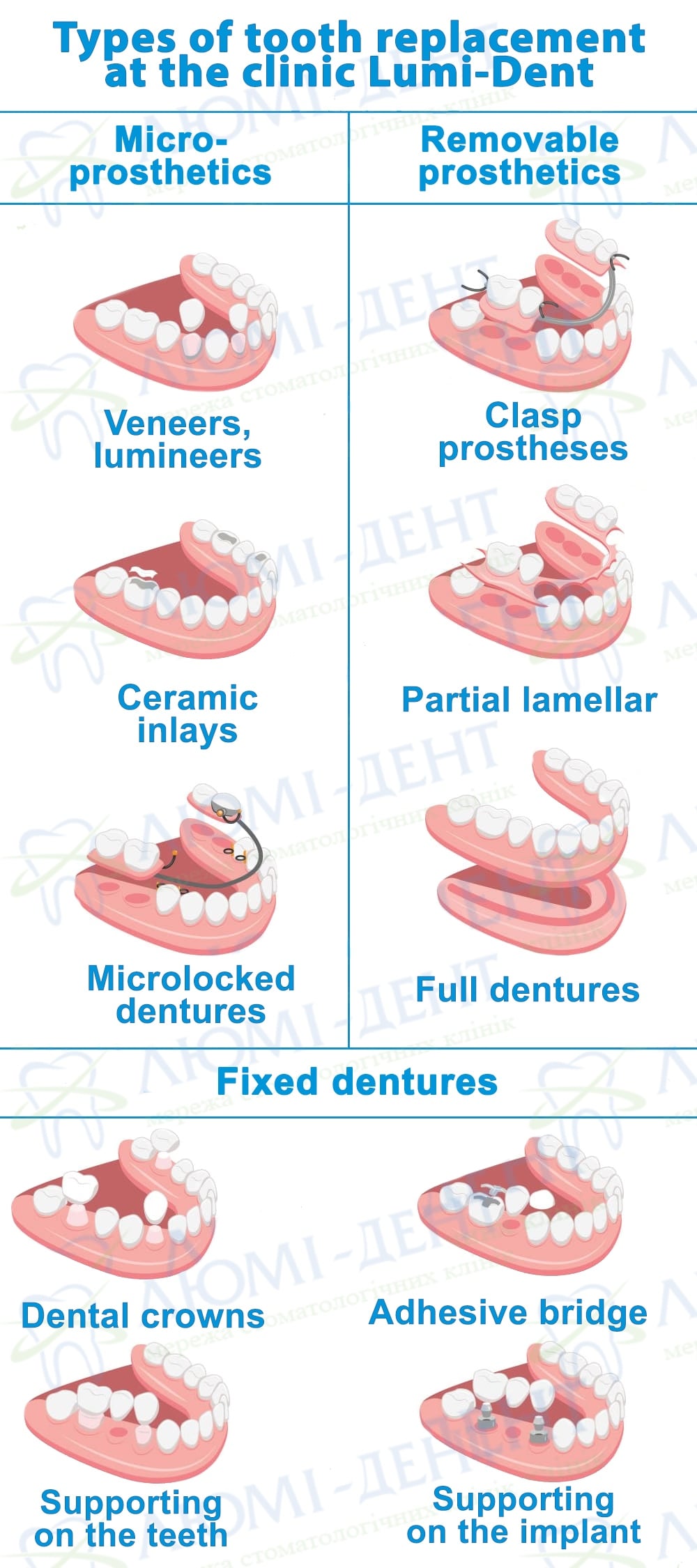
- Crown. Used when one tooth is missing. The support replaces the root, and the crown restores the visible part.
- Bridge. Suits several missing teeth in a row. The structure is fixed on two or more supports and helps restore chewing function.
- Removable structure with additional fixation. The patient can remove it, but thanks to special attachments it holds more stably than a conventional removable structure.
- Conditionally-removable structure. Fixed with screws. The patient does not remove it; the doctor can remove it for maintenance or correction.
- All-on-4. A method of full dental-arch restoration on 4 implants. Can be used when teeth are completely missing, if the clinical situation allows for such a load.
- All-on-6. Restoration of the dental arch on 6 implants. Often used when more even load distribution and a stable support for a full structure are required.
An orthopedic dentist's opinion
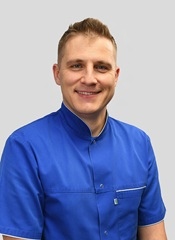
Haidaienko Oleksandr Vitaliyovych — orthopedic dentist of the Lumi-Dent network, 20 years of experience:
"This method restores chewing function without loading the neighbouring teeth. We take load distribution, bite and smile aesthetics into account. Accurate planning of the structure helps achieve a stable and durable result."
📌 The structure is selected individually;
📌 Modern digital modelling technologies are used.
Make an appointment
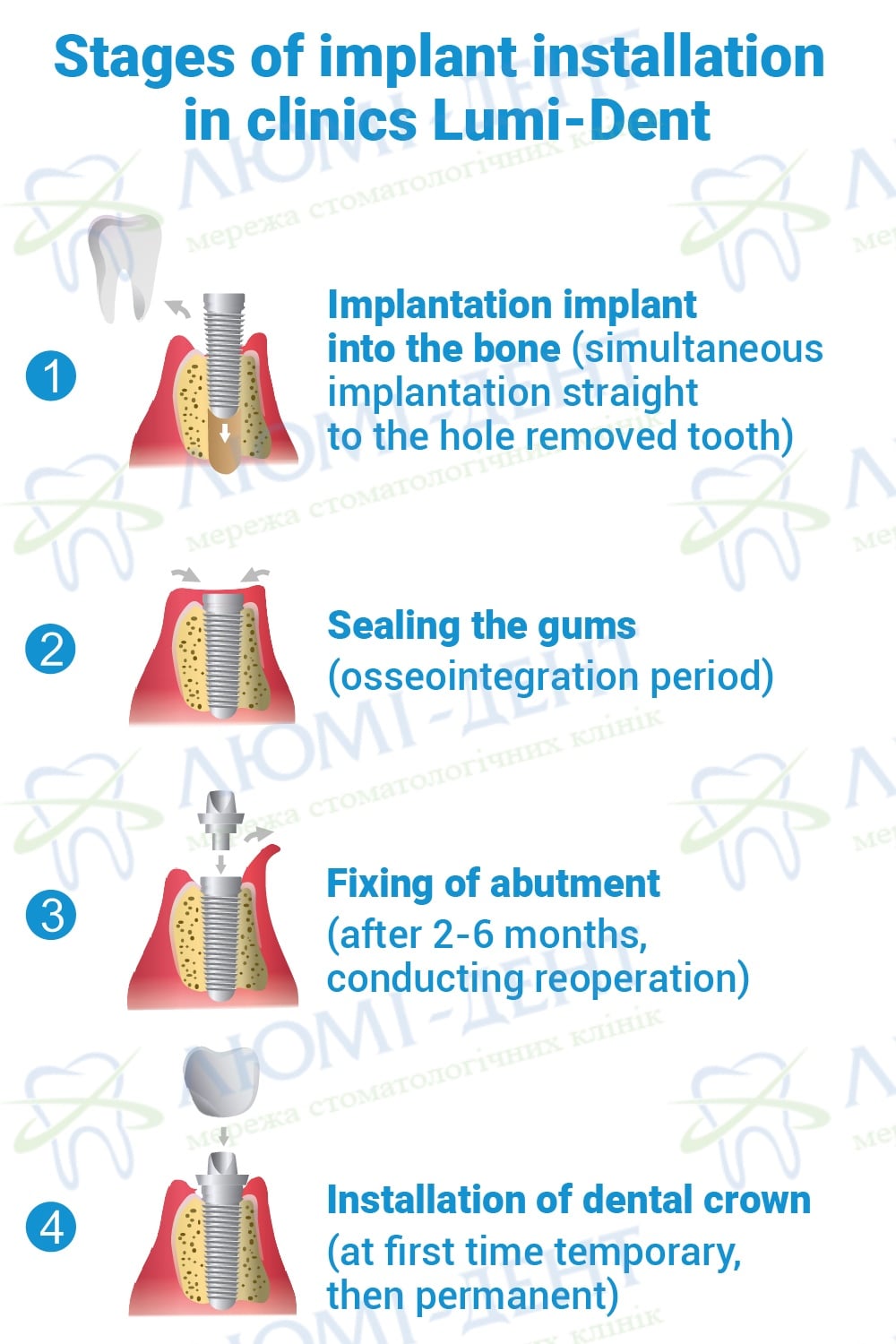
How the doctor selects the structure
The doctor takes into account the number of missing teeth, the bone condition, the bite, the chewing load, smile aesthetics, the budget and any contraindications.
After an examination and CT, the patient is offered a suitable option: a crown, bridge, removable, conditionally-removable or full structure.
With pronounced bone atrophy, an option with an artificial gum may be required — it helps restore not only the teeth but also the visual volume of the soft tissues.
Advantages of this restoration
- Implant-supported structures are fixed more stably than many removable options. They shift less while eating and talking, so it is usually easier for the patient to chew and speak.
- The chewing load is distributed more evenly, and healthy neighbouring teeth do not need to be ground down for support.
- Fixed and conditionally-removable options can be more compact than conventional removable prostheses. They cover less of the mucosa and palate, which benefits comfort, diction and taste perception.
- Fixed structures do not need to be removed after every meal. They do, however, require regular home hygiene, professional cleaning and check-ups.
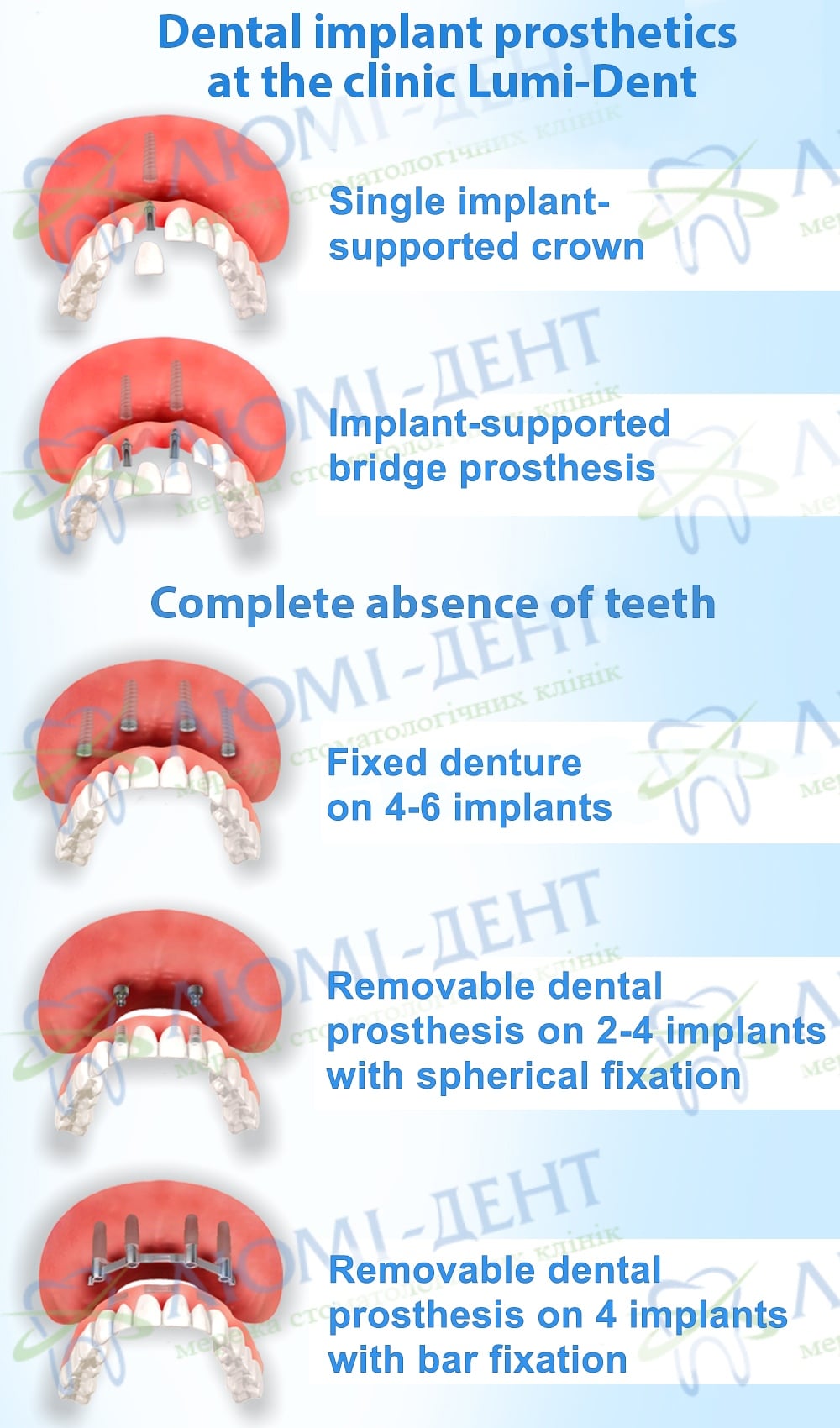
Stages of treatment
- doctor's consultation — examination, discussion of complaints and the patient's wishes;
- CT diagnostics — assessment of the bone condition and anatomical features;
- digital planning — selecting the number of implants, the prosthesis type and the fixation method;
- surgical stage — placing the supports for the future structure;
- temporary prosthetics — a temporary structure is fixed if needed;
- osseointegration period — the implants integrate with the bone;
- permanent structure — fixation of the crown, bridge or full prosthesis;
- check-ups — verifying fixation, bite and the condition of the tissues around the implants.
Clinical cases
We show real patient cases: from diagnostics and planning to the permanent structure and follow-up monitoring.
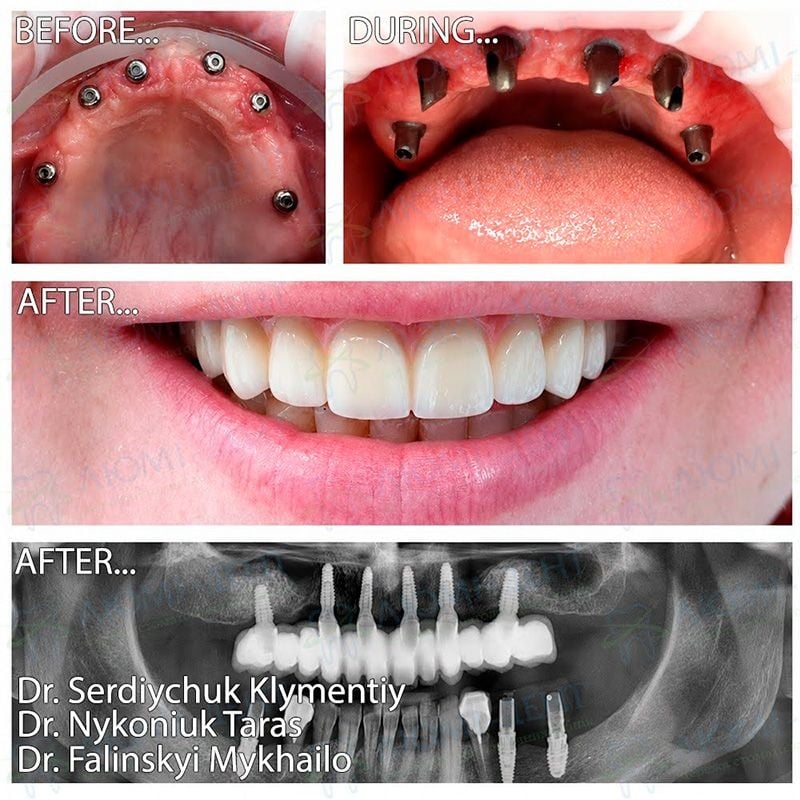
Case 1: upper-jaw restoration with All-on-6
The patient came in because of missing teeth on the upper jaw, impaired chewing and smile aesthetics.
Diagnostics showed complete adentia, bone atrophy and a bite disorder. After CT and 3D planning, bone grafting and an open sinus lift were performed, and the upper jaw was restored using the All-on-6 concept on the Nobel Biocare Replace CC system.
On the lower jaw, 3 Straumann BLT SLA Ti implants were additionally placed.
After osseointegration, a zirconia structure was fixed on the upper jaw and crowns on the lower.
Result: chewing, bite and smile aesthetics were restored. After 12 months the structures are stable and the soft tissues are healthy.
The case was carried out by a team of doctors:
- orthopedic dentist Nykoniuk Taras Viktorovych (8 years);

- implant surgeon Serdiychuk Klymentiy Oleksandrovych (7 years);

- gnathologist dentist Falinskyi Mykhailo Mykhailovych (11 years).

All-on-6 Clinical Case.
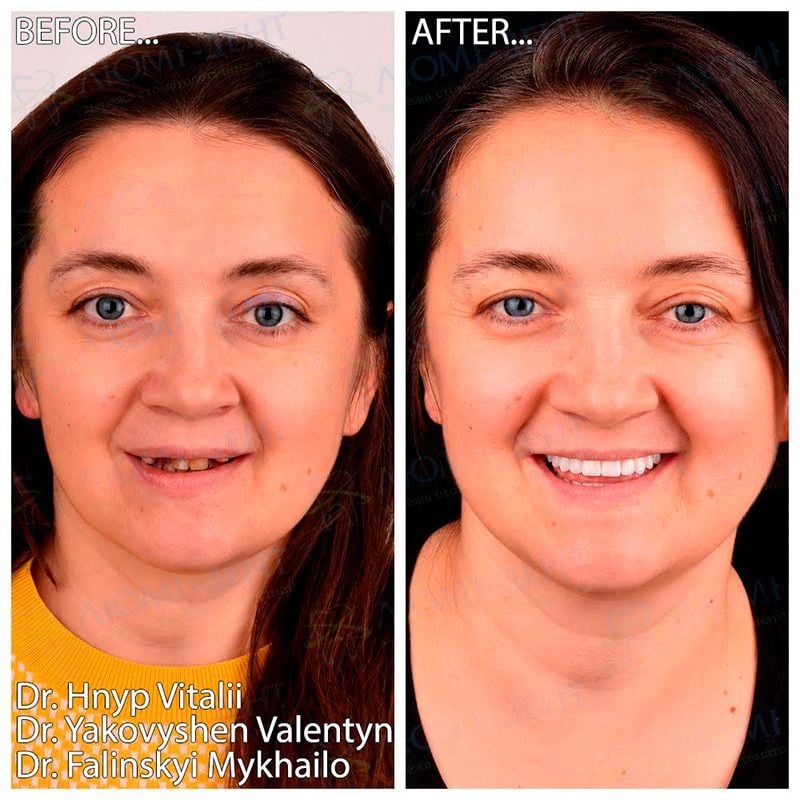
Case 2: restoring chewing after tooth loss
The patient came in because of significant tooth loss on the upper jaw, chewing problems and aesthetic discomfort.
Diagnostics showed local bone atrophy, a reduced bite height and TMJ overload.
After CT, digital diagnostics and gnathological planning, the damaged teeth were removed under sedation and 4 Straumann BLT SLA Ti supports were placed with a temporary structure on a titanium bar.
After osseointegration, a permanent zirconia structure with screw fixation was placed.
Result: bite, TMJ function, chewing efficiency and smile aesthetics were restored. After 12 months the structures are stable, with no complaints of pain or discomfort.
The case was carried out by a team of doctors:
- orthopedic dentist Yakovyshen Valentyn Mykolayovych (10 years);

- implant surgeon Hnyp Vitaliy Volodymyrovych (12 years);

- gnathologist dentist Falinskyi Mykhailo Mykhailovych (11 years).
Before and After Teeth Restoration.
Price of prostheses on implants in Kyiv
This page shows the cost of the orthopedic stage — making and fixing a crown, bridge or full structure on implants that have already been placed.
The surgical stage — implant placement, bone grafting, sinus lift, anaesthesia and other procedures — is calculated separately if it is required.
The cost of the orthopedic stage is affected by the material of the structure, the number of teeth in the prosthesis, the fixation method, the complexity of the bite and the need for individual modelling. The doctor prepares the exact calculation after a consultation, CT and digital planning.
Before treatment begins, we also recommend reviewing the "clinic warranty obligations" section.
The price of the surgical stage is shown on the "dental implantation" page. The full cost of treatment including the surgical stage can be seen on the "turnkey implantation prices" page.
| Type of structure | Price, UAH |
|---|---|
| Metal-ceramic crown | 16 170 |
| Ceramic crown | 18 310 |
| Zirconia crown | 18 600 |
| E-max zirconia crown | 23 395 |
| Temporary crown | 9 620 |
| Temporary acrylic All-on-4 prosthesis | 62 970 |
| Temporary acrylic All-on-6 prosthesis | 72 075 |
| Permanent titanium-composite All-on-4/6 prosthesis | from 111 625 to 122 750 |
| Full zirconia All-on-4 prosthesis | 151 040 |
- All prices on the page are current as of 13.11.2026;
- prices are synchronised automatically with the clinic's official price list;
- the cost is calculated individually, and the doctor confirms the exact plan and price after a consultation, CT and oral examination.
What is included in the price
- orthopedic dentist consultation;
- digital impressions or data preparation for making the structure;
- making the crown, bridge or prosthesis;
- try-in and fixation of the structure;
- bite adjustment;
- care recommendations.
What is not included in the cost
The stated price does not include the surgical stage: X-ray, implant placement, bone grafting, sinus lift, anaesthesia and other procedures if they are required.
The cost of implant placement is shown separately on the "Dental implantation prices" page.
Methods of fixing the structures
Prostheses can be fixed in different ways. The type of attachment is chosen by the doctor based on the number of supports, the bone condition, the type of structure and the convenience of further maintenance.
- Ball fixation. Used for removable structures. The prosthesis attaches to special elements and holds more stably than a conventional removable option.
- Bar fixation. Used for full removable or conditionally-removable prosthetics. The implants are joined by a bar onto which the prosthesis is fixed.
- Screw fixation. Often used for conditionally-removable and fixed structures. The patient does not remove the prosthesis; the doctor can remove it if needed.
- Cement fixation. The crown or bridge is fixed on the abutment with dental cement. Used as indicated.
Materials of the structures
- Metal-ceramic. A durable and more affordable crown or bridge option. Can be used in the chewing zone as indicated.
- Zirconia / all-ceramic structures. A more aesthetic option with no metal frame. Often used for crowns, bridges and full orthopedic structures.
- Acrylic / composite. Used to make conditionally-removable prostheses, both temporary and permanent.
Why patients choose Lumi-Dent
- We use modern equipment and technology: Vatech PHT-6500 CT, STA computer anaesthesia, 3Shape Trios scanners, Seiler Evolution XR6 microscopes, Diagnocat AI, Picasso lasers, and the Dental Bot 3D virtual consultant.
- Before work begins, we carry out digital modelling of the future smile — Digital Smile Design (DSD). This makes it possible to see the final result before treatment starts.
- 3 specialised implantation centres — 6 operating units, 6 implant surgeons, 9 orthopedic dentists, 6 anaesthesiologists on staff, with diagnostics (jaw CT) on site;
- Our in-house digital CAD/CAM dental laboratory helps us make orthopedic structures faster and control quality at every stage;
- Warranty: lifetime on implants, 2 years on the doctor's work and the prostheses;
- Implant survival at Lumi-Dent clinics is 97–98%. The figure is based on our own 2025 statistics: of 3,972 implants placed, complications in the first five years are recorded in under 3%. The data is updated annually.
Prosthetics on implants at a UBA 2026 winning clinic
Prosthetics on implants belongs to the category in which the Lumi-Dent network took first place among 20 Kyiv clinics in the Ukrainian Business Award ranking in August 2026 — 10.63 points.
Second place scored 10.61 (99.8%), third — 9.89 (93.0%). The judging considered the number of specialist doctors and services, patient reviews, website quality, customer service and social-media activity. The average jury score was 10.0.
The surgical and orthopedic stages are handled by doctors of one network, and the structures are made by our own laboratory — this shortens the time between implant placement and the permanent crown.
2025 orthopedic-work statistics:
| Type of work | Quantity |
|---|---|
| Metal-ceramic crowns | 1,532 |
| All-ceramic crowns | 908 |
| Zirconia crowns | 1,284 |
| Bridges | 164 |
| Titanium-composite structures | 122 |
| Zirconia structures on a titanium bar | 64 |
Book a consultation at Lumi-Dent — the doctor will assess the situation and suggest a suitable restoration plan.
Make an appointment
It includes making and fixing a crown, bridge or full structure on implants that have already been placed.
This stage restores the visible part of the teeth and chewing function.
A crown restores one tooth, a bridge — several missing teeth in a row, a full structure — the whole dental arch on one jaw.
Not always. In some cases a temporary structure is fixed first, and the permanent prosthesis is placed after the implants have integrated and the load has been checked.
The cost is affected by the material of the structure, the number of teeth in the prosthesis, the fixation method, the complexity of the bite and the need for individual modelling.
The patient does not remove such a structure. When needed, the doctor removes it — for maintenance, correction or professional hygiene.






 Free consultation